
Author: Gp Capt (Dr) DK Pandey (Retd), Senior Fellow, Centre for Aerospace Power and Strategic Studies
Keywords: UAS, LUCAS, Epic Fury. MQ-9, Shahed-136
Introduction
Operation ‘Epic Fury’ was initiated by the United States (US) Central Command (CENTCOM) on February 28, 2026, at 1:15 am Eastern Time (ET) under the orders of the President of the United States. The US and Israel resorted to striking targets to destroy the security apparatus of the Iranian regime, focusing on those that presented an imminent threat. The targets included the Islamic Revolutionary Guard Corps (IRGC), command and control centres, air defence systems of Iran, missile and drone launchers, and military airfields.[1]
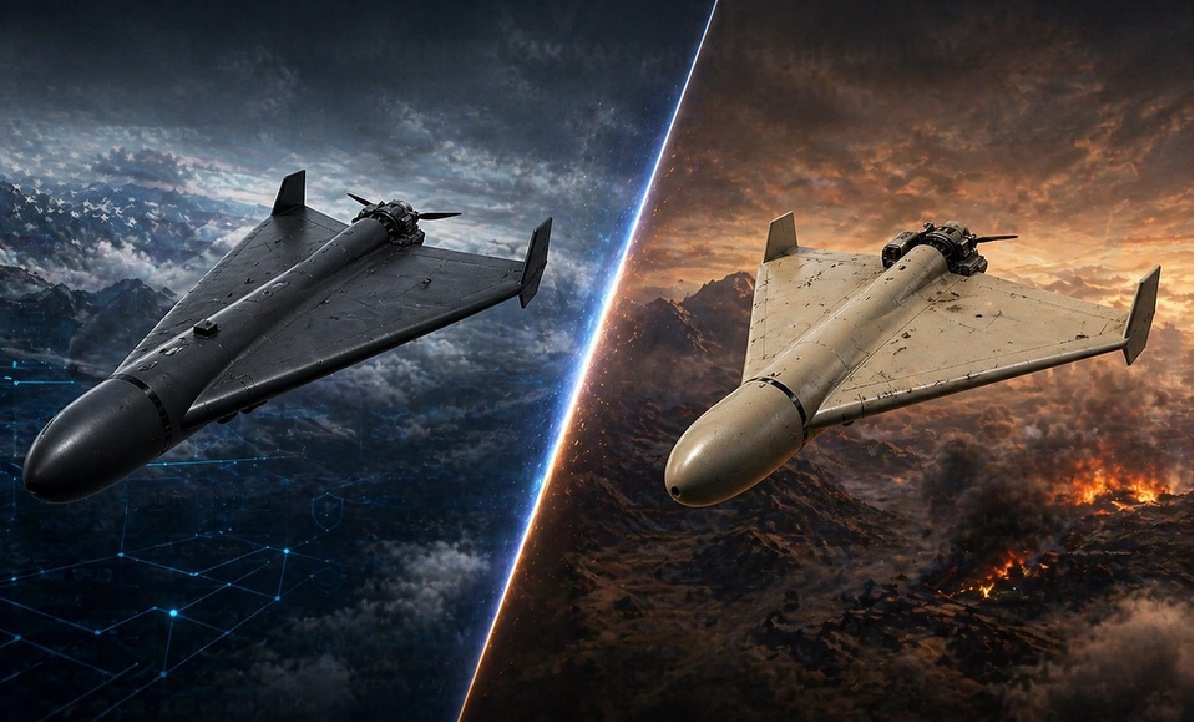
CENTCOM recently deployed the LUCAS (Low-cost Uncrewed Combat Attack System) platforms, which belong to a one-way attack drone squadron, to West Asia to enhance regional security and deterrence index. At an event in early July 2025 at the Pentagon, Secretary of Defense (~War) Pete Hegseth officially unveiled the LUCAS and dubbed it the American response to the Shahed-136. The philosophy of design was evident in matching Shahed’s price, surpassing its capabilities, and constructing it within a timeframe short enough to enable mass production.[2]
The Machine
LUCAS, in the wider military context, can be considered a game-changer in Western air doctrine. It was invented by SpektreWorks, an Arizona-based company, and expedited by CENTCOM for mass production. Although displayed in July 2025, it was deployed for combat early in 2026.
LUCAS is a straight reverse-engineering of the Shahed-136 kamikaze drone of Iran. SpektreWorks was able to seize a damaged Shahed airframe, reassemble it using American electronics and guidance systems, and create a platform that excels in several important aspects over the original. The outcome is an enhanced category of Unmanned Aerial System (UAS) having autonomous AI flight controls, GPS-denied inertial flight and swarm coordination.[3]
It takes off either in trucks or on rails propelled by rockets, with no runway requirements. It costs a fraction of an MQ-9 Reaper, at USD 35,000 per unit, which can be in the tens of millions of airframes, depending on configuration. The drone is also compatible with the Multi-Domain Unmanned Systems Communications (MUSIC), a mesh network that enables it to serve as a communications relay node in a GPS-jammed or signal-degraded environment. It is that two-function ability, strike assets, and communication node, which makes LUCAS not just a kamikaze design, but a class above. Its development signifies the conclusion of the “exquisite era” of warfare, in which costly reusable resources (such as the MQ-9) are currently being complemented by the so-called mass of cheap (low-cost) to bypass advanced air defences.
The Importance of the LUCAS
The primary aspect of the LUCAS is that it is a ‘Script-Flipper’: over the years, the US has spent millions of dollars on high-end interceptors (such as the Patriot or the SM-2) to intercept low-end Iranian Shahed drones, which cost only USD 30,000. LUCAS enables the US and its allies to fight an attritable war, compelling the enemy into experiencing the same unequal economic predicament. The other salient aspects are:
(a) Mass Saturation. It allows hundreds of units to be deployed at the same time (swarming) to saturate enemy radars.
(b) Strategic Deterrence. It offers a long-range strike capability, which is politically and financially disposable, and which reduces the threshold of retaliatory strikes.
Technical Specifications
The LUCAS is a westernised variant of the delta-wing Shahed-136, but with much more advanced internal electronics. It is a Kamikaze, i.e., one-way attack (OWA) drone, 10 ft long and an eight-metre wingspan. It is a loitering munition.
The drone has a Carburetted Internal Combustion (Piston) Engine of 215 cc. It has a maximum speed of over 100 kts and a cruise speed of approximately 74 kts. It can loiter at a point for six hours. It is capable of travelling up to 800 km (approximately 500 miles). It may carry a payload (warhead) capacity of 18 kg. It may be a modular warhead. It is a Global Positioning System/Inertial Navigation System (GPS/INS) fusion (hardened) Artificial Intelligence (AI) Vision-based object recognition platform.[4]
Cost Analysis
The LUCAS is made to be very cost-effective to allow procurement in large volumes. Although the Unit Cost is estimated at the present at USD 35,000, the Pentagon, in its Drone Dominance campaign, is working to bring it down to between USD 5,000 and USD 10,000 by means of mass production (going to 300,000 units by the end of 2026).
Table 1: Comparison: Shahed-136 vs. LUCAS vs. MQ-9
Feature |
Shahed-136 (Iran)[5] |
LUCAS (USA) |
MQ-9 Reaper (USA)[6] |
Reusability |
Expendable (One-way) |
Expendable (One-way) |
Reusable (multi-mission) |
Cost |
USD 20,000 – USD 50,000 |
~USD 35,000 |
USD 15M – USD 30M |
Autonomy |
Low (Static GPS) |
High (AI Target ID) |
High (Remote/Autonomous) |
Payload |
40–50 kg |
18 kg (Modular) |
1,700 kg (Hellfire/GBUs) |
Electronic Warfare |
Vulnerable to Jamming |
Hardened/Mesh-Networked |
Highly Protected |
Primary Role |
Strategic Terror/Harassment |
Precision Attrition/Swarm |
ISR and Precision Strike |
Operational Capabilities Observed During Operation Epic Fury
The first use of LUCAS drones in a contested environment was in February 2026 during Operation Epic Fury. These platforms were deployed by the US to attack targets linked to the IRGC.
(a) Suppression of Enemy Air Defences (SEAD). Iranian surface-to-air missiles were suppressed by LUCAS swarms to expose the location of the batteries to further high-end strikes.
(b) Tactical Strikes. They were able to attack drone production facilities and command and control hubs.
(c) Psychological Effect. The application of reverse-engineered design showed a kind of ‘technological mockery’ which was effective in countering the opponent’s asymmetrical superiority.
Limitations
Although the LUCAS platforms have accomplished the assigned missions, they have a few limitations. They are appended below:
(a) Poor Survivability. It is easily shot down by even primitive anti-aircraft guns (e.g. Gepard or SHORAD systems) due to its low speed and inability to be stealthy.
(b) Limited Payload. The 18 kg warhead is not powerful enough to attack hardened bunkers. It is most useful against soft targets such as radar systems, fuel depots, and parked aircraft.
(c) Meteorological Challenges. Small and piston-powered engines and light airframes are more vulnerable to inclement weather, high winds and icing, which adversely impact the LUCAS operations, compared to the larger platforms such as the MQ-9.
(d) Logistical Footprint. The logistical support of a mass of 300,000 drones would pose transportational challenges. This demands a huge reorganisation of military logistics, storage and training.
Conclusion
LUCAS fulfilled its stated objectives by providing an affordable, easily deployable solution in large quantities and demonstrating significant effectiveness in disabling Iranian air defences and other military infrastructure. The introduction of LUCAS prompted a shift in the US military strategy from precision strikes to large-scale saturation attacks. CENTCOM attributed a substantial reduction in Iranian drone operations post the deployment of LUCAS.
These drone designs require continuous enhancement to evade air defence systems, which are becoming increasingly robust with the help of emerging technologies.
*****
CLICK TO VIEW THE PDF
Notes:-
[1] Mike Stone, David Jeans and Joey Roulette, “US debuts suicide drone in Iran after fast-tracked Pentagon procurement,” Reuters, March 03, 2026, https://www.reuters.com/world/middle-east/us-debuts-suicide-drone-iran-after-fast-tracked-pentagon-procurement-2026-03-03/. Accessed on March 12, 2026.
[2] Ibid.
[3] Jay Hilotin, “Shahed and LUCAS: The different drones explained”, Gulf News, March 06, 2026,
https://gulfnews.com/world/mena/which-suicide-drone-is-better-shahed-vs-lucas-what-you-need-to-know-1.500465180. Accessed on April 12, 2026.
[4] Robert Sailo, “FLM 136 Drone USA,” Army Recognition, March 30, 2026, https://www.army-technology.com/projects/flm-136-drone-usa/. Accessed on April 12, 2026.
[5] “Shahed-136 / Geran-2”, GlobalSecurity.org, https://www.globalsecurity.org/military/world/iran/shahed-136.htm. Accessed on April 12, 2026.
[6] “MQ-9 Reaper”, Air Force, January 2025, https://www.af.mil/About-Us/Fact-Sheets/Display/Article/104470/ mq-9-reaper/. Accessed on April 12, 2026.