Author: Ms Radhey Tambi, Associate Fellow, Centre for Aerospace Power and Strategic Studies
Keywords: Island countries, Indian Ocean Region, Colombo Security Conclave, Seychelles, Comoros, Maldives, Madagascar
Introduction
The latest visit of Prime Minister Narendra Modi to Seychelles was another leaf in the island diplomacy of India, with indications already visible at the beginning of PM Modi’s third term. Though the continental threat persistently looms large over India, balancing the focus between both the continental and maritime neighbourhoods is emerging as a significant trend in India’s foreign policy. Island countries are often left behind due to their small size, slim financial and administrative resources, limited military capacity, and fewer diplomats and experts in international regimes and organisations. However, being a leading voice of the Global South and a central resident of the Indian Ocean, India has been making attempts to refresh its approach and include large ocean countries — island states — as quintessential stakeholders in the security architecture of the Indian Ocean Region (IOR). To this end, the high-level political and diplomatic visits, which were earlier lacking from New Delhi, and vice versa, have now emerged as a significant part of India’s Mutual and Holistic Advancement for Security and Growth Across the Region (MAHASAGAR) policy.
At a time when the strategic and security presence of the extra-regional countries is zooming out to give an edge to India’s presence in the island countries of the Indian Ocean, the visit by PM Modi on the national days speaks enormously about the importance these countries attach to India. In 2025, PM Modi was invited as the chief guest at the 57th Independence Day of Mauritius, guest of honour at the 60th Independence Day of Maldives, and now at the golden jubilee celebration of Seychelles in 2026. Visits like these are also a reflection of the continued trust and faith placed at the government level. He was also the first foreign leader to be hosted by the newly elected Sri Lankan President, Anura Kumara Dissanayake, in 2025. Likewise, the President of the Maldives, Mohamed Muizzu; the Prime Minister of Mauritius, Navinchandra Ramgoolam; and the President of Seychelles, Dr Patrick Herminie have visited India since Modi 3.0, thereby suggesting strong political and leadership-level ties.
India further enjoys the confidence of its island partners in security issues, especially while dealing with the multifaceted non-traditional challenges. The India-led Colombo Security Conclave (CSC) brings together all the island countries of the Indian Ocean, including Bangladesh, except Comoros and Madagascar in the Western Indian Ocean (WIO). Recently, India has announced the internationalisation of this important regional organisation, which deals with issues concerning the maritime security of the Indian Ocean. Furthermore, New Delhi has a broad canvas of defence cooperation with the littoral countries ranging from equipment transfer to capacity building, training and conducting joint exercises. Therefore, it has also been called upon as the preferred security partner by various countries in the IOR.
However, it is no longer tenable to consider that India is the only security provider in the IOR. The increase in the number of extra-regional players and their amplified bilateral and multilateral engagement through exercises, agreements, and transfer of platforms suggests a shifting discourse and has the potential of giving India a tough time in its maritime vicinity. Since 2008, with its participation in the anti-piracy patrols, China has substantially increased its military presence, reflecting its broader economic and strategic objectives in the region, while also building up its operational capability. Apart from undertaking military exercises with the littoral countries like Iran, Pakistan, Tanzania, Mozambique, Indonesia, and Thailand, it is increasingly also engaging with the island countries of the IOR, where India has enjoyed a considerable advantage in the past. In January 2024, China signed a defence agreement with the Maldives, signalling a growing closeness between the two, while at the same time Indian personnel operating the gifted assets were asked to leave. This is despite India providing training to 70 per cent of the Maldivian personnel, and gifting various military platforms like Dornier aircraft and patrol vessels. In 2024, the Chinese fleet arrived in Sri Lanka; the officers and soldiers of the fleet carried out joint exercises and training. For the first time, the Chinese People’s Liberation Army (PLA) took part in the military parade in Comoros while celebrating 50 years of its independence in 2025. While Indian naval ships, INS Tarkash and INS Ikshak, were docked at Port Victoria, and a contingent from the Indian armed forces participated in the national day parade, guided-missile destroyer of the 48th Chinese PLA Naval escort taskforce, Tangshan, was also at Port Victoria for a five-day friendly visit. In addition to these bilateral defence cooperation, China is also undertaking multilateral exercises with Russia, South Africa, and Iran in the Indian Ocean.
Apart from China, other countries are also expanding their engagements in the Indian Ocean. Turkey has recently provided drones to the Maldives to assist them in conducting surveillance of the Exclusive Economic Zone (EEZ). While recognising the Northeast Indian Ocean as a priority area, Australia is enhancing defence engagement with both the Maldives and Sri Lanka by gifting patrol vessels and conducting exercises, respectively.
Further, the leadership-level convergence has not been able to transform into strong economic ties. India is often found lagging behind in building strong economic ties, despite some impressive infrastructural projects, both big and small, including community-driven projects. Compared to other countries like China, which involves both the public and the private sector to make massive economic footprints, India has often limited itself to large public sector enterprises or large conglomerates. This has restricted India’s economic way into the island nations of the Indian Ocean.
What Lies Ahead?
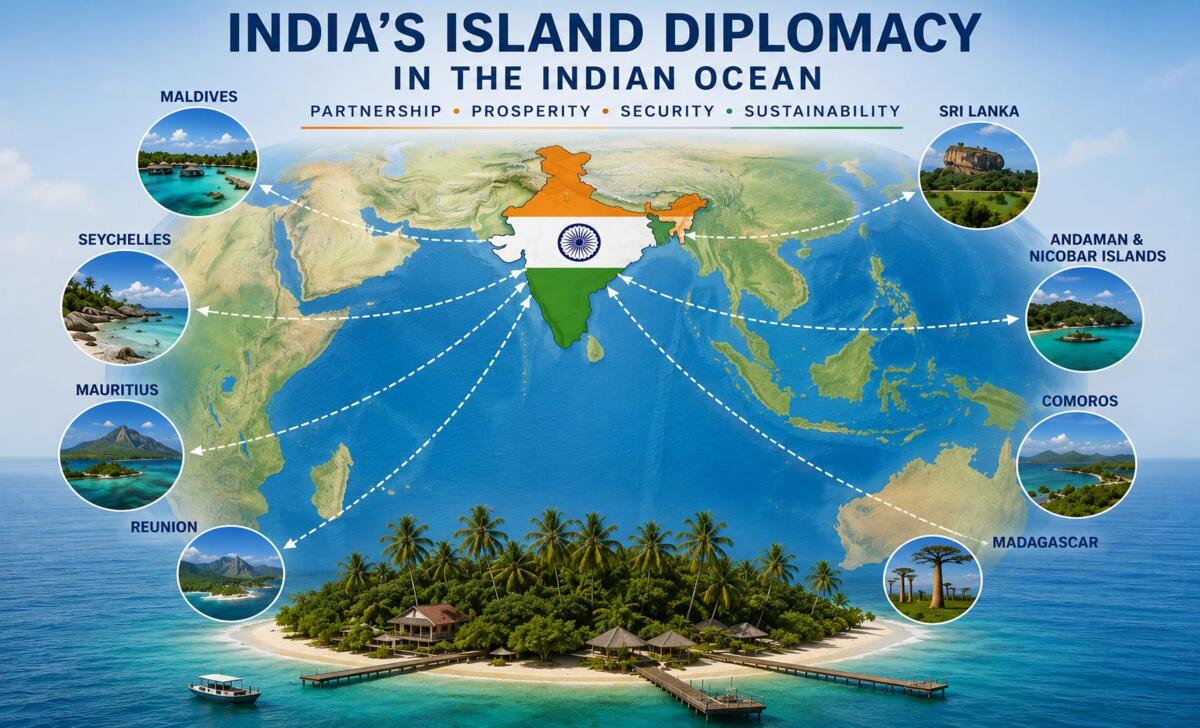
As India moves ahead by not being a mentor, but a megaphone for the island countries or rather large ocean countries—there is a need for a more inclusive, innovative approach and to forge institutional cooperation to deal with the island countries who are important stakeholders in the safety and security of the Indian Ocean. Currently, India’s approach seems a bit divided as it engages with the island countries by focusing on Maldives, Mauritius, Seychelles and Sri Lanka, along with island territories La Réunion (France) and Cocos (Keeling) (Australia). There is an increasing need to tie in Comoros and Madagascar, which are strategically located near the Mozambique Channel, and to enhance ties in various domains, along with establishing ties with the East African littorals like Kenya, Tanzania, and Mozambique. The importance of the Mozambique Channel has often been underrated considering the other chokepoints in the IOR. However, this is where future resource contestation in the IOR will take place, particularly regarding the use of critical and emerging technologies. For instance, apart from hydrocarbon resources, this waterway is rich in resources like graphite, lithium, nickel, neodymium, praseodymium, dysprosium, and terbium, all of which are quintessential elements in the development of green and future technologies.
Second, as India is considered the preferred security provider, old rules to the new game will not yield significant results. Despite the political, economic, and cultural differences among the littoral and island members, threats from non-traditional challenges bring all of them together. To this end, there is a need for India to invest in modern and innovative platforms like drones and high-altitude pseudo-satellite (HAPS) to cover the vast maritime domain. India can also provide night vision devices that will enhance visibility in the dark. Integration platforms can also be provided, which will allow the data from different applications and platforms to come on a single platform. As island countries look up to India for defence acquisition, advanced platforms need to be provided; countries with better technology and innovative solutions will start carving a place for themselves in the area where India had been enjoying considerable advantage, trust and confidence. For example, Turkey has been providing Bayraktar TB2 military drones to the Maldives to monitor the vast EEZ, which was earlier done by India.
To this end, there is a need to increase the number of diplomatic missions in the island countries that support the military attachés. Attachés help promote defence exports, understanding the specific demands of the nations. In this regard, the role of the Air Force attachés should be underlined due to their swiftness, mobility, precision, speed and reach. They are important not only to extend our reach but also to create a favourable and positive image of India. Currently, there is no air attaché in the IOR. The nearest is Tanzania in the East and the Philippines in the West.
Lastly, as the development gap between India and other countries involved widens, there is a need to explore new options. Along with traditional areas of cooperation, other sectors like digitisation of the economy, financial technology, institutionalised tourism, sports training, food and beverage, and hospitality should also be explored. It should also explore triangular development mechanisms with like-minded countries in the region. For instance, India and Germany are undertaking millet cultivation in Madagascar. More such options may be explored with France, which is a residential player in the Indian Ocean, through its overseas island territories of Mayotte and La Réunion. Additionally, it enjoys significant cultural and economic influence in the island countries of the Western Indian Ocean (WIO) due to its colonial past.
*****