
Author: Mr Aayush Parekh, Research Intern, Centre for Aerospace Power and Strategic Studies
Keywords: Credible Minimum Deterrence, India, Nuclear Warhead, Recessed Deterrence, SIPRI
Introduction
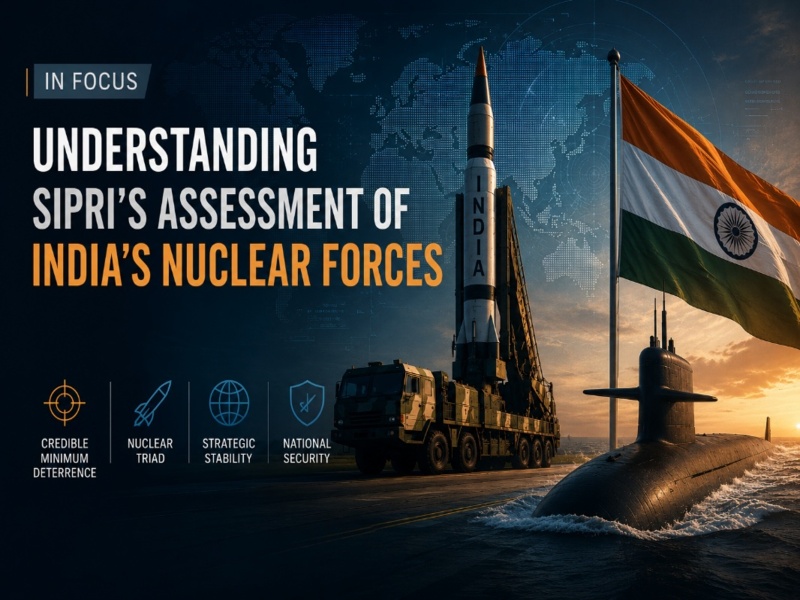
The Stockholm International Peace Research Institute (SIPRI) Yearbook 2026 indicated a small increase in the number of nuclear weapons in India.[1] As of January 2026, India has approximately 190 nuclear weapons. The most eye-catching thing in the report is that India may start deploying a small number of warheads on a single Ballistic Missile Submarine (SSBN) for conducting occasional deterrence patrols. However, it is important to understand that the report’s estimates about nuclear weapons are based on open-source data and tracking of fissile materials (plutonium and highly enriched uranium) production, and it is not based on any official government declarations. SIPRI itself confirms that the figures are inherently uncertain and do not accurately reflect a change in the state’s official policy. Some media channels described the findings as “Big Policy Shift.”[2] This questions India’s long-held recessed deterrence. Recessed deterrence is understood as a nuclear warhead that would remain separate from delivery vehicles (missiles or aircraft) during peacetime, either semi-assembled or completely unassembled.[3] After examining the report, it is observed that India has slightly shifted from a low-readiness to a medium-readiness operational posture. It is noteworthy that India has not adopted a high-readiness operational posture, in which warheads are always ready for launch.
This position is nevertheless in line with India’s broader goals of Credible Minimum Deterrence (CMD).[4] Rather than a shift in policy, it reflects a shift in operational practices driven by a constantly shifting security environment and changing security concerns. The discrepancy between media interpretations, SIPRI conclusions and India’s nuclear triad will be examined in the following sections of this article.
Opinion vs. Reality
Generally, the deployment of a nuclear weapon is understood as having warheads mated with the delivery systems and ready for immediate use. Media reports often conflate this high alert state with the normal operation of strategic platforms.[5] SIPRI notes that India’s “recent moves towards placing missiles in canisters and conducting sea-based deterrence patrols suggest that India could be shifting in the direction of mating some of its warheads with their launchers in peacetime.”[6]
This assessment is based on India’s naval deployment patterns under its nuclear triad. SIPRI highlights that “as of January 2026, India may have started to deploy a small number of nuclear warheads on a single SSBN conducting occasional deterrence patrols.” The assessment is viewed from an operational perspective rather than a political one, as a naval nuclear vessel requires loaded missile tubes to carry out deterrence. An SSBN patrolling with empty tubes provides no CMD because warheads are stored in a land-based storage facility, and the vessel lacks second-strike capability. Thus, limited patrols of naval platforms are a technical requirement for sea-based deterrence and not an aggressive shift in policy.
Comparative Analysis of Global Nuclear Postures
The following is a comparison of other nuclear-armed states to evaluate India’s current nuclear posture:
(a) United States of America and Russia: Together, the United States (US) and Russia control about 85 per cent of the world’s nuclear inventory, with an estimated active deployment of 1,770 warheads by the US and 1,790 by Russia.[7] Both countries maintain a significant portion of their land- and sea-based ballistic missiles at high operational readiness. In contrast, India has a much smaller inventory of about 190 warheads, with most remaining un-mated and stored in central facilities during peacetime.
(b) The United Kingdom (UK) and France: Both the United Kingdom and France maintain aerial and maritime deterrence on high operational readiness. The UK follows a “triple-lock” policy, focusing on continuous sea-based deterrence. France maintains a stockpile of approximately 290 warheads, focusing on capability modernisation and increasing numbers.[8] India, on the other hand, has minimal involvement and conducts only occasional sea patrols, unlike the continuous patrol of the UK and France.
(c) China: For a long time, China has adhered to ‘No First Use.’ However, SIPRI estimates that China’s nuclear arsenal has grown to around 620 warheads. The US Department of War suggests that China is adopting an “early warning counter strike” strategy with a “launch on warning” posture. While most of China’s warheads remain in central storage, routine drills during mobile battalion exercises and near-continuous SSBN patrols suggest that China has started mating warheads in peacetime, raising questions about its traditional No First Use commitment.
(d) Pakistan: Pakistan, in contrast to India, has developed low-yield weapons targeted at India under a “Full Spectrum Deterrence” stance and publicly opposes the “No First Use” doctrine. In the past, Pakistan has frequently managed conflicts by using nuclear signals through brinkmanship. However, India’s strategic position has shown itself to be a restraint on such acts. Despite Pakistan’s Full Spectrum Deterrence (FSD), India has continued its approach of No First Use and CMD and continued with conventional military actions in retaliation. The same was showcased during India’s counter-offensive Operation Sindoor in 2025.
Conclusion
India’s nuclear force structure is shaped by variables that affect India’s nuclear triad. As per its policy of CMD, the nuclear forces must be able to withstand an enemy’s initial attack and possess the capability to react effectively. There is no evidence of a change in India’s policy in the reports on the mating of warheads. Instead, loaded tubes are a prerequisite of an SSBN under India’s nuclear triad because empty tubes would render the vessel incapable of deterrence. This allows India to be capable of continuous nuclear retaliation, guaranteeing India’s CMD. Hence, before a vessel is deployed for patrol, warheads are mated.
The SIPRI Yearbook 2026 makes it clear that the sporadic presence of weapons on a single SSBN is not a major change but rather a requirement for sea patrols. To maintain its second-strike capabilities under CMD, India has modernised its operational stance to a steady medium-readiness posture rather than changing its basic framework of recessed deterrence.
*****
CLICK TO VIEW THE PDF
Notes:-
[1] Hans M Kristensen and Matt Korda, “World Nuclear Forces,” in SIPRI Yearbook 2026: Armaments, Disarmament and International Security (Oxford: Oxford University Press, 2026), pp. 251- 301.
[2] “In A First, India Deploys 12 Nuclear Warheads in Big Policy Shift: Report,” NDTV, June 09, 2026, https://www.ndtv.com/india-news/in-a-first-india-deploys-12-nuclear-warhead-in-big-policy-shift-report-11611678. Accessed on June 19, 2026.
[3] Debalina Ghoshal, “India’s Recessed Deterrence Posture: Prospects and Implications,” The Washington Quarterly, Spring 2016, April 29, 2016, pp.1-13, https://www.cndpindia.org/wp-content/uploads/2019/11/The-Washington-Quarterly-Indias-Recessed-Deterrence.pdf. Accessed on June 20, 2026.
[4] Ministry of External Affairs, Government of India, “The Cabinet Committee on Security Reviews perationalization of India’s Nuclear Doctrine,” January 04, 2003, https://www.mea.gov.in/press-releases?dtl/20131/The_Cabinet_Committee_on_Security_Reviews_perationalization_of_Indias_Nuclear_Doctrine+Report+of+National+Security+Advisory+Board+on+Indian+Nuclear+Doctrine. Accessed on June 20, 2026
[5] NDTV, n. 2.
[6] Kristensen, Korda, n. 1, pp. 251-301.
[7] Ibid.
[8] Government of France, “President delivers speech on France’s nuclear deterrence,” March 04, 2026, https://uk.diplomatie.gouv.fr/en/president-delivers-speech-frances-nuclear-deterrence#haut-de-page. Accessed on June 23, 2026.