
Authors: Ms Radhey Tambi, Research Associate, CAPSS, Mr Prahlad Kumar Singh, Research Associate, CAPSS, Ms Priyadarshini Baruah, Research Associate, CAPSS, Dr Javed Alam, Research Associate, CAPSS & Ms Saima Azim, Research Associate, CAPSS
Keywords: Vayushakti, Air Power, SEAD/DEAD, Operation Sindoor
Introduction
To read and discuss Air Power is one thing, but to be in the spectator gallery and witness the largest Fire Power Demonstration (FPD) of the Indian Air Force (IAF) unfold before one’s own eyes offers a unique depth of appreciation that isn’t easy to put into words. It was exhilarating to witness the skies alive with the thunderous roars of fighter jets piercing the clouds with precision and helicopters hovering with purpose. The air crackled with tension as surface-to-air and air-to-surface missiles were launched, creating a powerful spectacle of sound and light. As each missile soared through the sky, it left trails of smoke in its wake, while the ground trembled beneath as bombs detonated with ferocious intensity, shaking the earth as the targets were struck.
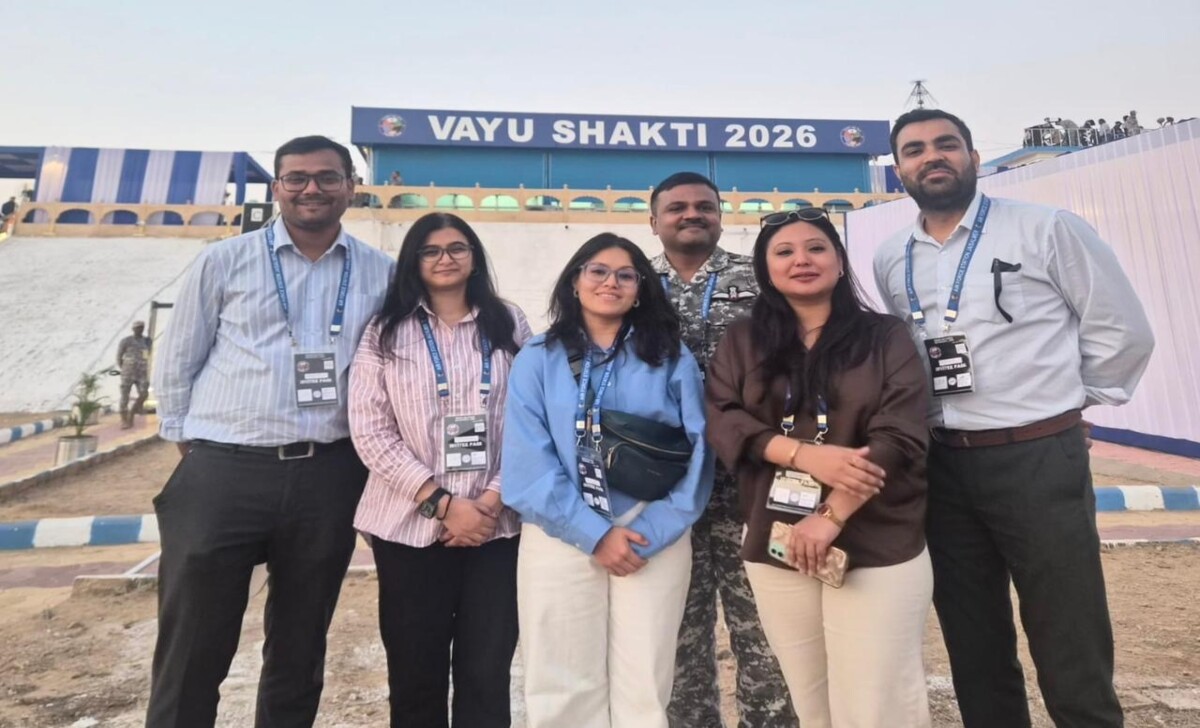
This spectacle of military power was engrossing. Transport aircraft soared overhead, their engines roaring with power, as the ground trembled beneath the thunderous blast of bombs striking designated targets. This extraordinary display unfolded in an area just a few kilometres from where India had previously conducted its nuclear test, creating a surreal atmosphere for all who witnessed it. That’s the distinguished experience of the five civilian researchers of the Centre for Aerospace Power and Strategic Studies (CAPSS) at Vayushakti 2026, and it was nothing short of extraordinary. Against the backdrop of the vast blue sky that stretched endlessly above and the earthy hues of the terrain below, the scene unfolded an impressive showcase of the nation’s air assets. These capabilities, honed through rigorous training and strategic deployment, have demonstrated their effectiveness in swiftly and accurately addressing regional conflicts. Additionally, they have played crucial roles in conducting humanitarian operations worldwide, successfully evacuating individuals from perilous conflict zones and providing a lifeline to those in distress.
The Demonstration of Resolve
Vayushakti 2026 took place on February 27, 2026, at the Pokhran Air-to-Ground Firing range, Jaisalmer, Rajasthan. The event was attended by noble dignitaries, including the President of India, Smt. Droupadi Murmu, Raksha Mantri Shri Rajnath Singh, and the Chief of Air Staff, Air Chief Marshal AP Singh. [1] Guided by the core values enshrined in the Hindi phrase, Achook, Abhedya aur Sateek, [2] the IAF showcased exceptional capabilities and operational readiness through various day and night missions. A significant highlight of this year’s event was the emphasis on structured storytelling, particularly focusing on Operation Sindoor. The event also included coordinated Multi-Domain Operations, an integrated combat theatre, and simulated wartime scenarios.
The present form of Ex Vayushakti dates back to 1999, when the demonstration of India’s Aerial firepower, human skills, and tri-service integration was displayed at Pokhran, and has continued since then. But the roots of the air power spectacle that displayed the entire range of the IAF’s aerial platforms go back to 1954, in Tilpat near Delhi, which was witnessed by the then Prime Minister of India, Pt. Jawaharlal Nehru. The importance of the event grew immensely with the historic attendance of the Supreme Commander of the Indian Armed Forces, the President, N. Sanjeeva Reddy, who graced the occasion for the first time in 1978. His presence not only underscored the event’s importance but also highlighted the connection between the military and the nation’s leadership, marking a memorable moment in the annals of India’s history.
The afternoon sun was low over the sands of Pokhran Firing Range when the silence was suddenly shattered by a sharp sonic boom. A Dassault Rafale streaked across the skies, marking the commencement of Vayushakti-26. From the viewing area, it appeared that a live operation was taking place in stages. Vayushakti-26 was just not a simulated exercise, but it was also a strategic signaling as the international border is barely 125 km from Jaisalmer. The exercise was a mesmerising display of the IAF’s prowess, showcasing its ability to seamlessly integrate a diverse array of platforms in a harmonious and synchronised manner. A total of 77 aerial platforms took part in the operation, including state-of-the-art fighter jets, agile combat helicopters and versatile transport aircraft, each playing a vital role in the unfolding drama above. The initial phase launched with an array of surveillance drones, which soared high, expertly pinpointing simulated ground targets. These drones diligently relayed real-time intelligence to the IAF’s sophisticated Integrated Air Command and Control System (IACCS) network, making sure that every move was calculated and strategically aligned.
The tempo quickly increased as strike aircraft moved in to suppress enemy air defences. The formations targeted mock radar sites and missile batteries, and used Suppression of Enemy Air Defences (SEAD) and Destruction of Enemy Air Defences (DEAD) missions, loitering munitions, and fighter aircraft, the formations targeted mock radar sites and missile batteries, and created the way for the main strike package. This was followed by the coordinated attack runs. Fighters like the Sukhoi Su-30MKI, Mirage 2000, and SEPECAT Jaguar unleashed precision air-to-ground munitions on simulated terror camps, bunkers, and logistics nodes.
While the offensive phase began overhead, the defensive grid on the ground also came to life. Surface-to-air missiles from the Akash and the SPYDER air defence system soared swiftly into the sky, demonstrating how a layered air defence network responds to aerial threats. Akash and SPYDER are just the tip of the icebergs of how India seeks to build its future-ready air defence systems. Mission Sudarshan Chakra and Project Kusha will definitely supplement the existing air defence capabilities.
As the dipping sun cast a warm glow over the expansive desert, the atmosphere shifted from the frenetic pace of the high-speed aerial acrobats to the quiet precision of special operations. In a phenomenal display of tactical innovation, Chinook helicopters gracefully soared through the twilight sky, deftly airlifting M-777 Ultra-light Howitzers in an underslung mode of operation. The message: when required, such methods can be used to rapidly deploy combat assets, and with an impressive blend of strength and agility. Mil Mi-17 helicopters flew low over the area, inserting Garud Commando Force commandos and Para Special Forces men for a mock rescue mission. Transport aircraft, including the Lockheed Martin C-130J Super Hercules and the Airbus C-295, then made assault landings on a forward runway, delivering and evacuating troops in minutes. The darkness didn’t matter. Fighters returned to the range to display precision strikes in low-visibility conditions, while armed helicopters such as the Hindustan Aeronautics Limited (HAL) Prachand and HAL Dhruv assisted ground forces below. The exercise came to a halt when a single Boeing C-17 Globemaster flew overhead in a symbolic ceasefire fly-past.
Automation in Action: The Drone Show
In the climactic stage of the exercise, the sky erupted into a breathtaking display as hundreds of precisely coordinated drones filled the air, creating a silent but powerful spectacle. Their synchronised movements painted patterns against the sky, casting an enchanting glow that transcended the usual noise of the world below, transforming the scene into a silent yet profound, powerful spectacle. The massive drone formation transformed the desert sky into a digital canvas, with each drone moving in perfect synchronisation to create dynamic shapes and images. The choreography displayed the precision and coordination that swarm technologies require, each drone maintaining exact distances from the others, guided by algorithms that ensured smooth formations despite the desert winds. For the audience, the display was captivating; whereas for strategic observers like us, it clearly signalled something deeper: the increasing role of automation, artificial intelligence (AI), and networked systems in modern Air Power. However, what elevated the drone show from spectacle to strategic storytelling was the narrative it presented. The formations followed the theme of the IAF’s journey “from inception to execution,” visually recounting key milestones in the force’s history. As the drones shifted across the sky, they recreated moments that have shaped India’s air power identity, operations from the 1965 war, the bombing of Tiger Hill during the Kargil conflict, to the most recent Operation Sindoor. Each formation reminded the audience that the Indian Air Force’s current capabilities are rooted in decades of operational experience and strategic evolution.
In luminous formations across the night sky, the drones depicted the sequence of an air campaign planning, precision targeting, and coordinated execution. This symbolised how modern air operations are increasingly shaped by intelligence, surveillance, digital networks, and rapid decision-making cycles. The narrative clearly conveyed that contemporary warfare is no longer defined solely by platforms but by the integration of data, technology, and speed.
The show came to a spectacular close with a vibrant map of India glowing radiantly against the night sky, the contours of the nation beautifully outlined. The crest of the Indian Air Force was illuminated proudly and showcased the iconic tricolour of saffron, white, and green. Accompanying this stunning display was the exercise motto, adding an inspiring touch. Witnessed by hundreds, the moment carried both symbolism and intent. The display of the drone show successfully showcased that the Indian Air Force is not only proud of its legacy but also firmly focused on the future. The exercise’s display before the sunset highlighted the destructive precision of modern air power, and the second part of the exercise, after sunset, the drone show emphasised its evolving technological backbone. Together, they conveyed a decisive message: the Indian Air Force is undergoing a significant transformation into a multi-domain force. This evolution encompasses not only the traditional roles of pilots and aircraft but also advanced technologies such as algorithms, integrated networks, and autonomous systems. Together, these elements create a synergised operational environment where human skill and cutting-edge technology come together to enhance agility and effectiveness in modern aerial warfare.
Conclusion
Operation Sindoor highlighted India’s resolve in air power to thwart its adversaries, but Vayushakti-26 demonstrated the IAF’s capabilities and future roadmap. The exercise over a three-hour period dropped approximately 120 tonnes of ordnance over a 2-square km area, and showcased the lethality and precision with which the IAF operates. Vayushakti 2026 was far more than a display of firepower—it was a captivating display of the IAF’s transformation into a modern force projecting aerospace power in all domains. From high-intensity strike missions and integrated air defence operations to precision night and special operations, the exercise displayed operational readiness. The continuous coordination among aerial platforms, ground systems, and digital networks reflected a force increasingly defined by flexibility and versatility. The exercise also displayed the unity of command, effective control, and seamless communication, which help shorten the Observe, Orient, Decide, Act (OODA) loop, leading to effective warfighting and the winning of wars. The grand drone display symbolised the shift towards automation, artificial intelligence, and network-centric warfare. At the same time, the narrative of past operations embedded in the display reinforced the idea that this technological evolution is firmly grounded in decades of combat experience. Ultimately, through Vayushakti 2026, the IAF made it clear that as a force it honours its legacy, but is ready to embrace the future, to project power, safeguard national security, and respond swiftly across the full spectrum of aerospace.
*****
CLICK TO VIEW PDF
Notes:
[1] Press Information Bureau, President’s Secretariat, Government of India, “President of India Witnesses the ‘Vayu Shakti–2026’ Exercise at the Pokhran Firing Range,” February 27, 2026, https://www.pib.gov.in/PressReleasePage.aspx?PRID=2233725®=3&lang=2#:~:text=PRESIDENT%20OF%20INDIA%20WITNESSES%20THE,combat%20strength%20and%20operational%20readiness. Accessed on March 12, 2026.
[2] Press Information Bureau, Ministry of Defence, Government of India, “Curtain Raiser Exercise Vayushakti 2026,” February 11, 2026, https://www.pib.gov.in/PressReleasePage.aspx?PRID=2226479®=3&lang=1#:~:text=Ministry%20of%20Defence,day%2C%20dusk%20and%20night%20missions. Accessed on March 12, 2026.
(Disclaimer: The views and opinions expressed in this article are those of the authors and do not necessarily reflect the position of the Centre for Aerospace Power and Strategic Studies [CAPSS ].