
Author: Ms Bhawna Budhwar, Research Associate, Centre for Aerospace Power and Strategic Studies
Keywords: Uranium, Non-proliferation, Nuclear Energy, India-Australia, Nuclear Fuel
Introduction
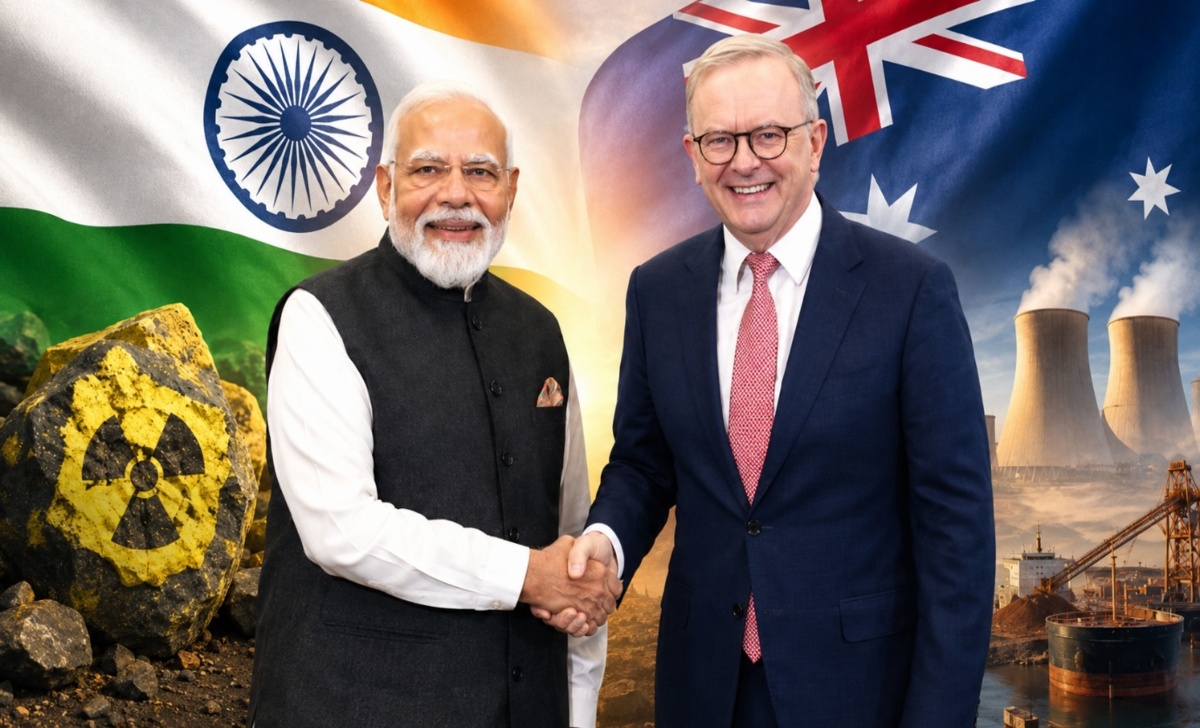
The third India-Australia Annual Summit was held in Melbourne on July 09, 2026. Prime Minister Narendra Modi and his Australian counterpart, Anthony Albanese, released a joint statement that focused on defence, energy security, space and technology, and on promoting a peaceful, stable, and prosperous Indo-Pacific. PM Albanese stated that Australia is looking forward to becoming a reliable, trusted supplier of uranium to India this is one of the most eye-catching strategic developments [1] Since the beginning of 2026, Australia has become the third country to agree on the long-term supply of uranium to India, after India signed a major agreement with Canada’s Cameco Corporation and Kazakhstan’s National Atomic Company Kazatomprom Joint-Stock Company (NAC Kazatomprom JSC). Against this backdrop the article is focused on Australia’s transition from a long-standing sceptic of uranium exports to an emerging partner in ensuring India’s long-term fuel security and analyses India’s strategic position to ensure nuclear fuel for the upcoming reactors.
Australia’s Position on Uranium Cooperation with India
Historically, Australia refrained from exporting uranium to India due to India’s non-signatory status to the Non-Proliferation Treaty (NPT).[2] Australia has maintained a strict policy of exporting uranium only to countries that are signatories to the NPT and have concluded a safeguards agreement. India signed an Additional Protocol (AP) with the International Atomic Energy Agency (IAEA) in 2009. Under this arrangement, India implemented a “separation plan” that designated its nuclear facilities as either civilian or military.[3] The civilian facilities were placed under IAEA safeguards, while the military facilities remained outside international inspections.
Unlike the Model Additional Protocol for Non-Nuclear-Weapon States (NNWS), which mandates comprehensive safeguards on all nuclear facilities, detailed reporting on imports, exports, uranium mining and R&D activities, along with IAEA access to undeclared sites, India’s AP applies only to its declared civilian facilities under safeguards. By remaining outside the NPT while accepting a facility-specific AP, India safeguarded its strategic autonomy while meeting the non-proliferation requirements necessary for international civilian nuclear cooperation. The AP marked a major shift because it let India engage globally in the civilian nuclear sector.
Australia’s position also eased after AP came into force in 2014, and as a result, it agreed to allow uranium exports. But even after the “Australia-India Nuclear Cooperation Agreement” entered into force in 2015, no commercial uranium exports took place from Australia to India. The commercial uranium supply to India remained stalled because the Administrative Arrangement (AA) was the necessary enabler for implementing the agreement to continue the export of uranium.[4] The AA is a confidential implementation document that accompanies the Australia-India Civil Nuclear Cooperation Agreement. While the bilateral agreement sets out the legal obligations, the AA establishes the practical procedures for tracking, accounting and reporting the use of Australian Obligated Nuclear Material (AONM), ensuring that Australian uranium is used exclusively for peaceful civilian purposes in accordance with both the bilateral agreement and IAEA safeguards.[5] Australia signs a country-specific AA under each bilateral nuclear cooperation agreement, detailing how both parties will implement their safeguards obligations.
The AA is ensuring effective monitoring and control of AONM beyond the requirements of the IAEA safeguards. Thus, Australia’s bilateral nuclear cooperation agreements provide an additional layer of oversight by imposing specific conditions on AONM.[6] Both countries had been unable to reach a consensus on the safeguards-related procedures governing the tracking of uranium supplied under the agreement. Following nearly two years of intensive negotiations, these outstanding issues were resolved through a government-to-government framework.[7] The finalisation and signature of the AA, therefore, signal a renewed commitment to operationalising the agreement and strengthening Australia’s role in India’s uranium supply chain. It enabled commercial uranium trade to proceed between Australian suppliers and Indian importers.
Australia is home to the world’s largest uranium reserves, holding approximately one-third of the global uranium.[8] Despite this vast resource base, it does not operate commercial nuclear power plants. Instead, Australia exports all uranium under rigorous bilateral nuclear cooperation agreements and IAEA safeguards, ensuring that the material is used exclusively for peaceful civilian applications. Due to India’s present and planned nuclear energy expansion plans, it is becoming an attractive importer of uranium in the world. From 2008-09 to 2024-25, India imported 18,842.60 MTs of uranium in various forms under IAEA safeguards.[9] It has a flawless non-proliferation record and a commitment to using imported uranium exclusively for peaceful civilian purposes. India has steadily earned international confidence as a responsible nuclear actor. The Australia-India uranium partnership reflects this growing trust, underscored by Canberra’s “strong support” for India’s membership of the Nuclear Suppliers Group (NSG) and its recognition of India’s commitment to global non-proliferation norms despite its non-NPT status.[10]
India’s Strategic Approach
All these developments are unfolding under the broader umbrella of India’s ambitious nuclear energy expansion plan, which aims to increase the country’s installed nuclear power capacity from 8.78 GW to 100 GW by 2047. To achieve 100 GW, the government is focusing on both “fleet mode” expansion of large reactors for grid applications and allocating INR 20,000 crore to research and develop small modular reactors for off-grid or captive use. The major milestone in India’s nuclear sector was the enactment of the Sustainable Harnessing and Advancement of Nuclear Energy for Transforming India (SHANTI) Act. The Act allows greater private participation in the nuclear sector; it also preserves government strategic control over security-sensitive segments of the nuclear fuel cycle to ensure continued state oversight of critical nuclear materials and activities. In the same vein, the Union Budget 2026-27 announced customs duty exemptions on imports of goods required for Nuclear Power Projects till the year 2035.[11] Keeping in view the planned large-scale expansion and India’s low-grade uranium, which result in higher extraction costs and significant tailings generation, ensuring a reliable supply of nuclear fuel has become a strategic priority. Accordingly, India is pursuing a broader fuel security strategy to secure uranium for its upcoming reactors and sustain the rapid expansion of its nuclear energy programme.
The NSG waiver (2008) marked a watershed moment in India’s civil nuclear programme. It ended decades of nuclear isolation and opened the door for bilateral civil nuclear cooperation agreements. Since 2008, major uranium suppliers to India under the IAEA safeguards have included M/s AREVA, France, which supplied approximately 299.87 MTU of natural uranium ore concentrate; M/s JSC Kazatomprom NAC, Kazakhstan, with approximately 10,460.004 MTU (Metric Tonnes of Uranium) of natural uranium ore concentrate; M/s Cameco Inc., Canada, with approximately 5,462.2472 MTU of natural uranium ore concentrate; M/s PJSC TVEL Corporation, Russia, which supplied approximately 2,122.029 MTU of natural uranium dioxide (UO₂) pellets and 100.44 MTU of enriched uranium dioxide (UO₂) pellets; and M/s Navoiyuran State Company, Uzbekistan, which supplied approximately 600 MTU of natural uranium ore concentrate.[12]
Conclusion
The recent statement by the Australian Prime Minister indicates a move towards broadening India’s network of trusted uranium suppliers. While the announcement by the Australian PM did not specify the volume of uranium to be supplied or the delivery timelines, it nevertheless signals a significant shift in bilateral civil nuclear cooperation. It implies India’s proactive approach to diversifying uranium sources to secure the long-term fuel requirements. The ongoing geopolitical conflicts, supply chain disruptions and energy crises continue to expose the vulnerabilities of global energy markets. In this context, energy security is more relevant than ever, highlighting that assured access to nuclear fuel is fundamental to sustaining economic growth and strategic resilience.
*****
CLICK TO VIEW THE PDF
Notes:-
[1] Prime Minister of Australia, Australian Government, “Collaborating with India on energy and resources,” July 09, 2026, https://www.pm.gov.au/media/collaborating-india-energy-and-resources. Accessed on July 15, 2026.
[2]Ministry of External Affairs, Government of India, “Supply of uranium to India,” August 10, 2011, https://www.mea.gov.in/lok-sabha?dtl/16825/Q1712_Supply_of_uranium_to_India. Accessed on July 15, 2026.
[3]David Morrison, “The US-India Nuclear Agreement: A Triumph for India,” David Morrison, May 28, 2006, http://www.david-morrison.org.uk/india/indian-triumph.htm. Accessed on July 15, 2026.
[4]“India, Australia finalise uranium export arrangements, deepen energy partnership,” ANI News, July 10, 2026, https://www.aninews.in/news/business/india-australia-finalise-uranium-export-arrangements-deepen-energy-partnership20260710012621/. Accessed on July 15, 2026.
[5]Parliament of Australia, Australian Government, “Safeguarding the use of Australian Uranium,” https://www.aph.gov.au/Parliamentary_Business/Committees/Joint/Completed_Inquiries/jsct/8august2006/report/chapter5. Accessed on July 15, 2026.
[6]Department of Foreign Affairs and Trade, Australian Government, “Australia’s network of nuclear cooperation agreements,” https://www.dfat.gov.au/international-relations/security/non-proliferation-disarmament-arms-control/policies-agreements-treaties/nuclear-cooperation-agreements/australias-network-of-nuclear-cooperation-agreements. Accessed on July 15, 2026.
[7]“India, Australia finalise administrative arrangement to operationalise Civil Nuclear Agreement,” ANI News, July 09, 2026, https://www.aninews.in/news/world/pacific/india-australia-finalise-administrative-arrangement-to-operationalise-civil-nuclear-agreement20260709193233/. Accessed on July 15, 2026.
[8] Minerals Council of Australia, Australian Government, “Uranium: Untapped Potential,” https://minerals.org.au/about/mining-facts/mineral-uranium/. Accessed on July 15, 2026.
[9] Press Information Bureau, Department of Atomic Energy, Government of India, “Parliament Question: Nuclear Power Generation,” March 11, 2026, https://www.pib.gov.in/PressReleasePage.aspx?PRID=2238309®=1&lang=1. Accessed on July 15, 2026.
[10]Department of Foreign Affairs and Trade, Australian Government, “Joint Statement on a Comprehensive Strategic Partnership between Republic of India and Australia,” June 04, 2026, https://www.dfat.gov.au/geo/india/joint-statement-comprehensive-strategic-partnership-between-republic-india-and-australia. Accessed on July 15, 2026.
[11] Speech of Nirmala Sitharaman, Minister of Finance, Government of India, “BUDGET 2026-2027,” February 01, 2026, p. 54, https://www.indiabudget.gov.in/doc/budget_speech.pdf. Accessed on July 15, 2026.
[12] Bhawna Budhwar, “Ensuring Fuel Security for India’s Nuclear Energy Expansion,” Centre for Aerospace Power and Strategic Studies, May 19, 2026, https://capssindia.org/ensuring-fuel-security-for-indias-nuclear-energy-expansion/. Accessed on July 15, 2026.