Authors: Air Vice Marshal Anil Golani (Retd), Director General, CAPSS, Gp Capt VP Naik VM, Senior Fellow, CAPSS, Mr Adrien Fontanellaz, Military Historian and Analyst Centre d’Histoire et de Prospective Militair, Dr Shalini Chawla, Distinguished Fellow, CAPSS and Dr Anu Sharma, Assistant Professor, AIDSS, Amity University
Introduction
This is a joint paper written by scholars of CAPSS and CHPM on the ongoing conflict between Iran, Israel and the United States of America. With an emphasis on the employment of air power and the strategic context with implications in the region, the scholars give their perspective on the conflict as it unfolded during the first two weeks. AVM Anil Golani in his introductory remarks discusses the employment of air power as a coercive tool to achieve political objectives. Adrien Fontanellaz has given his analysis on the Iranian strategy in its employment of air power while Gp Capt VP Naik has analysed the campaign as carried out by both the United States and Israel. Dr Shalini Chawla and Dr Anu Sharma write about the strategic context in West Asia with implications in India’s immediate neighbourhood.
Elusive Peace in West Asia
by Air Vice Marshal Anil Golani (Retd), DG, CAPSS
February 28, 2026 witnessed the start of another conflict that was a long time coming. The deployment of USS Gerald Ford and Abraham Lincoln, two of the most powerful and sophisticated aircraft carriers of the United States in the Persian Gulf region earlier during the year signaled the intentions and resolve of the country. Israeli Prime Minister Benjamin Netanyahu saw the present window of opportunity that aligned with American President Donald Trump’s proclivity to use force towards regime change, as a ‘now or never’ moment to decimate the regime in Iran. The twelve-day Operation ‘Rising Lion’ and ‘Midnight Hammer’ carried out by both Israel and the United States in June 2025 to neutralise Iran’s nuclear capability and infrastructure along with the elimination of its nuclear scientists and military leadership now seems to have been in vain. The process of dialogue between the United States and Iran, with mediation by Oman was apparently close to fruition when Operations ‘Epic Fury’ and ‘Roaring Lion’ were launched concurrently by both the United States and Israel on February 28, 2026. These operations, unprecedented in scale and magnitude, have engulfed the entire region with strategic implications that could well lead to greater instability reducing the chances of any rapprochement between Iran and the United States and Israel.
As this conflict enters its fourth week, it has become an existential crisis for Iran which will continue to leverage everything at its disposal to increase the cost for the United States, its allies in the region and Israel. For Israel, it seeks nothing less than total decimation of Iran and its military capability along with a regime change. For the United States, the most powerful nation in the world both in terms of military might and technological superiority, it sought a capitulation of the regime by using brute force through the instrument of air power. Even as the jury is out on the conflict there are major lessons that need to be learned not only by the nations directly engaged in conflict but also for those who seek to use military power to achieve political outcomes.
The proclivity to use air power by nations which can afford to do so has only increased in the recent past for a variety of reasons. Air power has become the most readily available instrument of military power that can deliver outcomes at the speed that only this medium provides with precision and accuracy that remains unmatched. Air power also has the unique ability to increase the intensity and scale of operations along with an ability to control the escalation matrix as deemed appropriate. While offensive air power with manned aircraft can effectively be used for counter force and counter value targeting, the ability of drones and missiles along with ground-based air defence systems that are mobile can also wreak havoc on a superior adversary. Iran, with its ability to launch missiles and unmanned aerial systems, despite pounding by the U.S. and Israel, has been able to cause a significant dent in the operations of the United States and Israel. Iran has also attacked more than eleven countries in the region that have U.S bases, closed the Hormuz Strait and dealt a severe blow to energy production and transportation.
The salience of a clear and unambiguous selection and maintenance of aim as one of the most important principles of war cannot be undermined. From regime change, to destruction of the Iranian Air Force, Navy and the IRGC, destruction of its missile and drone production facilities to the elimination of its political leadership, the goalposts have continually been changing. The visceral hatred between the Iranian regime and the state of Israel which seeks total annihilation and nothing less, borders on being delusional to say the least. This hatred would only get worse by the unmitigated use of force that leads to civilian casualties on either side as the conflict progresses. Even as the USA realises the limitations of the use of force it would only find itself in a predicament that becomes even more difficult to handle as the effects of the conflict begin to roost at home with body bags and increasing inflation. While scenarios would have been gamed by the United States and Israel before the conflict, a clear end state and political objectives appear to have been given the short shrift. In addition, the resilience of the Iranian regime and its ability to sustain missile production and launch capabilities is something that had apparently not been bargained for.
The consensus of allies and partners when an operation such as this is launched cannot be ignored. Unilaterally carried out by the United States and Israel, all their allies in the region find themselves being drawn into this conflict with unintended consequences. With inherent and impending danger to the lives of their citizens, adverse effects on their economies, trade and the vulnerability of the oil and gas production infrastructure the efficacy of protection by the United States that harbours bases in the region would increasingly be questioned.
The use of air power as a military instrument of force has several advantages that cannot be undermined. However, unbridled use of this instrument without clear objectives that include a political end state would invariably lead to unintended consequences, as is clearly evident from the present conflict in West Asia. The jury is still out whether West Asia would return to peace or continue to stay embroiled in a prolonged conflict that only exacerbates existing hostility between Iran, Israel and the United States. In addition, the utility of force as employed by the United States, Israel and Iran in this conflict would need a critical analysis of the use of air power in isolation, to achieve political objectives.
Precision, Paralysis and Persistence Multi-Domain Targeting in the Iran Imbroglio
by Gp Capt VP Naik VM, Senior Fellow, CAPSS
Introduction
Contemporary warfare has seen a radical change in the last decade, with attrition-based campaigns increasingly being avoided, and an effects-based approach making a comeback. Air power has become an instrument of choice and also an effective tool for controlling escalation. Increasingly, modern warfare is becoming a mélange of John Warden III’s model of Centre of Gravity (CoG) targeting, David Deptula’s concept of parallel warfare and John Boyd’s theory of dominating the decision cycle. Wherever air power has not been used correctly, warfare has become attritional, and the ongoing Russia-Ukraine war is a stark example. The moment it becomes a war of attrition, asymmetric technology like drones and loitering munitions (LMs) assumes tremendous significance. What emanates from here is that technology like drones becomes more effective when forces become static, which is very typical of attrition warfare. Drones have therefore not really changed the tenets of application of air power, but have significantly redefined the conduct of terrestrial warfare.
In the US-Israel versus Iran conflict, overwhelming technological superiority is being used by their combined force; however, resilience and innovative thinking have kept the Iranian system afloat, even after three weeks of relentless attacks. Neither the US nor Israel share land borders with Iran, and therefore, landing boots on the ground will always remain a challenge.
America primarily aims to end the Iranian nuclear dream because the world is witness to the strategic restraint that the US has to live with when faced with a nuclear-armed adversary. The woes of strategic miscalculations and underestimation of an adversary have returned to haunt the US. A moot question that emerges is, “If Iran had the capability to target mainland US, would this war have started?” This question has increasingly become synonymous with US strategic thought and a wider reflection of risk aversion and unacceptability of large-scale attrition.
Israel, on the other hand, sees this war as decisive in nature, driven by Iran’s cry for death to the Zionist regime and death to Israel. It is far more existential for Israel as compared to the US, and therefore, Israel has a greater appetite for risk. Israel seeks a West Asia safe for Jews, and Iran seeks a West Asia safe for an Islamic Republic, largely emanating from the years of dissonance between the Islamic nations and Israel in the region.
Iran has prioritised systemic resistance over capitulation. In spite of losing its strategic leadership on the very first day, the Iranian system did not collapse and has lately shown a distinct resolve. Use of a large number of drones and surface-to-surface missiles to saturate defences while simultaneously targeting US bases across the Middle East, Iran has also created the larger strategic narrative that the promised ‘US defence umbrella’ has multiple holes.
This paper seeks to understand the broad strategy of the combined US-Israel force and also looks at the targeting philosophy during the war. In Multi Domain Operations (MDO), air power theories of John Warden, David Deptula, and John Boyd can be brought together to create a distinct air power operational paradigm that would be useful for prosecuting future wars.
US-Israel Targeting Philosophy
What we see in the strategy adopted by the combined US-Israeli force is a congruence of John Boyd’s Observe, Orient, Decide and Act (OODA) loop, creating an overarching scaffolding for adaptation of John Warden’s systemic approach to warfighting and David Deptula’s Effects-Based Operations (EBO). The core targeting philosophy adopted by the Americans and Israelis can be put into three distinct phases: –
Phase I: Shock and Awe
The main Concept of Operations (CONOPS) for this phase was to outthink and outpace the enemy’s decision-making cycle and affect its OODA loop. [1] The US and Israeli forces operated at a much higher tempo than the Iranians and forced them into a reactive mode. The end state of the phase appeared to be the creation of adequate disorder and uncertainty to be able to launch parallel attacks on the Iranian leadership. John Boyd had prioritised that psychological victory must precede physical victory and therefore, Schwerpunkt[2] (Focus of effort) was on decisive points, viz., strategic leadership, Islamic Revolutionary Guard Corps (IRGC) and Early Warning (EW) networks. The first 96 hours saw the US expend around 532 GBU-31/32/38 JDAMs and 375 TLAMs. [3] In the same period, 325 US Patriot PAC-2, PAC-3 missiles, 618 of the Gulf partner countries’ Patriots (18 months of production) and 310 SM-2/3/6 Navy Aegis systems were used in defensive operations. [4] On the other hand, Israel used 450 Spice 2000/1000 guided bombs and 230 JDAMs during the first 96 hours. [5] The Iranians traded their cheaper mass-produced munitions for the West’s expensive, finite interceptors in that time period, a rather interesting trade-off. The Iranians expended 1,300 Shahed drones and 565 ballistic missiles, as reported by the Payne Institute’s proprietary analysis. [6]
-
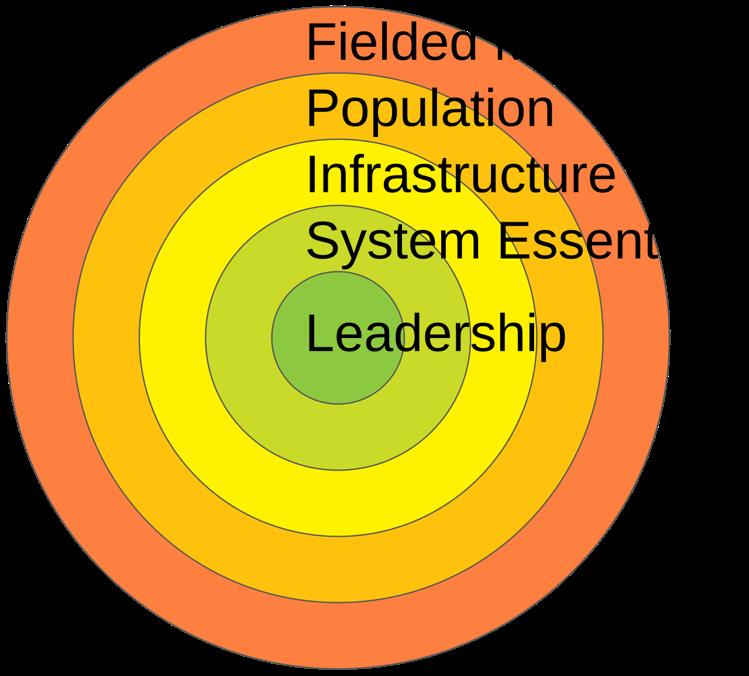
Systemic Paralysis. Operations Epic Fury and Roaring Lion began with systematic degradation of the Iranian OODA loop by targeting the internet, communication systems, surveillance radars and associated networks to keep the Iranians in the Observe and Orient phase and not permitting them to make a decision. The Suppression/Destruction of Enemy Air Defences (SEAD/DEAD) campaign has continued ever since, primarily to gain information and decision dominance. The Iranian Command and Control (C2) grid was sufficiently degraded by striking the Headquarters of the Islamic Revolutionary Guard Corps (IRGC) to create the requisite degree of control of air for furtherance of operations. This targeting philosophy is in line with John Warden’s five rings model (Figure 1), where leadership is a CoG and air power must be used to directly target it.
-
Leadership Elimination. Having achieved the requisite degree of control of air and decision paralysis, the first day also saw long-range precision strikes on Iranian leadership and the elimination of the Iranian Supreme Leader, Ayatollah Ali Khamenei, along with the elimination of other top Iranian officials in their hierarchy. This targeting philosophy is in line with John Warden’s five rings model (Figure 1), where leadership is a CoG and air power must be used to directly address it. The main aim was to target the inner rings first and simultaneously strike critical infrastructure and decision-making ability to cause functional paralysis.[7] By targeting leadership and system essentials, a systemic collapse of Iran was envisaged.
Phase II: Suppression of Military Capability.
This phase adopted David Deptula’s concept of Effects-Based Operations (EBO), where classical sequential campaigns were replaced with parallel warfare and simultaneous strikes by continuously attacking leadership, infrastructure, armed forces and networks. The desired outcome was the creation of a strategic shock and causing a system overload. The main aim of this phase was not ‘what to hit’ but ‘what is the desired effect’. The targeting philosophy was directed at overwhelming the adversary quickly before resistance formed. However, this was the phase where the desired effects had not quite manifested according to plan. A systems-based intelligence analysis is critical to the application of effects-based operations. Without adequate information about what an adversary relies upon to exert influence and conduct operations, parallel warfare cannot be effective. [8] The Iranians were able to react, respond and retaliate with renewed vigour, which caused the combined force of the US and Israel to rethink their targeting philosophy. In spite of the Iranian leadership being wiped out, the Iranian military system continued to function. Linearity in combat is no longer relevant, and because it is all about adopting a ‘system-of-systems’ approach, the initial part of the phase did not yield commensurate results.
-
Air Dominance. In their quest for air dominance, the Americans and Israelis continued hitting Iranian air defence (AD) and networks to blind them. Whilst Iranian airfields and AD elements were constantly targeted, Iranians themselves were able to target US and Israeli air-fields in the region. Use of kamikaze drones and ballistic missiles further created chaos in the US and Israeli operations. This saw the focus of targeting shift from purely Offensive Counter Air (OCA) to suppression of Iranian missile infrastructure. Missile launchers, drone launch sites and missile storage dumps were constantly targeted but have not quite proved to be effective. Iran also started using asymmetric means to target US assets from the sea by using fast attack crafts and boats.
-
Response Suppression. Surface-to-Surface Missiles (SSMs) coupled with drones and fast-attack boats caused Americans to rethink their targeting strategy, and their focus shifted to the source of these attacks. Unfortunately for the Americans, the Iranian response mechanism appears to be a well-knit system with adequate resilience. While technology gives credibility, effectiveness is measured by the correct use of that technology. As a consequence, the US forces have now shifted focus to an attrition-based targeting philosophy by addressing economic targets and energy infrastructure. This appears to be a turning point in the conflict where initial coherence in strategy has degraded, and desperate measures to cripple the Iranian will to fight have come to the fore. This also seems to be a stage where the initially envisaged Conflict Termination Criteria (CTC), Desired End States (DES) and use of ‘off-ramps’ appear to have changed, contradicting an endearing Principle of War, i.e., Selection and Maintenance of Aim.
Phase III: Pressure Campaign.
This phase saw the US and Israeli forces shift targeting to logistics and energy infrastructure. Fuel storage, military logistics and transportation networks have now begun to be targeted with the aim of weakening the regime’s sustainment capability. The shift from counter-force to counter-value signals a reactive strategy not quite anticipated by the planners. The Strait of Hormuz has been closed by Iran, and the conflict seems to be entering another phase where the stark realities of modern warfare are clearly visible. Cyber warfare may not have crippled Iranian networks, Information and Cognitive Warfare may not have impacted the Iranian people and more importantly, what has emerged is that the Iranian system has been able to take on the combined might of Israeli and the US forces, dragging the conflict into its fourth week.
-
Economic Strangulation. US and Israeli forces had started targeting Iranian oil production and storage facilities, thereby escalating the conflict. However, over the past three weeks, Iranian oil has flowed freely and more importantly, Iran has been able to target oil infrastructure in all other neighbouring countries, causing widespread disruption. With Iran practically controlling the Strait of Hormuz, economic strangulation of Iran at this stage seems to have had little effect on the Iranian will to fight.
The Convergence of Air Power Theorists.
Warden, Deptula and Boyd have all focused on a system-of-systems approach to warfare, using kill webs to counter kill webs. The first two weeks saw coherence in strategy where air power was used well; however, the resilience and response of the Iranians was not anticipated by both the Americans and Israelis. As a result, the next two weeks have shown a lack of strategic congruence in their targeting philosophy. This takes us back to what lies at the core of MDO, i.e., decision dominance and creating functional paralysis. Warden brings out the constituents of the system and clearly demarcates the five target rings (Figure 1), he tells us where and what to strike. Deptula tells us how to strike, how to carry out parallel operations and importantly, how to create the desired effects. Boyd gives us a glimpse of cognitive warfare and how to create decision dominance. Together, these three theorists form the backbone of MDO and targeting philosophy. The ‘where’ and ‘how’ of the equation are known, the ‘when’ part of it is left to the planners, and that is where a pragmatic approach rather than an euphoriant approach may have yielded better results. The essence of EBO is how time and space are exploited in terms of the effects desired. [9] That is where the crucial question of ‘when’ gets answered. Perhaps parallel counter-force and counter-value targeting, from the word go, would have resulted in desired results with greater rapidity and lesser mass.
Putting Two and Two Together.
The first press briefing conducted by the White House on March 02, 2026, revealed that in the first 24 hours of the operation, more than 1,000 targets were struck. The targets included Iranian leadership, C2 nodes, ISR infrastructure and ballistic missile sites in coordination with cyber and space operations to disrupt communication and sensor networks. [10] The very next briefing held on March 04 brought out that the Americans had moved over 90 per cent of their troops from their bases in the region to safer locations out of Iranian weapon ranges. [11] By March 05, the briefings claimed that Iranian missile launches had reduced by 90 per cent and drone attacks by 83 per cent since the first day. [12] The briefing also mentioned the use of B-2 bombers striking over 200 targets inside Iran, including ballistic missile sites, using 2000-pounds penetrator bombs. [13] The March 10 briefing brought out that the combined force had struck over 5,000 targets since the beginning of the war, and also said that the strikes have significantly reduced the response options of the Iranians. [14] Around the same time, a Reuters report dated March 10, 2026, reported that the number of ballistic missiles fired by Iran from February 28 onwards was in excess of 500, and the number of drones launched was in excess of 2,000 over 10 days. [15] Though the numbers had seen a reduction, it has not been very substantial and even after three weeks, Iran has continued to fire ballistic missiles and launch drones across multiple targets in the region. By March 13, the Americans claimed that the combined force had struck over 15,000 targets across Iran, averaging over 1,000 targets per day. The briefing on March 13 also brought out that only one per cent stand-off munitions were being used by the Americans. [16]
Analysing open-source information and juxtaposing the White House briefings from the first three weeks of the conflict, what emerges is the stress on the number of targets struck and not what effect was desired and created. As usual, rhetoric tended to rule the roost, and the briefings were designed to overwhelm the world with numbers! Iranian retaliation did not see too great a reduction, and ballistic missiles as well as drones continued to be fired with a fair amount of effectiveness. Yes, they were intercepted, but at what cost?
Another factor that emerges is that even a country like the US has a limited long-range precision arsenal, and eventually conventional weapons will come into play. Therefore, the use of precision weapons must be done with extreme caution to create the desired effects early in the operation and the congruence of ‘where, how and when’ would have yielded better results. Logistics stamina, especially for overseas operations, will remain critical. Warships and submarines will have a limited arsenal, especially with respect to weapons like the Tomahawk Land Attack Missiles (TLAM), and replenishment cycles will not necessarily be able to keep pace with the utilisation rate. Based on the numbers launched by the Americans and targets taken on, this factor has definitely resulted in the Americans being forced to significantly reduce stand-off weapon utilisation.
The briefings also brought out that preparation for this operation was going on for many months. The Americans were fully aware that most of their operating bases were within reach of the Iranian SSMs and drones. In spite of that, they launched operations from those bases and were forced to evacuate personnel within the first four days. What emerges is surprising. Either the Americans severely underestimated the Iranian response, or the effects desired from the initial volleys of attacks were not achieved. Either way, the fact that comes to the fore is that the plan that looks very good on paper may not necessarily be effective when executed. After the first two days, the targeting philosophy of the Americans and Israelis appeared to constantly shift focus and appeared to be random, rather than well thought out. Reading between the lines, what appears to be a shift of targeting focus from counter force to counter value may be signalling that the Iranian AD was not fully destroyed, and the transition from precision to mass bombing only reinforces that fact. The coming days might give us a glimpse of the operational status of Iranian AD weapon systems and either substantiate or refute claims of the US and Israel having destroyed all AD weapons of Iran.
Parting Shots.
Air power is a critical enabler for the conduct of MDO and is perhaps an instrument of choice, as can be seen from all major conflicts occurring around the world. While a systems approach to targeting is effective and causes functional paralysis, it does not guarantee victory. Parallel warfare, decision dominance and CoG targeting are realities which must be addressed across multiple domains. Adversaries may be numerically and technologically inferior; however, the effectiveness of asymmetric response capabilities has the potential to offset the effectiveness of technology. Future warfare will be a healthy mix of non-kinetic and kinetic options, including dominance in the cognitive domain.
In the absence of accurate empirical data, open-source inputs from both sides offer a fairly accurate glimpse into what must have happened, and one can safely predict what might happen in the future. This war is far from over, and the longer it lasts, the more serious global ramifications will be. Boyd, Deptula, and Warden have given us a framework for conducting MDO; however, sequencing and prioritising operations will forever remain a challenge, and it is only after the war that introspection can be done. Rhetoric will forever mar realistic assessments, and narratives will always add to the fog of war. The Iran-US-Israel conflict, however, poses a very pertinent question to everyone researching this war: “To what extent can a technology-driven, system-of-systems approach to targeting produce decisive outcomes against a resilient and adaptive adversary?” The jury is out.
Notes:-
[1] Davis S. Fadok, “John Boyd and John Warden, Air Power’s Quest for Strategic Paralysis,” School of Advanced Air Power Studies, February 1995, pp. 16-20, https://media.defense.gov/2017/Dec/27/2001861508/-1/1/0/T_0029_FADOK_BOYD_AND_WARDEN.PDF#:~:text=In%20his%20theory%20of%20conflict%2C%20Boyd%20highlights,OODA%20loops%20and/or%20“loosening”%20enemy%20OODA%20loops. Accessed on March 18, 2026.
[2] John R. Boyd, “Discourse on Winning and Losing,” US Marine Command and Staff College, April 25 – May 3, 1989, p. 100, https://static1.squarespace.com/static/5497331ae4b0148a6141bd47/t/5af842f8758d4615555d3f6d/1526219514965/Patterns+of+Conflict+Transcript.pdf. Accessed on March 15, 2026.
[3] MacDonald Amoah, Morgan D. Bazilian, and Jahara Matisek, “Over 5000 Munitions Shot in the First 96 Hours of the Iran War,” Foreign Policy Research Institute (FPRI), March 16, 2026, https://www.fpri.org/article/2026/03/over-5000-munitions-shot-in-the-first-96-hours-of-the-iran-war/. Accessed on March 20, 2026.
[4] Ibid.
[5] Ibid.
[6] Ibid.
[7] John A. Warden III, “The Enemy as a System,” Air Power Journal, vol IX, no 1, Spring 1995, pp. 41-55, https://www.airuniversity.af.edu/Portals/10/ASPJ/journals/Volume-09_Issue-1-Se/1995_Vol9_No1.pdf. Accessed on March 18, 2026.
[8] Brigadier General David A. Deptula, “Effects Based Operations: Change in the Nature of Warfare,” February 2001, p. 19, https://www.airandspaceforces.com/PDF/DocumentFile/Documents/2005/EBO_deptula_020101.pdf. Accessed on March 17, 2026.
[9] Ibid., p 5.
[10] US Department of War, “Transcript, Secretary of War Pete Hegseth and Chairman of the Joint Chiefs of Staff Gen. Dan Caine Hold a Press Briefing,” March 02, 2026, https://www.war.gov/News/Transcripts/Transcript/Article/4418959/secretary-of-war-pete-hegseth-and-chairman-of-the-joint-chiefs-of-staff-gen-dan/. Accessed on March 14, 2026.
[11] US Department of War, “Transcript, Secretary of War Pete Hegseth and Chairman of the Joint Chiefs of Staff Gen. Dan Caine Hold a Press Briefing,” March 04, 2026, https://www.war.gov/News/Transcripts/Transcript/Article/4421037/secretary-of-war-pete-hegseth-and-chairman-of-the-joint-chiefs-of-staff-gen-dan/, Accessed on March 14, 2026.
[12] US Department of War, “Transcript, Secretary of War Pete Hegseth and Admiral Brad Cooper, Commander of U.S. Central Command, Hold a Press Briefing at Central Command Headquarters on U.S. Military Operations in the Middle East,” March 05, 2026,
https://www.war.gov/News/Transcripts/Transcript/Article/4425459/secretary-of-war-pete-hegseth-and-admiral-brad-cooper-commander-of-us-central-c/, Accessed on March 15, 2026.
[13] Ibid.
[14] US Department of War, “Transcript, Secretary of War Pete Hegseth and Chairman of the Joint Chiefs of Staff Gen. Dan Caine Hold a Press Briefing,” March 10, 2026, https://www.war.gov/News/Transcripts/Transcript/Article/4429953/secretary-of-war-pete-hegseth-and-chairman-of-the-joint-chiefs-of-staff-gen-dan/, Accessed on March 18, 2026.
[15] “Number of Iranian Missiles and Drones Fired at Gulf Countries,” Reuters, March 03, 2026, https://www.reuters.com/world/middle-east/iranian-missiles-drones-fired-gulf-countries-2026-03-10/. Accessed on March 18, 2026.
[16] US Department of War, “Transcript, Secretary of War Pete Hegseth and Chairman of the Joint Chiefs of Staff Gen. Dan Caine Hold a Press Briefing,” March 13, 2026, https://www.war.gov/News/Transcripts/Transcript/Article/4434484/secretary-of-war-pete-hegseth-and-chairman-of-the-joint-chiefs-air-force-gen-da/. Accessed on March 18, 2026.
True Promise 4: the Iranian Counter-Strikes
by Adrien Fontanellaz Military Historian and Analyst Centre d’Histoire et de Prospective Militaire
Despite being targeted by a series of highly successful decapitation strikes against their headquarters during the early hours of the war— the latter killing at least 40 senior officials, including the Chief of Staff of the Iranian Armed Forces, Major General Abdolrahim Mousavi; the Commander of the Islamic Revolutionary Guard Corps (IRGC), Major General Mohammad Pakpour; the Secretary of Iran’s Defence Council, Ali Shamkhani; the Iranian Minister of Defence, Brigadier General Aziz Nasirzadeh; and foremost the Leader of the Islamic Revolution, Ayatollah Ali Khamenei— the Iranians began to retaliate within minutes, thus initiating Operation “True Promise 4,” which mostly consisted of successive waves of missiles and drones.[1]
The pace of the Iranian attacks slowed down markedly after the first three days of the war, but has continued unabated ever since, even though the country is on the receiving end of a pounding of an intensity unheard of for decades. By March 07, 2026, the Israeli Air Force had already dropped 6,500 bombs, whilst the Americans had struck a staggering 3,000 targets, according to the Israeli Defense Forces (IDF) and the American Central Command (CENTCOM), respectively. These numbers continue to grow at the same pace, with CENTCOM claiming to have struck a further 2,000 targets by day 10 of Operation Epic Fury, out of which a major portion was related to the Iranian offensive drone and missile array. The present article aims to explore why the Iranians are able to continue running their drone- and missile-centric retaliation operations under such adverse conditions, how their campaign is conducted, and finally what lessons might be drawn from their operations.[2]
The Sepah: An Overview
Iran has the particularity of maintaining two distinct armed forces, both operating under the umbrella of the Khatam al-Anbiya Central Headquarters. The Artesh is the regular army inherited from the time of the Shah. Its primary mission is the defence of Iranian territory, and it encompasses ground forces, a navy, an air force, and an air defence force. The IRGC, on the other hand, also known as the Sepah-e-Pasdaran commonly known as Sepah, answers directly to the Supreme Guide of the Revolution and is tasked with defending the regime against both external and internal threats, as well as conducting military interventions abroad. Like the Artesh, it includes ground forces, a navy, and an Aerospace Force, as well as the Jerusalem Force, which is responsible for its external operations. Unlike the Artesh, however, asymmetric warfare has been deeply ingrained in the IRGC’s institutional culture since its inception. Many of its founding members had already been trained in guerrilla warfare prior to the Revolution. This strategic culture persisted thereafter, even as the Corps expanded significantly and conducted numerous large-scale conventional operations during the Iran–Iraq War.[3]
In the early 2000s, Tehran faced the threat of an invasion of Iran by American forces in the aftermath of the Iraq War. In response to this perceived threat, General Mohammad Ali Jafari—who served as a senior figure within the Islamic Revolutionary Guard Corps (IRGC) before becoming its commander in 2007—developed the so-called “mosaic doctrine.” After assuming leadership of the IRGC in 2007, he proceeded to implement this doctrine. It was designed to enable the IRGC to confront a vastly superior adversary such as the United States (US). Under this framework, the IRGC was reorganised into thirty-one provincial commands intended to operate with a high degree of autonomy. These units were structured to conduct both symmetric and asymmetric operations simultaneously, thereby allowing the force to continue fighting even if the regime’s principal command centres were neutralised.
To ensure operational continuity under such conditions, both geographic and unit-level commands were granted pre-delegated authority to act independently if they became isolated from central command. In addition, military assets were dispersed and fortified in order to reduce their vulnerability to enemy strikes. Iran’s drone and missile arsenals were also significantly expanded to strengthen deterrence against potential aggression, and these were stockpiled into massive underground complexes, the so-called “Missile cities.” Finally, this strategy was complemented by the development of the so-called “Axis of Resistance,” a network of alliances with various armed movements operating across the region, which Tehran sought to leverage as an additional means of strategic deterrence. [4]
The Long Swords of Persia
Iran, unable to modernise its air force after the Iran–Iraq War, invested heavily in its ballistic missile program starting in the early 1990s and supported initially by North Korea. Early developments included short-range missiles such as Shahab-1 (300 km) and Shahab-2 (500 km), derived from North Korean designs, followed by the solid-fuel Fateh-110 in 2002 and the medium-range Shahab-3 (1,000 km). Iran has since focused on improving missile accuracy, deployment speed, and the ability to evade missile defences, introducing technologies such as manoeuvrable re-entry vehicles, submunition warheads, and decoys. Newer systems include the Khorramshahr (2017), Khaybar Shekan (2022), and the Fattah-1 hypersonic missile (2023). In parallel, Iran developed cruise missiles, notably the Soumar (2015), based on the Soviet Kh-55 design obtained from Ukraine. Estimates suggest Iran possessed over 3,000 medium-range ballistic missiles by 2022, and about 2,500 by early 2026, despite combat losses and expenditure in June 2025, alongside much larger numbers of short-range missiles.[5]
Similarly, Iran began developing its domestic drone industry during the Iran–Iraq War, initially with modest results. Over time, the program expanded significantly, leading to the production of a wide range of drone types. These include Medium Altitude Longe Endurance (MALE) combat drones like the Mohajer-6 and Shahed-129, as well as low-cost one-way attack drones such as the Shahed-101, Shahed-107, Shahed-136 and the newer Hadid-110, designed with reduced radar signatures and jet propulsion. Iran has also exported these drones, notably to Russia, where the Shahed-136 is produced as the Geran-2 and has been widely used in the war in Ukraine since late 2022.[6]
The IRGC Aerospace Force
The drones are widespread among the entire Iranian military apparatus. Both the regular air force and the IRGC Navy are known to possess them in high numbers, whilst the latter is also known to operate short-range ballistic missiles. The bulk of the Iranian long-range capabilities fell, however, under the precinct of the 15,000 to 20,000-men-strong IRGC Aerospace Force. It is divided into five commands. The air defence command is equipped with a wide range of air defence systems of national or Russian designs and operates in coordination with the Islamic Republic of Iran Air Defence Force under the umbrella of the Khatam-al Anbiya Air Defence Headquarters. The air operations command oversees the Corps’ small fleet of airplanes and helicopters, but its offensive capabilities remained limited, with a handful of operational Su‑22M4s and Tucano. A third command is responsible for spatial activities and has been credited since 2009 with the successful launch into orbit of several observation and telecommunications satellites. The drone command oversees the operation of the IRGC drone array, whilst the Missile command is in charge of the short- and long-range ballistic missiles. In turn, the latter is organised into five main units: the 5th “Raad,” the 7th “Al-Hadid,” the 16th “Qaam,” the 19th “Zulfiqar,” and the 23rd “Al-Towhid” missile brigades. These units operate from at least two dozen underground, fortified missile bases, which are clustered and interconnected by tunnels. As a rule, longer-range missiles are deployed from central Iran, whereas shorter-range missiles are launched from the western and southern regions of the country. Some bases are equipped with reloadable underground launch silos, although most missiles must be transported and launched using truck-based transporter erector launchers (TELs).[7]
True Promise 4
Following initial American and Israeli strikes, the Iranian Armed Forces launched its counterattack under Operation “True Promise 4,” mainly involving the IRGC Aerospace Force and Navy, with support from the Iranian Air Force. Early actions included several airstrikes until March 02, 2026, when two Iranian Su-24s were reportedly shot down by a Qatari F-15QA near Al Udeid Air Base while flying at very low altitude. [8]
Consequently, Iran’s principal means of retaliation consisted of missiles and attack drones. However, the exact number of weapons deployed remains difficult to determine with any precision, as Iranian authorities have not disclosed specific figures. Furthermore, the targeted infrastructure is dispersed across a vast geographical area spanning eleven countries. Several of these states, as well as the United States, have not released data regarding the number of weapons directed at their territory. Consequently, any assessment can provide only a partial view of the total quantity of weapons employed in these counterstrikes. Nevertheless, a Reuters review of available sources suggest that, at a minimum, 605 ballistic missiles, 15 cruise missiles, and 1,987 attack drones were launched against the United Arab Emirates (UAE), Qatar, Bahrain, and Kuwait between February 28 and March 10, 2026. Meanwhile, the United Arab Emirates Ministry of Defence acknowledged that by March 13, the UAE alone had been targeted by 285 ballistic missiles, 15 cruise missiles, and 1,567 attack drones. For its part, the IDF stated on March 10 that more than 300 medium-range ballistic missiles—approximately half of which carried cluster warheads—had been launched against Israel since February 28.[9]
However, the Iranian forces operated under increasingly intense pressure from the American and Israeli air forces, which allocated a significant proportion of their sorties to targeting missile and drone units and interdicting missile sites by striking the entrances of their underground facilities, while Unmanned Combat Aerial Vehicles (UCAVs) continuously monitored the areas used for weapon launches. The missile TELs were particularly vulnerable in this context, as they are relatively easy to detect via satellite during launches due to the substantial infrared signature generated by engine ignition. Consequently, although the IRGC conducted comparatively large missile volleys in the initial days of the conflict, the launch rate of its units declined markedly thereafter, especially for those based in western and southern Iran, where enemy air forces had greater freedom of operation. According to the IDF, 90 missiles were fired at Israel on February 28, followed by approximately 60 on March 1, and then roughly 20 per day until March 10. These attacks were conducted in small salvos, or even as single launches spaced several hours apart, resembling artillery harassment fire in their pattern and tempo. Similarly, 541 attack drones and 165 ballistic missiles were launched against the UAE during the first two days of the war. The pace of drone attacks against this country subsequently declined, falling to between 112 and 148 per day between March 2 and 8, before decreasing further to between 18 and 39 per day between March 9 and 14. In contrast, the number of ballistic missiles fired at the UAE remained relatively stable from March 2 onward, fluctuating between three and 16 missiles per day.[10]
Facing the Onslaught
The effectiveness of IRGC missile and drone attacks is limited by the dense and advanced air defence networks in the region. Israel has a multilayered system—including Arrow, David’s Sling, and Iron Dome systems—designed to counter Iranian ballistic missiles. Gulf states and Saudi Arabia have invested heavily in Patriot, THAAD, and other systems, supplemented by American batteries. While these networks also include short-range systems against drones, their primary vulnerability is the depth of interceptor stockpiles.
The United Arab Emirates, for instance, is assessed to have procured 192 MIM-140 Talon interceptors for its two THAAD batteries, 1,270 PAC-2, PAC-3, and PAC-3 MSE interceptors for its 13 Patriot batteries, and 400 missiles for its four Cheongung batteries. Between 28 February and 14 March 2026, Iran reportedly launched approximately 300 ballistic missiles against the country, and it can be estimated that between 600 and 900 interceptors may have been expended during these engagements. Other Gulf states possess similarly limited interceptor inventories relative to the scale of potential missile attacks. Kuwait, for example, reportedly acquired 504 interceptors for its eight Patriot batteries, while Qatar purchased approximately 1,125 interceptors for its 11 Patriot batteries. Compounding this vulnerability is the limited capacity to rapidly replenish interceptor inventories. Manufacturers are currently struggling to keep pace with the surge in global demand that has followed the February 2022 invasion of Ukraine. By December 2025, only 534 MIM-140 Talon interceptors had been delivered to the US Armed Forces, highlighting the broader production constraints affecting the global supply of advanced missile defence interceptors. In the meantime, however, these sophisticated air defence systems successfully intercepted most Iranian missiles, with no more than one in ten of the latter penetrating the regional air defence network. The expenditure of air defence missiles related to the interception of drones is much more difficult to gauge because the first line of defence of the targeted states consists of Barrier Combat Air Patrols (BARCAP) flown by their jet fighters and combat helicopters, which shoot down a significant number of them, while the number of types of air defence systems able to counter the drone threat is much higher than the one able to counter ballistic missiles.[11]
Iranian Targeting
The Iranian air offensive followed both counterforce and countervalue lines of operation. From the outset, the campaign incorporated a significant Suppression of Enemy Air Defences (SEAD) component, with particular emphasis on targeting enemy long-range radar systems and the fire-control radars associated with Terminal High Altitude Area Defense (THAAD) batteries. By March 13, visual confirmation indicated that one American AN/FPS-132 long-range early-warning radar had been damaged at Al Udeid Air Base, while the AN/TPY-2 long-range surveillance and fire-control radar of a US THAAD battery deployed at Muwaffaq al-Salti Air Base had been destroyed. In addition, at least three other radars of a similar type appear to have been targeted. Iranian forces also sought to degrade enemy command-and-control capabilities. This effort included strikes against the IDF General Staff headquarters in Tel Aviv, as well as US military headquarters facilities in Bahrain and Qatar. Alongside these attacks, satellite communications terminals were deliberately targeted. As of March 13, two such systems located at the US Fifth Fleet headquarters in Manama were visually confirmed destroyed, as were two similar installations at Camp Arifjan. Operation True Promise 4 also featured a substantial counter-air component, with multiple American and Israeli air bases subjected to repeated strikes. Satellite imagery revealed numerous impact points on the latter as well as the destruction of multiple hangars and other supporting infrastructures. Nevertheless, the full extent of the damage inflicted remains uncertain at the time of writing. According to leaks from US officials reported in the American press, five aerial refuelling tankers were damaged by Iranian strikes at Prince Sultan Air Base. Finally, the Islamic Revolutionary Guard Corps (IRGC) and the Artesh appear to have targeted elements of the Israeli intelligence apparatus as repeated strikes were conducted against facilities associated with the Israeli Military Intelligence Directorate (Aman), the Internal Security Service (Shin Bet), and Unit 8200, the latter being responsible for signals intelligence and electronic warfare operations. [12]
Counter-value targeting, on the other hand, follows two distinct logics. The first seeks to increase the overall cost of the war against Iran to such an extent that the adversary is compelled to cease hostilities and concede to Iran’s demands. In this sense, these operations serve a broader strategic objective. Other strikes, however, appear to be primarily retaliatory in nature and reflect the IRGC’s established tit-for-tat approach, whereby facilities similar to those targeted in Iran are struck in response. For instance, the IRGC claimed responsibility for an attack on the office of Israeli Prime Minister Benjamin Netanyahu on March 1, presented as retaliation for the February 28 strike that resulted in the death of Ali Khamenei. Additional counter-value strikes targeted several US diplomatic representations, international airports, and data centres across the Gulf states, as well as, most notably, major oil infrastructure in Saudi Arabia, Qatar, the United Arab Emirates, and Oman.[13]
Conclusion
Several airpower-related lessons can already be drawn from Iran’s operations in the conflict. First, although piloted aircraft were employed only marginally and operations were conducted within an asymmetrical strategic framework, Iranian commanders nonetheless followed a pattern familiar to airpower practitioners. From the outset, they committed substantial resources to suppression of enemy air defences (SEAD) and counter-air operations, in a manner broadly comparable to the opening phases of conventional air campaigns. At the same time, multiple symbolic and economic targets were struck, enabling Tehran to exert pressure on the global economy and thereby raise the strategic cost of the conflict for Washington.
At the operational and tactical levels, the use of missiles and drones allowed Iran to project offensive airpower through systems developed and produced domestically at a fraction of the cost associated with acquiring and sustaining a modern combat aircraft fleet and its enabling capabilities—assets that remain largely beyond Iran’s reach due to its international isolation. At the same time, the proliferation of such systems has compelled neighbouring states to invest in extremely costly defensive architectures. Operation True Promise 4 also underscores the critical importance of magazine depth in air and missile-defence interceptors. In this respect, the Gulf states and the United States appear to have erred by concentrating their acquisitions on systems designed primarily to counter high-end threats, thereby forcing them to expend expensive interceptors against extremely low-cost drones.
Notes:-
[1] “IRGC Begins Retaliatory Missile, Drone Strikes following US, Israeli Aggression,” Tasnim News Agency, February 28, 2026; “Top Iranian Generals Confirmed Martyred in US, Israeli Strikes, Tasnim News Agency, March 01, 2026.
[2] Emanuel (Mannie) Fabian @manniefabian X account, 7 March 2026; U.S. Central Command@CENTCOM X account, March 07 2026; US Central Command, “Operation Epic Fury, First 10 Days”, infographic.
[3] Gawdat Bahgat and Anoushiravan Ehteshami, Defending Iran. From Revolutionary Guards to Ballistic Missiles, (Cambridge University Press, 2021), p.103; Alma Keshavarz, The Iranian Revolutionary Guard Corps. Defining Iran’s Military Doctrine (Bloomsberg Academic, 2023), pp.40-42, 47.
[4] Marek Brylew, “Basiji-Iranian Militia as an element of “Mosaic Defence” and the Guarantee of the Islamic Regime”, in Journal of Modern Science, 2/62/2025; “Iran’s Mosaic Defence. Strategic Doctrine, Prox Networks & Asymetric Warfare” Commandeleven intelligence, March 2026.
[5] Adrien Fontanellaz, “Proche-Orient et Moyen-Orient: missiles dans la nuit.” in DSI hors-série no 97, August-September 2024.
[6] Farzin Nadimi, “Iran’s Game of Drones”, The Washington Institute for Near East Policy, Policy watch no 3585, March 02 2022.
[7] Gawdat Bahgat, Anoushiravan Ehteshami, Defending Iran. From Revolutionary Guards to Ballistic Missiles, (Cambridge University Press, 2021), p.106; Adrien Fontanellaz, “Promesse véritable 3: les frappes iraniennes de la guerre des douze jours” in DSI no 179, September-October 2025; Boaz Shapira, “Islamic Republic Revolutionary Guards Corps – Aerospace Force (IRGC-ASF)”, Alma research and education center, November 2024.
[8] “Iran Air Force Bombs US’ Regional Bases” Tasnim News Agency March 01 2026; Mostafa Salem, “Exclusive: Iranian bombers were “two minutes” from striking US air base before Qatari planes shot them down” CNN World, March 05 2026.
[9] Andew Mills, Anna Hirtenstein, Muhammad El Gebaly, “Number of Iranian missiles and drones fired at Gulf countries”, Reuters, March 03 2026, revised March 10 2026; United Arab Emirates Ministry of Defense, infographic released March 13 2026; Emanuel (Mannie) Fabian @manniefabian, X account, March 10 2026.
[10] Emanuel (Mannie) Fabian @manniefabian X account, March 06 and March 10 2026; Infographics released by the Emirates MoD from March 01 to March 14 2026.
[11] SIPRI database, consulted March 14 2026. https://armstransfers.sipri.org/ArmsTransfer/; U.S Department of War, “Department of War Establishes New Acquisition Model to More than Triple PAC-3 MSE Production in Partnership With Lockheed Martin”, January 06 2026; Wes Rumbaugh, “The Depleting Missile Defense Interceptor Inventory”, CSIS Brief, December 2025.
[12] “General Staff of Israel Targeted by IRGC”, Tasnim News Agency, March 01 2026; “IRGC Strikes Tel Aviv, Ben Gurion Airport with Khoramshahr-4 Missiles”, Tasnim News Agency, March 05 2026; “Iranian Army Announces Wave of Drone Attacks on US Military Sites in Kuwait”, Tasnim News Agency, March 06 2026; “IRGC Conducts Drone Swarm Attack on Al Dhafra Air Base”, Tasnim News Agency, March 07 2026; “IRGC Annihilates Tel Aviv Satellite Communication Center”, Tasnim News Agency, March 10 2026; “Iranian Army Launches Drone Operation against Israeli Military Intelligence Targets”, Tasnim News Agency, March 11 2026; “Iranian Army Launches Drone Operation against Israeli Military Intelligence Targets”, Tasnim News Agency, March 11 2026; “Iranian Drone Strike Hits Israeli Shin Bet Headquarters”, Tasnim News Agency, March 12 2026; “American FP-132 Radar in Qatar Destroyed in IRGC Attack”, Tasnim News Agency, February 28 2026; Elmustek, “Operation Epic Fury – Documenting Equipment Losses during the 2026 Israel/USA – Iran War”, substack account, consulted March 15 2026; Efe Ozkan, “Two weeks in, Iran strikes inflict nearly $4B in US military losses”, Anadolu Ajansı, March 13 2026; Lara Seligmand and Shelby Holliday, “Five Air Force Refueling Planes Hit in Iranian Strike on Saudi Arabia”, The Wall Street Journal, March 15 2026.
13] Sivam Pratam Singh, “Iran says it targeted Israel’s Benjamin Netanyahu amid escalating war, fate ‘unclear’: Report”, The Hindustan Times, March 02 2026; Daniel Boffey, “It means missile defence on datacentres: drone strikes raise doubts over Gulf as AI superpower”, The Guardian, March 07 2026; Alia Chughtai, “Which oil and gas facilities in the Gulf have been attacked?”, Al Jazeera, March 04 2026.
The Iran Crisis: Challenges for the Gulf and Pakistan
by Dr Shalini Chawla, Distinguished Fellow, Centre for Aerospace Power and Strategic Studies and Dr Anu Sharma, Assistant Professor, Amity Institute of Defence and Strategic Studies (AIDSS), Amity University, Noida
The crisis in West Asia, which began with the large-scale offensive of the United States (US) (Operation Epic Fury) and Israel (Operation Roaring Lion) against Iran in February 2026, entered a more volatile phase with Iran’s aggressive action against the neighbouring states. This has resulted in the rapid expansion of confrontation beyond traditional bilateral rivalries. What initially appeared as a localised escalation involving Iran and its adversaries has gradually transformed into a wider regional crisis with significant geopolitical implications. The immediate trigger for this escalation was a wave of joint US–Israeli airstrikes targeting key Iranian military and government installations. These operations targeted a range of strategic Iranian infrastructure in cities like Tehran, Isfahan, Minab, Kermanshah, Qom, Tabriz, Ilam, Karaj, Lorestan province, Zanjan, Urmia, Bushehr, Damavand, and Shiraz. The strikes also targeted missile production facilities, air defence systems, Islamic Revolutionary Guard Corps (IRGC) sites, and key command-and-control centres. The strikes had two key objectives: (1) to degrade Iran’s missile and drone capabilities, which underpin Tehran’s deterrence strategy and pose threats to regional military bases, infrastructure, and maritime routes; and (2) they aimed to weaken Iran’s regional influence by disrupting the logistical and operational networks supporting its partnerships with non-state actors across West Asia.
Iran’s response was swift and carefully calibrated to demonstrate both deterrence and strategic resolve. Tehran launched a series of retaliatory missile and drone strikes targeting American military bases across the Gulf states, Israeli strategic installations, and critical infrastructure in several Gulf states hosting American military infrastructure. These attacks showcased the operational reach of Iran’s missile and unmanned aerial capabilities, many of which were specifically designed to penetrate advanced air defence systems. Military facilities, energy infrastructure, and logistical hubs linked to the American military presence became primary targets, reflecting Iran’s strategy of increasing the costs of direct confrontation for Washington and its regional partners. The strikes and counterstrikes quickly transformed what initially appeared to be a limited military exchange into a wider regional crisis.
At the core of the present crisis lie tensions surrounding Iran’s nuclear programme, which was initiated in 1957. Over time, the programme evolved under changing security concerns and increasing international scrutiny. Although Iran consistently maintained that its nuclear activities were intended for peaceful energy purposes, disputes over reporting obligations and uranium enrichment prompted the International Atomic Energy Agency (IAEA) to declare Iran in non-compliance in 2005. In response, the United Nations Security Council (UNSC) adopted Resolution 1696 in 2006, demanding the suspension of enrichment activities and imposing sanctions that significantly affected Iran’s economy. A diplomatic breakthrough emerged with the 2015 Joint Comprehensive Plan of Action (JCPOA), which restricted Iran’s enrichment programme in exchange for sanctions relief. However, disagreements over missile development, compliance issues, and America’s withdrawal from the agreement in 2018 revived the tensions. These unresolved disputes escalated into confrontation between Iran, the US, and Israel, culminating in a twelve-day military escalation in mid-2025 after Israeli strikes on Iranian nuclear facilities.
The 2026 Escalation: From Strategic Rivalry to Regional Confrontation
Unlike the 2025 crisis, the February 2026 confrontation has quickly spilt beyond a narrow Gulf-centric framework, drawing in a wider network of regional and extra-regional actors. Several Gulf states, including the Kingdom of Saudi Arabia, the United Arab Emirates (UAE), Bahrain, and Qatar, host major American military bases and strategic logistical infrastructure that are integral to Washington’s broader security architecture in the region. Air bases in Qatar, the UAE, Kuwait and Iraq and a naval base in Bahrain were attacked by Iranian missiles. As tensions escalate, the presence of these installations has expanded the geographic and strategic scope of the crisis, transforming Gulf states from peripheral stakeholders into potential theatres of confrontation.
The current escalation of hostilities in the region has widespread implications for the Gulf states, involving Iranian attacks on regional energy infrastructure or American military assets. Gulf economies remain deeply dependent on hydrocarbon exports, making critical infrastructure highly vulnerable. Targeted attacks have significantly disrupted production and export capacity, triggering volatility in global energy markets and raising insurance premiums. A more severe scenario involves the blockade of the Strait of Hormuz, through which a substantial portion of global oil and gas trade happens. Iranian blockade of this chokepoint has created energy supply shocks, increased global prices and forced Gulf states to rely on limited alternative export routes. In the longer run, such a disruption would also generate a broader logistical crisis, affecting shipping lanes, port operations, and supply chains across the region. Continuation of the crisis/conflict is likely to place the Gulf states in a highly precarious position, compelling them to navigate between their security dependence on the US and the need to avoid direct confrontation with Iran. Eventually, the scenario would intensify regional instability and strategic uncertainty.
This evolving situation indicates a critical shift in the geography of conflict. Rather than remaining confined to the Persian Gulf or the immediate West Asian theatre, the confrontation is gradually intersecting with broader geopolitical dynamics that extend towards South Asia. Iran’s historical, political, and economic linkages with countries such as Pakistan, Afghanistan, and India have created a wider arc of instability that connects the Gulf region with the subcontinent. Maritime routes, energy flows, diaspora networks, and security partnerships increasingly link developments in West Asia with political and strategic dynamics in South Asia. The current conflict has acquired cross-regional implications, extending its security impact on Pakistan. Historically, West Asian conflicts have influenced South Asia through ideological narratives and sectarian mobilisation. Pakistan faces particular vulnerabilities due to its delicate diplomatic balance with Iran, the Gulf states, and Western partners, alongside domestic sectarian sensitivities that could intensify amid regional polarisation. Escalation may also generate pressures along the Iran–Pakistan border, where militant networks operate.
Pakistan: Walking a Tightrope
The conflict and intensifying tensions in the region have been unnerving for Pakistan, especially because Pakistan has been struggling to recover from its domestic instability, economic crisis and diplomatic challenges which it faced over the last few years. Pakistan shares a strained relationship with Iran, and the sectarian and strategic tensions have not allowed for a sustained phase of stability in the bilateral relationship. In January 2024, Pakistan and Iran exchanged missile and drone strikes and the conflict was diffused without too much damage for both sides. There have been ineffectual efforts from both sides to negotiate and settle the tensions. The current conflict, where the Iranian nuclear infrastructure and oil storage depots and missile sites are targeted, is a matter of deep anxiety for Pakistan. The news of Iran’s Supreme Leader, Ayatollah Ali Khamenei’s death, led to violent protests in Pakistan. Approximately 15 to 20 per cent of Pakistan’s population is Shiite Muslims, and instability in Iran is bound to have repercussions for Pakistan. Thousands of people gathered to condemn the US and Israeli strikes in Iran. There were protests around the US mission in Pakistan, and protesters attempted to storm the US consulate in Karachi, leading to 10 deaths.
Pakistan’s southwestern province, Balochistan, which has remained restive with raging insurgency, will feel the ripples of instability and tensions in Iran. Balochistan shares around 900 km long border with Iran’s Sistan and Balochistan province. The neighbours share ethnic and cultural ties. In this respect, two issues are critical:
Insurgency and militancy remain a major concern. Iran-based Sunni separatist militant group Jaish-al-Adl (Army of Justice), composed mainly of Baloch. The group has seemingly been drawing support and emulating the war tactics of the separatist groups in Balochistan in Pakistan, including the Baloch Liberation Army (BLA). There have been reports of the cross-border nexus between the two groups.
The second issue, which is closely related to this, is the China-Pakistan Economic Corridor (CPEC), a USD 60 billion investment from China and a strong reflection of China’s long-term commitment to Pakistan. The CPEC projects in Baluchistan have been frequently targeted by the BLA and the deadly military group Tehrik-i-Taliban Pakistan (TTP).
The economic impact of the crisis is serious on Pakistan, given the fact that Pakistan imports around 85 per cent of its crude oil from Saudi Arabia and the UAE. The oil is imported through the maritime route passing through the Strait of Hormuz. The Iran crisis has further impacted energy prices in Pakistan, which have already surged to fulfil the conditionalities of the International Monetary Fund (IMF) loan.
Remittances are a crucial part of Pakistan’s economy, and those from Pakistanis working in the Gulf stand at around USD 20 billion every year. Unrest in the Gulf and Iranian attacks on the Gulf countries will create an atmosphere of uncertainty, which is likely to dissuade Pakistani nationals from working in the Gulf.
On the diplomatic front, Pakistan is caught up in a precarious situation, and the ongoing conflict compels it to make some difficult choices. Before the conflict, Pakistan also tried to act as a mediator to diffuse the intensifying tensions between the US and Iran. The conflict raises some difficult questions for Islamabad. Pakistan has been trying hard to mend its relationship with the US after the Trump administration came into power. The leadership not only credited President Donald Trump for the ceasefire between India and Pakistan during the May 2025 conflict but also nominated Trump for the Nobel Peace Prize. Pakistan’s participation in the controversial US-led Board of Peace, to address the Palestine issue, expresses its desperation to be in the good books of Trump and leverage strategic dividends. Pakistan is facing domestic pressure to withdraw from the Board of Peace. Even though Pakistan is upset with the US and Israel’s strikes on Iran, it will be a challenge for Pakistan to raise its voice against American actions in Iran.
Although Pakistan is trying hard to remain neutral in the conflict, its relationship with the Gulf is complicated by the ongoing geopolitical and strategic shifts in the Gulf. In December 2025, Pakistan and Saudi Arabia signed a Strategic Mutual Defence Agreement, which includes a clause on a collective defence framework. This indicates that any aggression against either country will be seen as aggression against both. Pakistan projected the agreement as a force multiplier and a strategic win in the wake of heightened tensions vis-à-vis New Delhi in 2025. But now, how far Pakistan will uphold its commitments following Iran’s strikes against Saudi Arabia remains to be seen. Given the fact that it is engulfed in an intense cross-border conflict with Afghanistan. The core issue between the two neighbours has been Pakistan’s claims that the Afghan Taliban regime has been sheltering and providing safe havens to the TTP, which has been responsible for conducting relentless terror attacks targeting the security personnel in Pakistan. Tensions have been high, and Pakistan is now conducting air strikes on the civilian targets. Surely, it would not be feasible for Islamabad to open another front in the Gulf, with the ongoing conflict with Kabul and persistent tensions vis-à-vis New Delhi.
India’s Challenges and Concerns
The current conflict in West Asia marks a significant escalation in the long-standing strategic rivalries surrounding Iran. Since February 2026, tensions that had historically remained confined to proxy conflicts and covert operations have moved into the realm of direct military confrontation. The crisis has heightened vulnerabilities in key maritime chokepoints, particularly the Strait of Hormuz, through which a substantial share of global energy supplies pass. As a result, international energy markets have experienced volatility, insurance premiums for commercial shipping have increased, and concerns over supply chain disruptions have intensified. The conflict has also contributed to political uncertainty across the broader West Asia, prompting regional states to reassess their security postures and raising fears of wider escalation that could affect global trade and economic stability. This escalation has heightened vulnerabilities in global energy supply routes and increased risks to maritime security across the Persian Gulf and surrounding shipping corridors. Beyond the immediate military dimension, the confrontation generated widespread political uncertainty, compelling regional governments to reassess their security postures and raising fears of broader escalation. However, the present events indicate the breakdown of this uneasy equilibrium.
For India, the crisis presents a complex diplomatic and strategic challenge. New Delhi must balance its strong partnerships with Israel, the US, and Gulf states while maintaining important economic and geopolitical ties with Iran, including projects such as the Chabahar port and broader connectivity initiatives with Central Asia. Escalating tensions also threaten India’s energy security and maritime trade routes, compelling policymakers to navigate the conflict with careful diplomatic calibration while safeguarding national economic interests.
The impact of the continued Iran crisis on Pakistan is likely to intensify, leading to instability at the domestic level and strategic challenges for it at the international level. The terror groups in Pakistan would be the direct beneficiaries of the instability on Pakistan’s borders. India needs to closely monitor developments and assess its options vis-à-vis Pakistan to safeguard its security and strategic interests.
(Disclaimer: The views and opinions expressed in this article are those of the authors and do not necessarily reflect the position of the Centre for Aerospace Power and Strategic Studies [CAPSS ] & CHPM)