
Author: Mr Giordano Bertello, Retired US Air Force Cryptologic Linguistics Analyst
Keywords: Strait of Hormuz, US-India, Energy Crisis, Iran
Triangular Pressure
This is a story of how India’s strategic autonomy has managed to astutely survive a period of unprecedented American volatility. For now.
Earlier this year, Washington attempted to selectively dismantle the energy trade architecture that connects New Delhi to Tehran and Moscow, most visibly via aggressive punitive tariffs under the International Emergency Economic Powers Act (IEEPA) to force India into a more bilateral alignment with the United States (US). [1] The US President Donald Trump’s plan was rather simple in its objective: continue to secure US energy dominance through whatever deal could be struck, instil a total embargo on Iranian and Russian oil, and make tanker-loads of cash while doing it. Hubris would put an end to this wishful Washingtonian thinking in the form of the recent de facto blockade in the Strait of Hormuz.
In the span of mere three days, the US mocked its allies and partners for not joining the war, [2] and then, started begging and grovelling for international assistance. from both the North Atlantic Treaty Organisation (NATO) members and its non-NATO allies to keep the strait open. [3] Equally silly, after telling tanker fleets to man up , “show some guts” and simply sail through potential minefields, [4] presumably causing a floating disaster unseen since the Exxon Valdez or Deepwater Horizon, the US President reversed his most pressing demand on India: begging India to use its “unsanctioned” diplomatic channels and Russian oil connections to save the global market from a price shock that Washington’s own policy had set in motion.
India could realistically play the role of Emperor Commodus, leaving the Americans’ energy objective at the mercy of New Delhi, giving a thumbs-up or down.
The Politics of Compulsion
Our story begins with the US President’s favourite blunt instrument of economic force, reminiscent of pre-Second World War American economic policy making: the tariff. Washington began to attempt to use plans for adjusting its domestic market as a weapon of international trade alignment, essentially trying to use pressure on foreign markets to fight the flatlining of its internal market. For Indian exporters to the US, this reality was cemented when Washington abruptly revoked India’s Generalized System of Preferences (GSP) status and wielded Section 232 tariffs as a cudgel to force New Delhi into bilateral alignment.[5]
As Russia’s economy shifted more into a war production structure [6] and depended even more on being an 11-timezone petrol station, the deal continued to be quite beneficial to India’s voracious power grid. The threat of secondary US sanctions targeting Iran loomed, however, not only in regard to oil, but in the valuable flow of nitrogen fertilisers and Liquefied Natural Gas (LNG), the fuel for India’s agricultural heartland, and in return a fundamental source of revenue commonly traded back to Iran. [7] A “Basmati for Oil” relationship, neatly circumventing the petrodollar, one might add. Washington would ideally have none of that: the price of future access to the US market was the total abandonment of India’s historical energy partners.
The Briton’s Parting Gift
The foundation of the India-Iran energy partnership was forged in a shared sense of solidarity, a survival mechanism against British imperial extraction habits. While the Anglo-Iranian Oil Company systematically drained Persia’s petroleum wealth to fuel the Empire, the Raj stunted India’s industrialisation, [8] leaving the subcontinent critically energy-starved in 1947. When Prime Minister Mohammed Mossadegh’s Tehran finally moved to nationalise its oil in 1951 in an attempt to chip at London’s suffocating monopoly, the British called for their thuggish brother to put Iran in its place, [9] namely under a Western-puppeteered Shah’s thumb.
In this miserable crucible, a post-colonial synergy emerged: Tehran and New Delhi both recognised that true sovereignty meant circumventing Western corporate gatekeepers. Formative oil agreements in the 1950s led to joint ventures like the Madras refinery in the mid-1960s, [10] amounting to a fundamental act of defiance against the Anglo-American way of dealing with petroleum. Never again would former imperial masters be able to easily meddle in this South-South energy lifeline, up until very recently.
Death of a “Special Relationship”
This brings us to the current era. Before the US sanctions hammer fell in 2019, Iran stood as India’s second-largest oil supplier in spite of its iron-fisted, theocratic yet pragmatic regime. The aforementioned Rupee-Rial trade mechanisms in place functioned relatively smoothly, benefiting both nations. Chahbahar in particular was functioning as a hub of Indian trade connections conveniently bypassing Pakistan and reaching further North and Northwest, to anchor the International North-South Transport Corridor (INSTC). [11]
However, rather than functioning swimmingly, the port has spent years in a suffocating sanctions limbo. While Washington originally granted a waiver in 2018 to allow humanitarian supplies to reach Afghanistan, the US State Department has since aggressively reversed course, formally revoking that exemption in late 2025 as part of a renewed “maximum pressure” campaign. Despite India signing a defiant 10-year operational lease in May 2024, the subsequent sanctions threat forced New Delhi into a troublesome scramble, transferring its entire USD 120 million commitments upfront [12] to avoid frozen assets, while state-run Indian directors resigned en masse to shield themselves from U.S. Treasury penalties. [13]
Trump I, as one would call it, in 2019, brought an end to SREs (Significant Reduction Exceptions), pushing India towards zeroing out Iranian oil imports. [14] Bilateral trade between Tehran and New Delhi plummeted from USD 17 billion to hovering around USD 2.5 billion by 2025. [15]The timeline of it all is a good example of the power of secondary sanctions: In the 2018–2019 fiscal year, bilateral trade totalled a robust USD 17.03 billion, driven almost entirely by India’s massive appetite for Iranian crude. When Washington abruptly pulled the SRE waivers in May 2019, New Delhi capitulated to protect its broader access to the US financial system. By the 2020–2021 fiscal year, bilateral trade cratered to a mere USD2.1 billion. [16] Stripped of its petroleum lifeblood, the relationship was reduced to a trickle of Indian rice, tea, and pharmaceuticals paid for through rapidly depleting rupee reserves.

The transition from a USD 17 billion peak to a stagnant agricultural floor highlights the efficacy of secondary sanctions in dismantling South-South energy lifelines, a decay now exacerbated by the 2026 Hormuz blockade’s near-total logistical halt.
This economic chilling effect bled directly into the International North-South Transport Corridor (INSTC). [17] Without the underlying crude-oil volume to justify further large-scale infrastructure investments, and with Indian private firms wary of landing in the US Treasury’s crosshairs, development and cargo throughput at Chabahar Port slowed to a safer yet glacial, bureaucratic crawl for the next half-decade.
The war in Ukraine presented New Delhi with an excellent opportunity to financially and energetically secure its strategic autonomy. By acquiring massive volumes of Russian petrochemicals no longer headed Westwards, India became Russia’s second-largest customer, leveraging Moscow’s geopolitical isolation into a key economic advantage for New Delhi. In Fiscal Year 2024, India saved roughly USD 7.9 billion by securing Urals crude at steep markdowns.[18] With strategic reserves filled, India has navigated the crisis with strict economic self-interest, successfully insulating its energy market from global shocks in the long-term whilst maintaining a calculated distance from the conflict. While New Delhi’s UN abstentions and crude purchases have tested Kyiv’s patience, Ukraine has largely opted for continued diplomatic engagement over outright hostility.
Ripple Effect
In August 2025, Trump accused India of “financing the Russian war machine” and “profiting by selling much of its Russian oil purchases on the open market,” with the trademark transactional tone we have all grown accustomed to. [19] Thus, the 25 per cent punitive surcharge on Indian imports followed on August 6. Categorised as a “security levy”, [20] intended to offset the perceived benefits India was gaining from discounted Russian energy, one should understand this less as a move in support of Kyiv, and more as one of punishing India for dodging the US oil market. Washington cares not from where the oil flows, but it certainly cares about ensuring nations use billions of petrodollars to acquire the delicious black gold.
New Year, New Slap
The current year barely started, and here came a secondary tariff of 25 per cent targeting any nation maintaining trade with Iran, [21] perhaps an early Rosh Chodesh Shevat gift from President Trump to Prime Minister Benjamin Netanyahu. Charming for them, not so for New Delhi: between maintaining vital agribusiness export lifelines to Tehran and trying to salvage its strategic investments in the Chabahar port, [22] this raised the total potential tariff burden on India’s trade to the US to a chunky 50 per cent, effectively pricing Indian goods out of the US market.
Rather swiftly thereafter, in February, President Trump and Prime Minister Narendra Modi held a summit, resulting in a framework for an interim trade agreement. Washington could have its energy-dominant cake and eat curry, too, normalising Indian market access. The US agreed to lower the effective tariff on Indian goods from 50 per cent down to 18 per cent. This 18 per cent figure was not entirely pulled out of thin air, but established as a “reciprocal base”, [23] matching India’s average applied tariffs on American industrial products. India agreed to lower trade barriers for US speciality crops, particularly on almonds, walnuts and other nuts and fruits, much to the joy of farmers on the US West Coast. Not all was sunshine and roses on the subcontinent: a key condition for the tariff reduction was a commitment to wind down Russian oil imports. While private refiners completely halted orders to comply, overall Russian crude imports dropped from a peak of 40 per cent to less than 25 per cent of India’s total supply, though state-run refiners have been far more reluctant to fully cut the cord. [24]
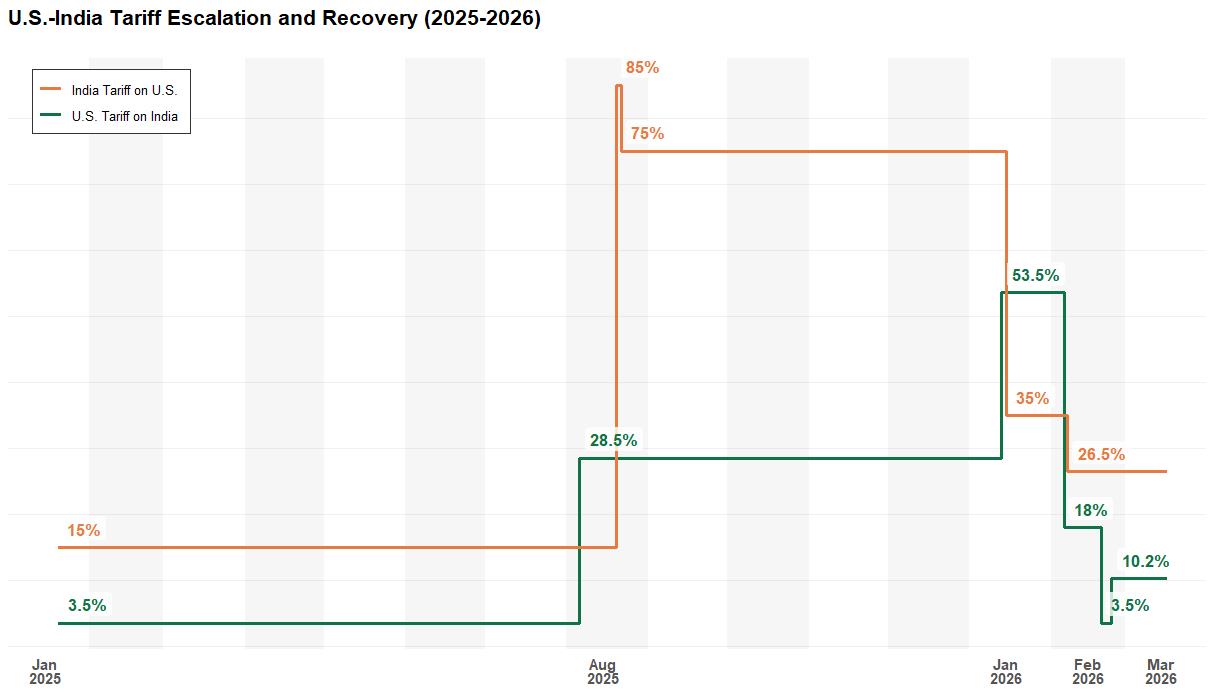
The US effective tariff rate reflects a broad, macroeconomic levy applied indiscriminately across the majority of Indian industrial and manufactured exports as a punitive baseline, a big, blunt instrument. Conversely, the Indian rate represents a blended, weighted average of highly targeted “surgical” duties (some even going above 100 per cent) specifically engineered to inflict maximum political pressure on vital American agricultural and manufacturing constituencies, while leaving unaffected sectors at the 15 per cent baseline.
The Supreme Court Intervention
In Learning Resources Inc. v. Trump, the US Supreme Court ruled 6-3 that the President exceeded his authority under the IEEPA by imposing his broad-based “reciprocal tariffs” without Congressional authorisation. [25]
Bottom Line: the ruling invalidated the use of the punitive surcharges as legal mechanisms used as a bargaining chip between Washington and New Delhi. [26] Promptly, India paused the formal signing of the February deal, waiting instead for Washington to restore its global tariff architecture before finalising the agreement, as the underlying leverage had vanished overnight. [27] With typical but predictable Trumpian pettiness, three weeks after the ruling, his administration completely shifted tactics, launching section 301 investigations into India’s “structural excess capacity” in the petrochemical, steel, and solar module sectors. [28] This is explicitly a manoeuvre to circumvent the US Supreme Court: Section 301 empowers the executive branch to unilaterally penalise “unfair” trade practices without relying on emergency powers, providing an alternative, court-insulated legal basis to replace the invalidated tariffs before temporary stopgap measures expire in July. [29] In plain English: Trump gets to keep tariffing while the Supreme Justices trip over their robes, failing to keep up.
The Ironic Kicker: just days ago, the US administration announced a USD 300 billion energy partnership backed by India’s largest private-sector behemoth, Reliance Industries. [30] While Washington fast-tracked the permits, it is ultimately Indian private capital, not the US, funding the construction of the first major new US refinery in half a century at the port of Brownsville, Texas. Texas cowboys playing with Indian-bought concrete is further relevant to us due to what the refinery is engineered to process: US light shale oil, thus nudging the US further from dependence on Middle Eastern grades. More importantly, this megaproject is the ultimate punchline to New Delhi’s quest for strategic autonomy: the USD 300 billion figure represents a massive 20-year off-take agreement where an Indian conglomerate is directly locking in American crude supply, [31] effectively hedging against the chaos of the Strait of Hormuz while handing Washington a massive domestic manufacturing win to potentially alleviate the very same trade tensions that came with the tariff war.
“آب از سر گذشت” (“Âb az sar gozasht” – The Party’s Over)
We now finally come to the hostilities in the Persian Gulf on February 28, 2026. The fragility of the “no Russian oil” pledge is laid bare, with Iran (perhaps predictably) using its control over the Strait of Hormuz as an economic weapon to leverage its position. It certainly has been felt in the market: 21 million barrels of oil per day [32] have been halted. As other defence economics analysts have thoroughly documented, a maritime blockade doesn’t just stop ships; it creates a massive queue upstream of increasingly Kafkaesque logistical bottlenecks.
With the tanker fleets physically unable to leave the Gulf, onshore storage facilities rapidly hit maximum capacity, forcing a hard halt to both Kuwait’s crude extraction and Qatar’s LNG liquefaction operations, and prompting East Asian countries to immediately dig into their petroleum reserves. Befitting a tragicomic situation as this, the US never bothered to fully refill its own Strategic Petroleum Reserve (SPR), deciding to start the conflict with only 60 per cent of fuel in the spare tank. [33]
Facing nearly USD120 per-barrel oil, US Treasury Secretary Scott Bessent, executing a rapid about-face after months of the administration’s tariff assaults on New Delhi based on its appetite for Russian petrochemicals, issued a 30-day emergency waiver [34] on March 6, graciously “authorising” India to purchase approximately 30 million barrels of Russian crude currently “stranded at sea” to prevent domestic fuel shortages. How generous of him to grant the rest of the world permission.
“Pragmatic Bilateral Coordination” in Tight Spaces
Another paradox in this crisis is that India’s ties with Tehran went from being the pecked-at target of the US sanctions to becoming a singularly rare functional tool for maritime safety around the strait for the time being. On March 15, a convoy of Indian-flagged commercial crude carriers, including the SCI Very Large Crude Carrier (VLCC) Desh Vaibhav, transited the Hormuz blockade without incident. [35] External Affairs Minister S. Jaishankar downplayed the geopolitical optics, describing the safe passage as a matter of “pragmatic bilateral coordination,” emphasising the ad-hoc nature of this interim arrangement with Iranian MFA Abbas Araghchi. [36] One can hope that bypassing the need for US-led naval ops like “Operation Epic Escort” does not attract the ire of US Secretary of Defense (SECDEF) Pete Hegseth; such sober diplomacy might get in the way of his evangelical dispensational postmillennialist plans for the region.
India’s Strategic Autonomy Gambit
As of mid-March 2026, the US-India partnership is in the pickle we currently find it in: Washington forced itself to sanction, then waive, then beg for the same energy flow it sought to prohibit. To stabilise a market that is stubbornly refusing to bend itself to the reality imagined by a presidential administration that thought itself clever by attacking on a weekend (with Wall Street oh-so-conveniently closed for the weekend), the hangover after the explosive party will pulsate stronger and stronger, leaving a lot of what’s in store in the immediate future in the fateful hands of India.
The crisis has revealed that India’s unique, valuable position lies in its geographic and diplomatic connections and, above all, in being on speaking terms with everyone involved. The Americans certainly can issue mandates from the gold-plated lounge chaises in the Oval Office as much as they like, but the logistical realities of the Indian Ocean remain the realm of people far more capable of handling the spice of international tension. No side needs to be picked per se by India; one can easily imagine New Delhi as the fulcrum around which everyone from Washington to Tehran needs to hinge.
*****
CLICK TO VIEW PDF
Notes:-
[1] Aaron Klein, Ben Harris, Daniel S. Hamilton, et al., “Brookings Experts on the Supreme Court’s Tariff Decision,” Brookings, February 24, 2026, https://www.brookings.edu/articles/brookings-experts-on-the-supreme-courts-tariff-decision/. Accessed on March 25, 2026.
[2] Peter Beaumont, “What Is the Strait of Hormuz and Can the US Stop Iran from Blocking It?,” The Guardian, March 16, 2026, https://www.theguardian.com/world/2026/mar/16/what-is-the-strait-of-hormuz-can-us-stop-iran-blocking-it. Accessed on March 25, 2026.
[3] Yashraj Sharma, “Trump Seeks Naval Coalition to Open Strait of Hormuz: Is Anyone Joining?,” Al Jazeera, March 15, 2026, https://www.aljazeera.com/news/2026/3/15/trump-calls-for-naval-coalition-to-open-strait-of-hormuz-can-it-work. Accessed on March 25, 2026.
[4] Mandy Taheri, “Hormuz Strait Attacks Follow Trump Saying Crews Should ‘Show Some Guts,’” Newsweek, March 11, 2026. https://www.newsweek.com/hormuz-strait-attacks-follow-trump-saying-crews-should-show-some-guts-11660339. Accessed on March 25, 2026.
[5] United States Trade Representative, Congressional Research Service (CRS), “United States Will Terminate GSP Designation of India and Turkey,” March 04, 2019, https://ustr.gov/about-us/policy-offices/press-office/press-releases/2019/march/united-states-will-terminate-gsp. Accessed on March 25, 2026.
[6] Daraya Korsunskaya, and Alexander Marrow, “‘Everything for the Front’: Russia Allots a Third of 2024 Spending to Defence,” Reuters, October 2, 2023., https://www.reuters.com/world/europe/everything-front-russia-allots-third-2024-spending-defence-2023-10-02/. Accessed on Marc h 25, 2026.
[7] Krzysztof Iwanek, “India and Iran: A Sanctioned Waiver Amid a Wave of Sanctions,” The Diplomat, November 9, 2018, https://thediplomat.com/2018/11/india-and-iran-a-sanctioned-waiver-amid-a-wave-of-sanctions/. Accessed on March 25, 2026.
[8] Shashi Tharoor, Inglorious Empire: What the British Did to India (Melbourn: Scribe, 2018).
[9] Stephen Kinzer, All the Shah’s Men: An American Coup and the Roots of Middle East Terror (Nashville: Turner Publishing Company, 2008).
[10] “Chennai Petroleum Corporation Limited (CPCL),” Indian Oil, 2026, https://iocl.com/chennai-petroleum-corporation-limited. Accessed on March 25, 2026.
[11] Ayjaz Wani, “India-Iran Chabahar Port Agreement: A New Era of Regional Connectivity,” Observer Research Foundation, May 15, 2024, https://www.google.com/search?q=https://www.orfonline.org/expert-speak/india-iran-chabahar-port-agreement-a-new-era-of-regional-connectivity. Accessed on March 25, 2026.
[12] P. Manoj, “India’s turbulent involvement in Iran’s Chabahar port all but collapses,” Economic Times Infra, January 18, 2026, https://infra.economictimes.indiatimes.com/news/ports-shipping/indias-strategic-withdrawal-from-chabahar-port-as-us-sanctions-loom/126541523. Accessed on March 25, 2026.
[13] “IPGL directors resign, website taken down as US sanctions on Iran’s Chabahar Port bite,” Economic Times Infra, October 01, 2025, https://infra.economictimes.indiatimes.com/news/ports-shipping/ipgl-directors-resign-website-taken-down-as-us-sanctions-on-irans-chabahar-port-bite/124261478. Accessed on March 25, 2026.
[14] Library of Congress, United States of America, “Iran Sanctions,” March 20, 2026. https://www.congress.gov/crs-product/RS20871. Accessed on March 25, 2026.
[15] “India Cuts down Dependence on Iran Oil,” Business Line, July 22, 2014. https://www.thehindubusinessline.com/economy/india-cuts-down-dependence-on-iran-oil/article23122418.ece. Accessed on March 25, 2026.
[16] Ibid.
[17] Darshana M. Baruah, “India’s Answer to the Belt and Road: A Road Map for South Asia,” Carnegie Endowment for International Peace, August 21, 2018, https://carnegieendowment.org/research/2018/08/indias-answer-to-the-belt-and-road-a-road-map-for-south-asia. Accessed on March 25, 2026
[18] Sanjay Dutta, “India saved $7.9 billion by buying more Russian crude in FY24,” The Times of India, April 30, 2024, https://timesofindia.indiatimes.com/business/india-business/india-saved-7-9-billion-by-buying-more-russian-crude-in-fy24/articleshow/109736144.cms. Accessed on March 25, 2026.
[19] Rezaul H Laskar, “India welcomes Trump-Putin summit, backs peace in Ukraine,” Hindustan Times, August 16, 2025, https://www.hindustantimes.com/india-news/india-welcomes-trump-putin-summit-says-world-wants-end-to-conflict-in-ukraine-101755344046566.html. Accessed on march 25, 2026.
[20] Shyam Gowtham, “The Delhi-Washington Rift: Can the US and India be friends again?,” CrossDock Insights, August 14, 2025, https://crossdockinsights.com/p/us-india-trade-tariff. Accessed on March 25, 2026.
[21] Koh Ewe, “Trump Threatens Tariffs on Countries ‘Doing Business’ With Iran,” TIME, January 13, 2026.
[22] Ilkhan Ozsevim, “Iran: US’ fresh tariff threats throw global production into turmoil,” January 19, 2026, https://www.automotivemanufacturingsolutions.com/analysis/iran-us-fresh-tariff-threats-throw-global-production-into-turmoil/2588914. Accessed on March 25, 2026.
[23] Yashraj Sharma, “Modi, Trump announce India-US ‘trade deal’: What we know and what we don’t,” Al Jazeera, February 03, 2026, https://www.aljazeera.com/news/2026/2/3/modi-trump-announce-india-us-trade-deal-what-we-know-and-what-we-dont. Accessed on March 25, 2026.
[24] Chietigj Bajpaee, “Despite reset in India–US relations, New Delhi retains commitment to strategic hedging,” Chatham House, February 17, 2026, https://www.chathamhouse.org/2026/02/despite-reset-india-us-relations-new-delhi-retains-commitment-strategic-hedging. Accessed on March 25, 2026.
[25] Learning Resources, Inc et al. v. Trump, President of the United States et al., 24-1287 (2026).
[26] Womble Bond Dickinson, “Supreme Court Tariff Decision & Second Term U.S. Trade Deals,” JD Supra, 2026, https://www.jdsupra.com/legalnews/supreme-court-tariff-decision-second-8894615/. Accessed on March 25, 2026
[27] “India-US Trade Deal to Be Signed after New US Tariff Framework Is Finalised,” Economic Times, March 17, 2026, https://m.economictimes.com/news/economy/foreign-trade/india-us-trade-deal-to-be-signed-after-new-us-tariff-framework-is-finalised/articleshow/129618250.cmm. Accessed on March 25, 2026.
[28] “US initiates Section 301 probe against India, China, 14 others,” The Indian Express, March 12, 2026, https://indianexpress.com/article/business/us-initiates-section-301-probe-against-india-china-14-others-10579085/. Accessed on March 25, 2026.
[29] Ravi Dutta Mishra, “US Initiates Section 301 Probe against India, China, 14 Others,” The Indian Express, March 13, 2026, https://indianexpress.com/article/business/us-initiates-section-301-probe-against-india-china-14-others-10579085/. Accessed on March 25, 2026.
[30] “Reliance to invest in first new US oil refinery in 50 years, says Trump; calls $300 billion Texas project ‘historic deal’,” The Economic Times, March 11, 2026, https://m.economictimes.com/industry/energy/oil-gas/reliance-to-invest-in-first-new-us-oil-refinery-in-50-years-says-trump-calls-300-billion-texas-project-historic-deal/articleshow/129429489.cms. Accessed on March 25, 2026.
[31] “Reliance-backed refinery project in Texas: All about the ‘$300-billion deal’ Trump announced,” The Indian Express, March 10, 2026, https://indianexpress.com/article/explained/explained-economics/all-about-reliance-backed-texas-refinery-project-by-trump-10575784/. Accessed on March 25, 2026.
[32] United States Energy Information Administration (EIA), “The Strait of Hormuz Is the World’s Most Important Oil Transit Chokepoint,” March 20, 2026. https://www.eia.gov/todayinenergy/detail.php?id=39932. Accessed on March 25, 2026.
[33] Department of Energy, United States of America, “Strategic Petroleum Reserve,” 2026. https://www.energy.gov/ceser/strategic-petroleum-reserve. Accessed on March 25, 2026.
[34] “Indians had been very good actors, says U.S. Treasury Secretary Bessent on Russian oil waiver,” The Hindu, March 07, 2026, https://www.thehindu.com/business/Economy/we-had-asked-india-to-stop-buying-sanctioned-russian-oil-this-fall-they-did-says-us-treasury-secretary-bessent/article70714581.ece. Accessed on March 25, 2026.
[35] Maziar Motamedi, “Iran grants rare Strait of Hormuz transit exception to Indian commercial fleet,” Al Jazeera, March 15, 2026, https://www.aljazeera.com/news/2026/3/15/iran-grants-rare-strait-of-hormuz-transit-exception-to-indian-commercial-fleet. Accessed on March 25, 2026.
[36] Suhasini Haidar, “Safe passage in Gulf a result of ‘pragmatic bilateral coordination’, says Jaishankar,” The Hindu, March 16, 2026, https://www.thehindu.com/news/national/safe-passage-in-gulf-a-result-of-pragmatic-bilateral-coordination-says-jaishankar/article70732891.ece. Accessed on March 25, 2026.
(Disclaimer: The views and opinions expressed in this article are those of the author and do not necessarily reflect the position of the Centre for Aerospace Power and Strategic Studies [CAPSS])