
Author: Mr Sameer Joshi, CEO, NewSpace Research & Technologies Pvt. Ltd.
About this Paper
This Policy Paper presents new thinking and concrete recommendations on the strategic, doctrinal, and force-structure challenges confronting the Indian Air Force in the wake of Operation Sindoor (May 2025). It is written for policymakers, parliamentarians and their staff, defence industry leaders, the strategic-studies community, journalists, and the informed Indian public.
The paper makes three core arguments. First, the classical model of airpower — gain superiority, suppress defences, dictate terms — no longer holds against any capable and near peer adversary, including in the Indo-Pacific. What has replaced it is the Zone of Ambiguity: a contested space in which neither side can win the sky outright, but both can deny it, and in which political and informational uncertainty are as decisive as kinetic outcomes. Second, despite this, airpower remains the single most effective instrument of statecraft and power projection available to a nation — a point Operation Sindoor itself reaffirmed. The question is not whether airpower matters, but how to wield it in a denial-dominant environment. Third, given India’s structural and persistent shortfall in manned squadron strength, the only credible path to operational mass over the next decade runs through unmanned systems at scale — Collaborative Combat Aircraft, UCAVs, swarms, one way attack (OWA) drones and loitering munitions, and Manned–Unmanned Teaming–based effects. This wave is breaking globally right now. India must catch it in time, not after.
SOURCES & METHODThis paper draws on open-source reporting and analysis published through May 2026, including studies by the Centre for Military History and Perspective Studies (Pully, Switzerland), the Royal United Services Institute (London), the Stimson Center (Washington), the Carnegie Endowment for International Peace, on-the-record statements by IAF leadership, and the Indian and international defence press. Where claims remain contested in the open source — particularly engagement ranges and order-of-battle figures from Operation Sindoor — the paper notes the disagreement and reasons accordingly. The intent is to give policymakers a defensible, citable basis for decisions. |
Executive Summary
For decades, airpower has been the reset button of modern statecraft. Bekaa Valley 1982. Desert Storm 1991. Kosovo 1999. The recent Israel-US campaign over Iran. A clean method — gain air superiority, suppress defences, dictate terms. That button no longer works as it once did — and yet airpower remains the single most effective tool of national power available to any modern state, including India. Operation Sindoor proved both propositions in the space of eighty-eight hours.
Three campaigns in five years — Nagorno-Karabakh, Ukraine, and India’s own Operation Sindoor in May 2025 — have demonstrated that classical air superiority is no longer achievable against any capable adversary. What replaces it is the Zone of Ambiguity: a contested space in which neither side owns the sky, but both can deny it to the other, and in which political and informational uncertainty are as decisive as kinetic outcomes.
The Zone has three faces. Politically, adversaries cultivate strategic uncertainty — China through salami-slicing along the LAC, Pakistan through hybrid war and proxy terrorism — to constrain India’s response options. Operationally, dense BVR envelopes, layered air-defence networks, and networked kill webs make manned penetration costly and uncertain. Informationally, global narratives of conflict outcomes are now contested in the first 72 hours, shaping strategic perception independently of battlefield reality.
Yet Op Sindoor — 88 hours, Indian strikes eliminating terror infrastructure, Pakistan’s anti-air counter attack, an Indian S-400 reaching out 300 kilometres to kill a PAF AEW&C platform, BrahMos missiles cratering five Pakistani airbases, destruction of PAF C4I centres and aircraft on ground, Pakistan requesting ceasefire on the morning of 10 May — reaffirms that airpower remains uniquely capable of delivering strategic effects rapidly, precisely, and reversibly. No other instrument of national power could have produced that outcome in that timeframe with that level of escalation control. The Zone of Ambiguity changes how airpower works. It does not change the fact that airpower works.
But the next conflict will be harder. The IAF is at 29–31 squadrons against an authorised 42. Tejas Mk1A is dribbling out of HAL. AMCA will not enter service before the mid-2030s. The PLAAF is heading toward a thousand J-20s by 2030. Pakistan has ordered Chinese J-35As. India cannot solve this gap with manned platforms alone on any realistic procurement timeline.
The only credible answer is mass through autonomy — Collaborative Combat Aircraft, attritable UCAVs, drone swarms, loitering munitions, and Manned–Unmanned Teaming, ingested at industrial scale and woven into doctrine. This wave is breaking globally right now: the USAF’s CCA Increment 1 has selected airframes flying in 2025–26; the UK-Italy-Japan GCAP programme has CCA wingmen baked into its architecture; the PLAAF has the GJ-11 Sharp Sword operational and J-20 manned-unmanned teaming in active development. This is the moment for India to enter the wave, not the moment to study it.
E I G H T F I N D I N G S
Finding 01 — Airpower still wins the momentOp Sindoor reaffirmed airpower’s unique capacity for rapid, precise, reversible strategic effect. The argument is for adapting how it is wielded, not for replacing it. |
Finding 02 — Air superiority can no longer be assumedAgainst any capable adversary, the IAF must plan for mutual denial — neither side owning the sky — not for classical air-superiority campaigns. |
|
Finding 03 — A Chinese-pattern threat through a Pakistani interfacePL-15, J-10CE, HQ-9BE, reported live Chinese ISR support during Sindoor — India fought networked Chinese airpower in May 2025, without fighting China directly. |
Finding 04 — The squadron gap is structural and a decade longAt 29–31 squadrons of an authorised 42, with Tejas, MRFA, AMCA and Super Sukhoi all years away, the IAF will fight outnumbered on manned platforms through 2032 at minimum. |
|
Finding 05 — Unmanned at scale is the only available massCCAs, UCAVs, swarms, and loitering munitions are not nice-to-have. They are the only mass-generating capability available on India’s actual industrial and procurement timelines. |
Finding 06 — The wave is breaking now, globallyThe next-gen unmanned wingman, CCA, and MUM-T technology cycle is being defined this decade by the US, UK-Italy-Japan, France-Germany-Spain, Turkey and China. India must enter it with the leaders, not behind them. |
|
Finding 07 — Catalogue intelligence is deadSindoor demonstrated that adversary capability on the night can exceed published specifications substantially. Intelligence and doctrine must build on this reality. |
Finding 08 — The first 72 hours of information war must be wonOp Sindoor’s kinetic victory was partially obscured by an early information defeat. A dedicated strategic-communications capability is now an operational requirement. |
This paper makes ten specific recommendations spanning doctrine, force structure, industrial policy, and strategic communications (Section VIII). Taken together, they describe a transition from an IAF organised around platforms to an IAF organised around ecosystems — networked, distributed, partially autonomous, and built to fight from mutual denial rather than assumed superiority.
Airpower remains the most effective instrument of statecraft a modern nation possesses. The Zone of Ambiguity does not contradict this — it makes the case for getting airpower right in a more urgent manner.
1. The Long Shot
Somewhere over central Pakistan, in the early hours of 9 May 2025, a Pakistan Air Force Erieye airborne early warning platform was orbiting in what its crew believed was sanctuary. They were operating deep inside their own airspace, well behind their air-defence umbrella at over two hundred and fifty kilometres from the International Boundary (IB), doing what AEW&C aircraft do — looking east, painting the picture, feeding the kill chain that had given the PAF the tactical edge in the early hours of 7 May 2025, now degraded post the Indian Air Force Harop / Harpy SEAD strikes on 8 May 2025.
What the crew did not know was that an Indian S-400 battery had moved into ambush position near the western border. Silent. Patient. Waiting.
The engagement, when it came, was at roughly three hundred kilometres. By the IAF’s own subsequent acknowledgement, it was the longest recorded surface-to-air kill in combat history. That single shot did more than destroy an airframe. It redrew the entire Pakistani air picture. Within hours, surviving PAF radars across the western theatre were switching off voluntarily, expecting the next wave of Indian SEAD campaign. With the AEW&C eyes blinded and the ground-based eyes blinking out, the PAF lost the ability to repeat the coordinated, network-cued operations that had given it tactical success on the opening night, or for that matter mount any manner of effective Defensive Counter Air (DCA) in the air. This was the defining event of the war, beyond which the PAF was confined strictly to the bunker; the road now open for India’s 10 May strike package — BrahMos, SCALP-EG, Crystal Maze, Rampage — to roll across Sargodha, Nur Khan, Jacobabad, and Bholari, where another BrahMos would find an Erieye in its hangar.
One shot. Three hundred kilometres. And the air war turned.
But here is what matters: that shot was the easy part. It was kinetic. It was decisive. It was clean.
The hard part — the part this paper is about — was everything that happened in the seventy-two hours before that shot, and everything that has been happening for five years before this campaign. It is the murky, ambiguous, politically-constrained, information-contested space in which the Indian Air Force now operates. It is the space in which a kinetic victory in the second 48 hours can be drowned out by an information bias in the first 24. It is the space in which the next conflict will be fought.
This is the Zone of Ambiguity. It is not a place on a map. It is the operational, political, and informational space where nothing is clear, nothing is settled, and nothing is decisive — and where India must now fly, fight, and signal intent without breaking the world.
And yet — and this is the part that matters most — airpower delivered the strategic outcome at Sindoor. It was the IAF’s stand-off precision strikes, its long-range air defences, and its credible escalation control that forced Islamabad to request a ceasefire on the morning of 10 May. No other instrument of Indian state power could have produced that result in that timeframe, with that level of calibration. The Zone of Ambiguity does not diminish airpower. It raises the cost of getting airpower wrong.
This paper proceeds in three movements. First, it defines the Zone of Ambiguity rigorously across its three faces. Second, it draws the operational lessons of Sindoor and the broader pattern visible across Nagorno-Karabakh and Ukraine, mapping these onto India’s specific two-front problem. Third, it lays out a ten-point programme of doctrinal, force-structure, industrial, and informational reforms — with particular emphasis on unmanned systems at scale as the functional answer to India’s structural squadron gap.
WHY SINDOOR MATTERS BEYOND THE SUBCONTINENTSindoor is the first instance of a Chinese-pattern networked kill web being employed in combat — by Pakistan, with Chinese-supplied AEW&C, fighters, missiles, and reportedly real-time ISR. Every serious air force is now studying it. The Swiss CHPM, RUSI, the Stimson Center, and Carnegie have all published detailed analyses. The lessons being drawn in those papers will shape USAF, RAF, and PLAAF doctrine for the rest of the decade. India should ensure its own lessons-learnt process is at least as rigorous as those being conducted by foreign analysts who studied the campaign from a thousand miles away. |
2. Defining the Zone of Ambiguity
The phrase has been used loosely. Let me be precise. The Zone of Ambiguity has three faces, and you cannot understand one without the other two
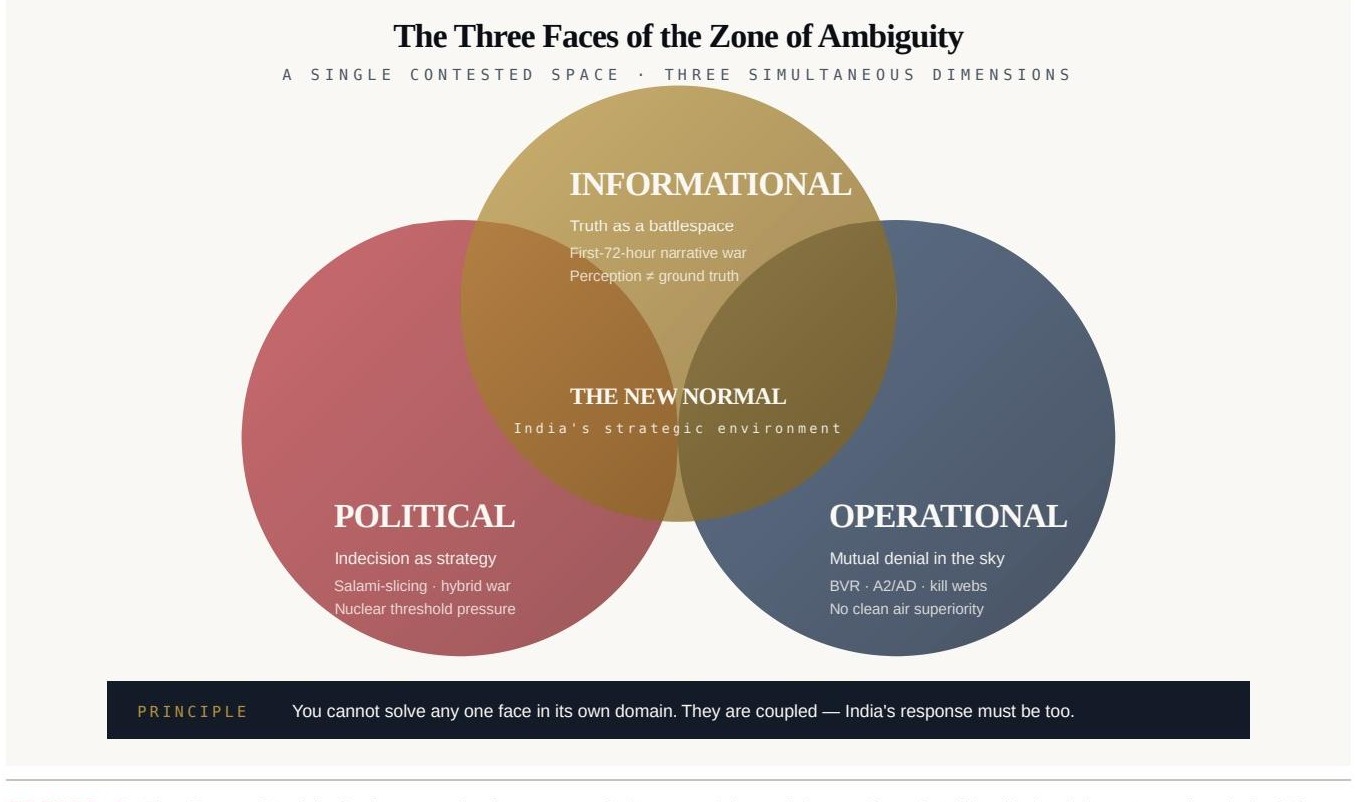
Face One — The Political Zone: Indecision as Strategy
The first face is political. It is the deliberate cultivation of strategic uncertainty by an adversary who knows India’s response options are constrained by the nuclear threshold above, the political cycle below, and an international audience all around.
China practises this through salami-slicing. A Chinese patrol pushes ten kilometres south of where it was yesterday. A road is built that wasn’t there last year. A tent appears, then a structure, then a permanent post. No single act crosses a threshold. The cumulative act redraws the map. Eastern Ladakh in 2020 was occupied by ambiguity.
Pakistan practises it through hybrid war. A terror attack in Pahalgam kills twenty-six civilians. Is it state action? Non-state action? State-tolerated non-state action? The label changes the response. The ambiguity is the strategy.
In this face of the Zone, the adversary wins by making you choose badly. React too hard, and you escalate to a war you didn’t want. React too softly, and you cede sovereignty, signal weakness, and invite the next slice. The Zone is where reasonable people inside your own government disagree about what just happened — and by the time they agree, the news cycle has moved on.
Balakot 2019 was India’s first serious answer to this dilemma. Op Sindoor 2025 was the second. Neither was a war. Both were not peace. Both demonstrated that airpower — specifically, calibrated stand-off air strikes — is the instrument best suited to operating in this face of the Zone, because it can deliver effects rapidly, precisely, at scale, and with reversibility built in.
Face Two — The Operational Zone: Contested Airspace Without Air Superiority
The second face is what airmen mean when they say “Zone of Ambiguity.” It is the physical airspace where neither side can establish air superiority — but both can deny it to the other.
For most of the post-Cold-War period, airpower theorists drew a clean diagram: phase one was counter-air, phase two was air interdiction, phase three was close air support. Each phase assumed the one before. The Bekaa Valley in 1982 fit this. Desert Storm in 1991 fit this. Even Kosovo in 1999 fit this, and the Israel-US air campaign over Iran eventually.
Nagorno-Karabakh 2020 did not fit. Ukraine 2022–present does not fit. Op Sindoor 2025 did not fit.
In the contested operational Zone, BVR missile envelopes overlap from both sides of the line. Long-range SAMs reach across borders. Sensors are everywhere — satellites, AEW&C, ground-based radars on the Tibetan plateau looking 500 kilometres into India. Networks fuse them. The result is an airspace in which manned penetration is possible only at the price of attrition you cannot easily replace.
Russia’s VKS has, for three years, been largely confined to lobbing glide-bombs from inside its own airspace because Ukrainian denial is too thick to penetrate. Russia has not lost air superiority — it never had it. Neither does Ukraine. Both deny it to the other. This is the future. Sindoor confirmed India is already in it.
Face Three — The Informational Zone: The First 72 Hours
The third face is newer and, in some ways, the most dangerous. It is the informational ambiguity that surrounds every modern operation.
Within hours of the opening engagements of Sindoor on 7 May 2025, Pakistani official channels were claiming multiple IAF aircraft shot down. Recycled images from older, unrelated incidents were circulating globally, labelled as Op Sindoor losses. International press went ballistic in repeating the claims without verification. The Indian government, working from a doctrine of operational silence, did not respond at speed. By the time the IAF demonstrated air superiority on 9/10 May — the 300-kilometre S-400 kill, the Bholari hangar strike, the cratering of Sargodha, the rollback of Pakistani air defences — the global narrative had already calcified around Pakistan’s opening-night version of events.
The kinetic war was won by India. The first 72 hours of the information war were lost.
THE NARRATIVE GAPOperational silence is not strategic communicationsThe Indian convention of withholding operational details until the dust settles is honourable, but in the modern information environment it concedes the first 72 hours of narrative shaping to the adversary. By the time IAF publicly confirmed the Bholari Erieye kill and other strikes — the international defence press had consolidated on the early Pakistani claims, which became reference points in global coverage for quite some time.This is not a public-affairs problem. It is an operational problem requiring an operational solution. |
Why the Three Faces Are Coupled
The analytical bite of this framework is that the three faces are not independent. They are coupled — and the coupling is what makes the Zone of Ambiguity uniquely difficult.
An adversary exploits political ambiguity to create the operational space for a strike. It exploits operational ambiguity by deploying systems whose published catalogue specifications understate their actual capabilities. And it exploits informational ambiguity by saturating the global news cycle with contested claims before kinetic facts are established.
India’s response must therefore also be three-faced. A purely kinetic response wins the operational face but loses the political and informational faces. A purely communicative response wins the informational face but cedes the operational and political. The strategic skill is orchestrating across all three simultaneously — which is institutionally hard, because the three faces sit in three different parts of the Government of India: the CCS, the IAF and integrated commands, and a Strategic Communications function that does not yet exist in mature form.
This paper’s recommendations address all three.
3. Airpower’s Enduring Primacy
It would be easy to read the previous section as a counsel of despair — if neither side can win the sky, perhaps the sky no longer matters. That reading would be wrong. Airpower remains the single most effective instrument of statecraft and power projection available to any modern nation, and the case is in some ways stronger today than it was in the era of clean air superiority. The Zone of Ambiguity changes how airpower works. It does not diminish what airpower uniquely does.
What Airpower Uniquely Does
Stripped to its essentials, airpower delivers five effects that no other military instrument can match — and all five were on display during Operation Sindoor.
(a) S P E E D O F E F F E C T: An airpower-led campaign delivers strategic effect in hours. Ground operations take days to weeks. Naval operations take days. Diplomatic and economic instruments take weeks to months, sometimes years. The decision to launch Op Sindoor was taken in the days after Pahalgam; the first strikes hit targets hundreds of kilometres in depth from launch points on the night of 7 May. No other instrument operates on that clock.
(b) P R E C I S I O N A N D C A L I B R A T I O N: Modern stand-off weapons — BrahMos, SCALP-EG, Crystal Maze 2, Rampage, Spice 2000, and a growing inventory of loitering munitions — allow targeting at metre-level accuracy from hundreds of kilometres away. This is what makes airpower the instrument of choice for operations in the political face of the Zone: the ability to put a precise effect on a precise target sends a precise message. A salvo against a terrorist training camp says one thing. A salvo against a military airbase says another. The choice of target is the message.
( c) R E V E R S I B I L I T Y A N D E S C A L A T I O N C O N T R O L: An air strike can be halted at any moment. A ground assault, once committed, has its own momentum and cost-of-disengagement. Airpower is therefore uniquely suited to graduated coercion — the central requirement for operating in a nuclear-armed subcontinent. Op Sindoor’s 88-hour escalation curve, from terror-camp strikes on Day 1 to airbase strikes on Day 4, was choreographed almost entirely by air assets. Each rung gave Islamabad a decision point: escalate further, or de-escalate. The choreography is what made the ceasefire possible.
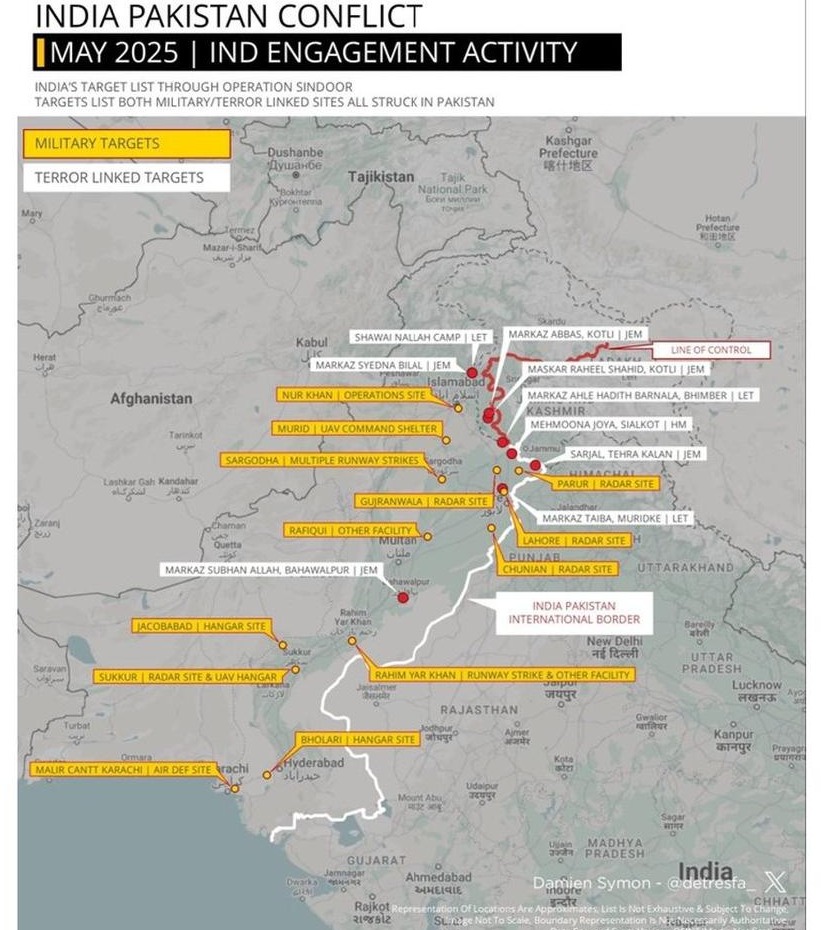
(d) R E A C H A C R O S S T H E C O N T I N E N T: From bases inside India, the IAF holds at risk every target on the subcontinent and substantial portions of the Tibetan plateau. No other Indian instrument has that reach. Sindoor’s strikes hit Bahawalpur, Muridke, Muzaffarabad, Sargodha, Nur Khan, Jacobabad, Bholari and Rahim Yar Khan — a target set spanning the length of Pakistan. The same launch profiles, redirected northward, would hold at risk targets across the breadth of southern Tibet.
(e) S T R A T E G I C S I G N A L L I N G: Perhaps most importantly in the Zone of Ambiguity: the demonstrated capability to project airpower is itself a strategic instrument, independent of any actual use. The presence of S-400 squadrons, the existence of BrahMos inventory, the visibility of Rafale and Su-30MKI sorties, the publication of AMCA programme milestones — these shape adversary calculation continuously, not only during crises. Airpower deters and signals before it strikes.
C A S E · T H E S T R A T E G I C E F F E C T O F 8 8 H O U R SSindoor reaffirmed airpower’s primacy under denialThe campaign began on the night of 6/7 May with strikes against nine terror-linked targets, expanded on 8 May to PAF air-defence sites, escalated on 9 May to deeper strikes, and culminated on 10 May with a coordinated multi-axis package against five Pakistani airbases. Pakistan requested ceasefire on the morning of 10 May. The entire strategic outcome — coercion, signalling, message delivery, and ceasefire — was mostly achieved by airpower, with naval and land forces in supporting positions.No other instrument of Indian state power could have delivered that result in that timeframe with that level of escalation control. The Zone of Ambiguity made Sindoor harder than it would have been in 1991. It did not make it impossible. And it did not displace airpower from the centre of Indian strategic options. |
The Implication: Get Airpower Right
If airpower remains the most effective instrument India possesses, then getting airpower right in the Zone of Ambiguity is not one priority among many. It is the priority. Every doctrinal, technological, industrial, and informational decision the IAF takes over the next decade will compound — either toward an air force capable of operating effectively under denial, or toward one that finds itself unable to deliver the strategic effects its political leaders will continue to demand.
The remaining sections of this paper describe what “getting it right” requires.
4. The Geography of Denial
No country in the world faces a two-front strategic problem like India’s. To the north, a technologically advanced competitor with continental reach and a thousand-strong fifth-generation fleet projected by 2030. To the west, a nuclear-armed adversary increasingly integrated into Chinese kill chains. To the south, an Indian Ocean that is no longer an Indian preserve. Geography is destiny — but only if doctrine and force structure refuse to read the map.
The Northern Front: The Tibetan Air-Defence Belt
Along the LAC, the PLA has constructed an air-defence and offensive-strike complex that reaches 300–500 kilometres into Indian airspace from a series of upgraded airbases on the Tibetan plateau. Hotan, Ngari Gunsa, Shigatse, and Lhasa Gonggar host HQ-9B and HQ-22 long-range SAM batteries, with second-echelon S-3/400-class systems providing depth. J-10 & J-15/16 multirole fighters, J-20 stealth fighters, and KJ-500 airborne early warning aircraft operate from these bases under permanent IADS protection.
The PLAAF currently fields approximately 300 J-20s across at least thirteen regiments. RUSI projects the fleet at approximately 1,000 J-20s by 2030 — larger than the entire combined Western fifth-generation inventory. Two sixth-generation prototypes (J-36 and J-50) have flown. The GJ-11 Sharp Sword stealth UCAV is operational. The PL-15 family of long-range air-to-air missiles is mature, with the PL-16 enabling six-missile internal carriage on J-20 and the PL-17 (400-km class) designed explicitly to kill AEW&C and tankers from beyond escort range.
The Western Front: The Chinese-Pattern Threat Through a Pakistani Interface
What used to be a clean India-versus-Pakistan calculus is now something more complex. Pakistan is increasingly an extension of Chinese military power on India’s western flank — not in the sense of formal alliance, but in the sense of integrated weapons, doctrine, sensor architectures, and crisis behaviour. The visible inventory tells the story:
-
-
30–40 J-35A stealth fighters ordered from China, with first deliveries expected from 2026–27 and PAF pilot training already under way at Hotan
-
J-10CE multirole fighter squadrons combat-proven during Sindoor
-
PL-15 / PL-15E long-range BVR missiles in active inventory, with reported performance exceeding publicly advertised export specifications
-
HQ-9BE long-range SAMs protecting Karachi, Lahore, and Islamabad
-
Saab 2000 Erieye AEW&C providing networked sensor coverage to Chinese assets (Link 17) — the platform type lost on the ground at Bholari and in the air to the 300-km S-400 engagement
-
Reported real-time Chinese ISR feeds during Sindoor (per public statements by the Indian Deputy Army Chief), effectively giving PAF access to PLA-grade space-based and OTH-radar coverage.
-
The geopolitical reality is unavoidable: India did not fight just Pakistan in May 2025. India fought a Chinese-pattern force, operated by a Pakistani crew, on Pakistani territory. The next encounter — whether with Pakistan again, or directly with the PLAAF along the LAC, or in a two-front contingency — will be against a more confident, more networked, more capable version of the same architecture.
The Maritime Flank
To the south, the Indian Ocean is no longer an Indian preserve. Chinese naval presence in the IOR has grown steadily through the 2020s. Pakistani acquisition of Type 054 frigates and Yuan-class submarines closes the loop. Chinese UCAV exports to Saudi Arabia, the UAE, and Egypt — and Turkish UCAV transfers to Pakistan — broaden the threat envelope across India’s western maritime approaches. The IAF’s responsibilities now include maritime strike at extended range, a mission set for which the BrahMos-equipped Su-30MKI and the future Tejas Mk2 are the only available platforms.
The two-front problem, in other words, has become a two-front-plus-maritime problem. The IAF cannot solve all of it simultaneously with manned platforms. This is the structural argument that drives the rest of this paper.
5. The Kill Web
Two ambushes were attempted during Operation Sindoor. Looking at them together explains everything about how modern air combat actually works.
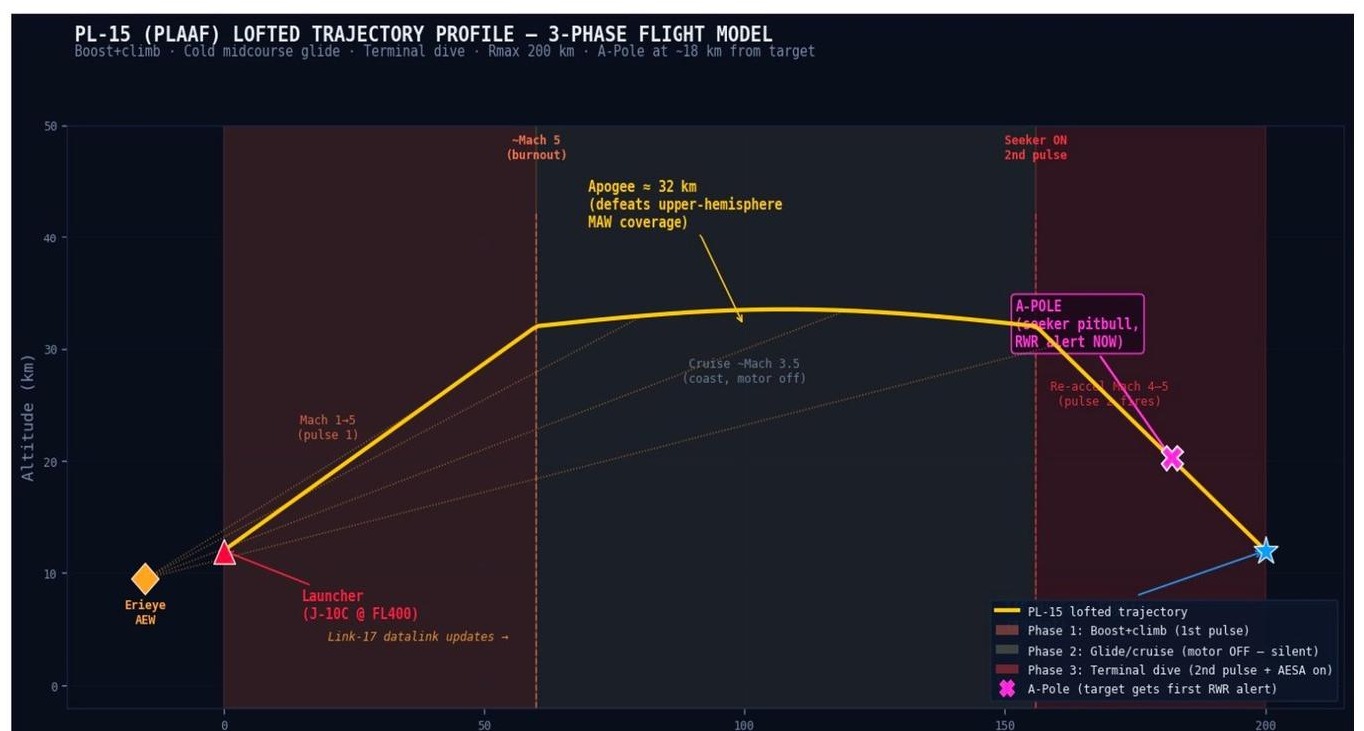
Ambush One — by the PAF, opening exchanges: PAF formations executed an “air ambush” geometry from deep inside their own airspace: AEW&C orbiting in sanctuary providing sensor coverage, fighters operating radar-silent under that umbrella, long-range air-to-air missiles fired on offboard cueing and mid-coursed via tactical datalink, terminal acquisition only at the very end. The whole package was Chinese-pattern: Saab 2000 Erieye doing what a KJ-500 does for the PLAAF, J-10CE as the shooter, PL-15 as the missile, Pakistani Link 17 & Chinese XS-3 datalink as the connective tissue. No single Pakistani platform had to expose itself to risk. The kill chain was distributed across multiple nodes, any of which could have been substituted. The geometry gave the PAF opportunities to target IAF assets at over two hundred kilometres.
This is not Pakistan’s air force. This is a Chinese-pattern kill web with a Pakistani interface. Sindoor was the first time the world saw it employed in combat. It is just the beginning.
Ambush Two — by the IAF, forty-eight hours later: An S-400 battery was moved into ambush position close to the western border, deliberately silent. PAF AEW&C orbits at this point were still calibrated against the previously-known S-400 deployment locations and the publicly-cited engagement envelope. The new position changed the geometry. When a PAF AEW&C platform entered the redrawn envelope, the engagement was executed at roughly three hundred kilometres — beyond what Pakistani planners had assessed possible. The longest recorded surface-to-air kill in combat history.
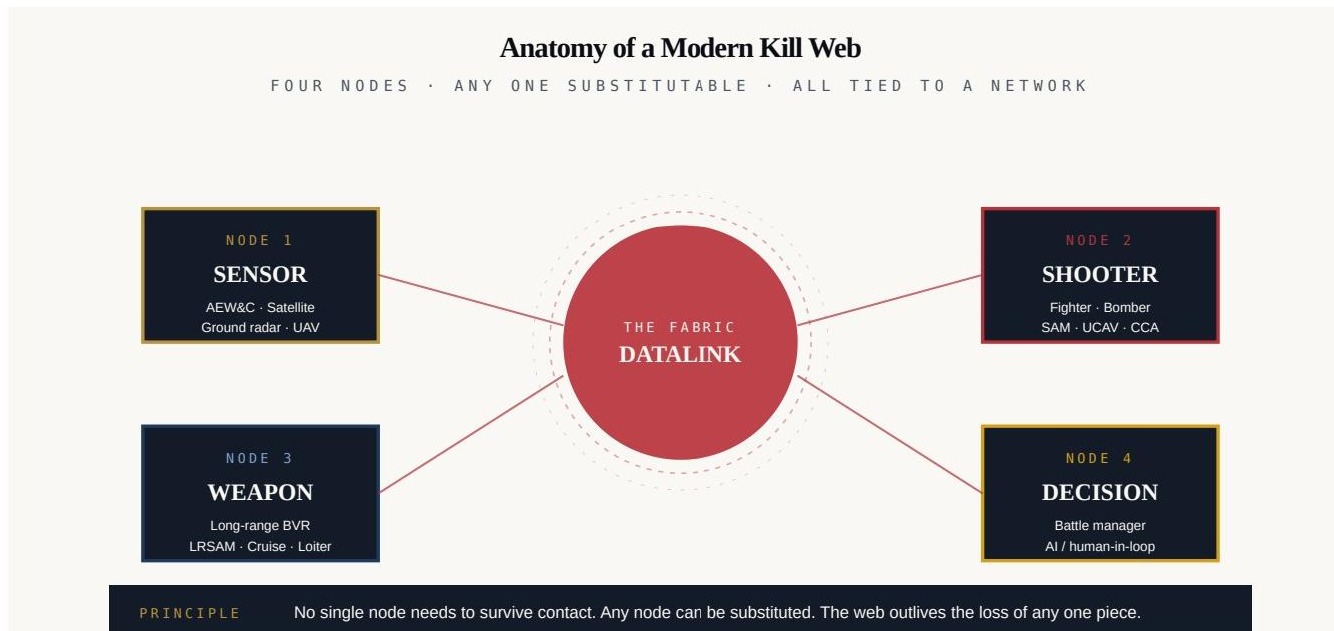
What the Two Ambushes Have in Common
Notice the symmetry. Both ambushes worked the same way:
-
-
A sensor in sanctuary, well clear of the adversary’s retaliation envelope
-
A shooter that did not have to expose itself to detection until commit
-
A weapon with the legs to cross a large engagement volume
-
A datalink stitching the three together so they functioned as a single system
-
An adversary whose mental model of the engagement envelope was wrong — either because catalogue specifications had been under-classified, or because deployment geometry had been miscalculated, or both
-
Both sides were operating in the Zone of Ambiguity. Both demonstrated that the kill web has replaced the kill chain as the unit of analysis. And both ambushes shared a single deeper lesson:
Catalogue intelligence is dead. In the Zone of Ambiguity, the side whose intelligence picture is closest to the night’s actual capability holds the initiative. Everything else is a lagging indicator.
Five Operational Principles That Flow from This
If the kill web is the new unit of analysis, five operational principles follow. These are not nice-to-haves. They are how the IAF must fight in the next contingency.
Don’t seek superiority. Buy minutes.The 10 May strike package — multiple platforms, multiple axes, multiple weapons, all converging in a narrow window — bought hours of effective freedom over Sargodha and Bholari. That was enough. Plan for windows, not for dominance. |
Push the manned platform back. Push the unmanned forward.Rafale, Su-30MKI, AMCA are battle managers and stand-off launchers, not penetrators. CCAs, UCAVs, swarms, loitering munitions enter the contested zone. This inverts seventy years of fighter-pilot identity. Training pipelines must catch up. |
|
Disperse, harden, and accept airbase attrition.Operation Bunyan un-Marsoos showed Pakistani drone and Fatah-1 rocket salvos targeting Indian airfields on 10 May 2025. The next conflict — particularly against PLAAF reach — will be worse. Hardened aircraft shelters, rapid forward base deployment, highway-as-runway, distributed weapons stockpiles, rapid runway repair, and point air defence at every operating base are now operationally non-negotiable. |
Build the kill web with friction in mind.Networks degrade under EW. GPS will be denied. Datalinks will be jammed. Every system must degrade gracefully — full networking when available, autonomous fallback when not. NavIC PNT on every combat platform. GSAT-7C launched. Quantum-key-distribution on the highest-priority C2 backbone. Next evolution of the IACCS and Akashteer must be underway. |
P R I N C I P L E F I V E — A N D T H E B R I D G E T O T H E N E X T S E C T I O NWin the first 72 hours of the information warThis is not a Public Affairs problem. It is an operational problem. A dedicated IAF Strategic Communications cell, with combat-cam release authority, technical-data clearance, and the bandwidth to push at social-media speed, must exist before the next crisis. The kinetic war and the informational war are now the same war.All five principles are achievable. None of them is achievable without one prior commitment: solving the numbers problem. That is the subject of the next section. |
6. The Numbers Problem
The IAF is currently down to 29–31 active combat squadrons against an authorised strength of 42 — the lowest level since the early 1960s. The MiG-21 Bison fleet retired in September 2025, removing the last three squadrons. Even the most advanced multi-domain strategy fails if there isn’t enough mass to sustain a high-intensity, two-front conflict. And the structural problem is not that India lacks ambition. It is that India’s procurement and industrial timelines cannot close the gap with manned platforms alone — on any realistic schedule.
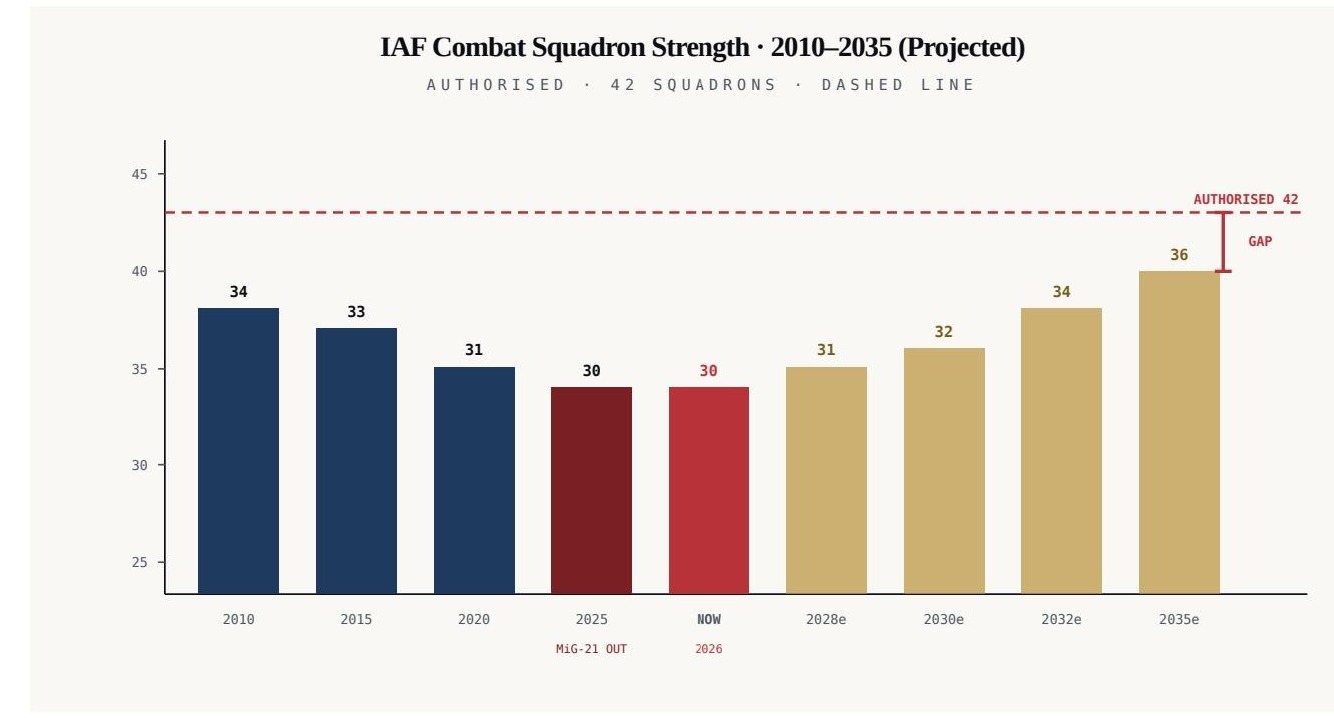
The Programme Timetable — and Why It Cannot Close the Gap
Here is the honest arithmetic of every major Indian fighter programme:
PROGRAMME |
NUMBERS |
STATUS |
REALISTIC SQUADRON SERVICE |
Tejas Mk1A |
83 ordered + 97 follow-on (180 total) |
F404 engine supply chokepoint; HAL ramping to 24/yr by 2027 |
3 new squadrons by 2028–29; full delivery by 2035–36 |
Tejas Mk2 |
6 squadrons committed (~120 aircraft), possible expansion to 12 |
First flight slipped to 2026; GE F414 powered |
Squadron service 2030–31 onwards |
Super Sukhoi upgrade |
84 Su-30MKIs to Virupaksha AESA standard |
₹30,000+ crore programme |
Deliveries 2028–2035 |
MRFA Rafale |
114 4.5-gen aircraft |
Fast-track approved Jan 2026; G2G expected |
Operational squadrons 2030 onwards |
AMCA |
5 prototypes; first batch ~60–80 |
CCS-cleared; PPP model; 5 prototypes from 2026–27 |
First flight 2029–30; squadron service 2034–35 at earliest |
Add it all up. By 2035 — on optimistic assumptions for every programme above — the IAF reaches perhaps 36 squadrons of manned combat aircraft. Still six squadrons short of authorised. The shortfall is not a procurement crisis that can be fixed by signing one more contract. It is a fact of industrial physics.
The Only Available Answer: Unmanned at Scale
If manned aircraft cannot close the gap, what can? The answer is mass through autonomy — and the economic case is unambiguous.
T H E U N I T - C O S T A R I T H M E T I COne Tejas Mk1A versus six CATS WarriorsA Tejas Mk1A costs roughly ₹550 crore per unit (including weapons, training, and infrastructure overhead). A CATS Warrior CCA is estimated at ₹25–30 crore. For every Tejas Mk1A India does not buy, India could field roughly 18 to 22 CCAs — providing perhaps 40–60% of the combat utility of the Tejas across a much larger number of effective combat nodes, with attrition tolerances and production timelines an order of magnitude better.This is not an argument against the Tejas. India needs the manned fleet for its high-end roles. The argument is that the available manned procurement budget cannot generate the mass India needs, and that the marginal rupee of new defence spending generates many times more combat effect when it buys unmanned mass than when it buys an additional manned airframe. |
India has the foundational programmes:
-
-
HAL CATS Warrior — a stealth UCAV designed to team with a two-seat Tejas as the “mothership,” intended as the first line of offence against heavily defended IADS networks
-
DRDO Ghatak — a delta-winged flying-wing stealth UCAV; SWiFT technology demonstrator has flown; full programme expected mid-decade
-
NewSpace Research Abhimanyu — iDEX-supported baseline CCA for the Indian Navy
-
A growing private-sector ecosystem — BEL, Tata Advanced Systems, L&T, Adani Defence, NewSpace, Raphe mPhibr, ideaForge, Sagar Defence, Bharat Forge subsidiaries — competing for CCA, UCAV, and loitering-munition contracts
-
The technology base exists. The industrial base is emerging. What is missing is the scale of order book required to make industry treat this as a serious line of business. The IAF has historically placed orders in tens. It needs to place orders in hundreds — even thousands.
This is not a leap of faith. It is what every peer air force is now doing.
7. Catching the Wave
A single technology and doctrinal wave is breaking simultaneously across every serious air force in the world: the integration of Collaborative Combat Aircraft (CCA), attritable UCAVs, swarms, and Manned–Unmanned Teaming (MUM-T) as the central mechanism of combat mass generation. The wave will define airpower for the next two decades. India must enter it now — alongside the United States, the UK-Italy-Japan consortium, France-Germany-Spain, and China — not after.
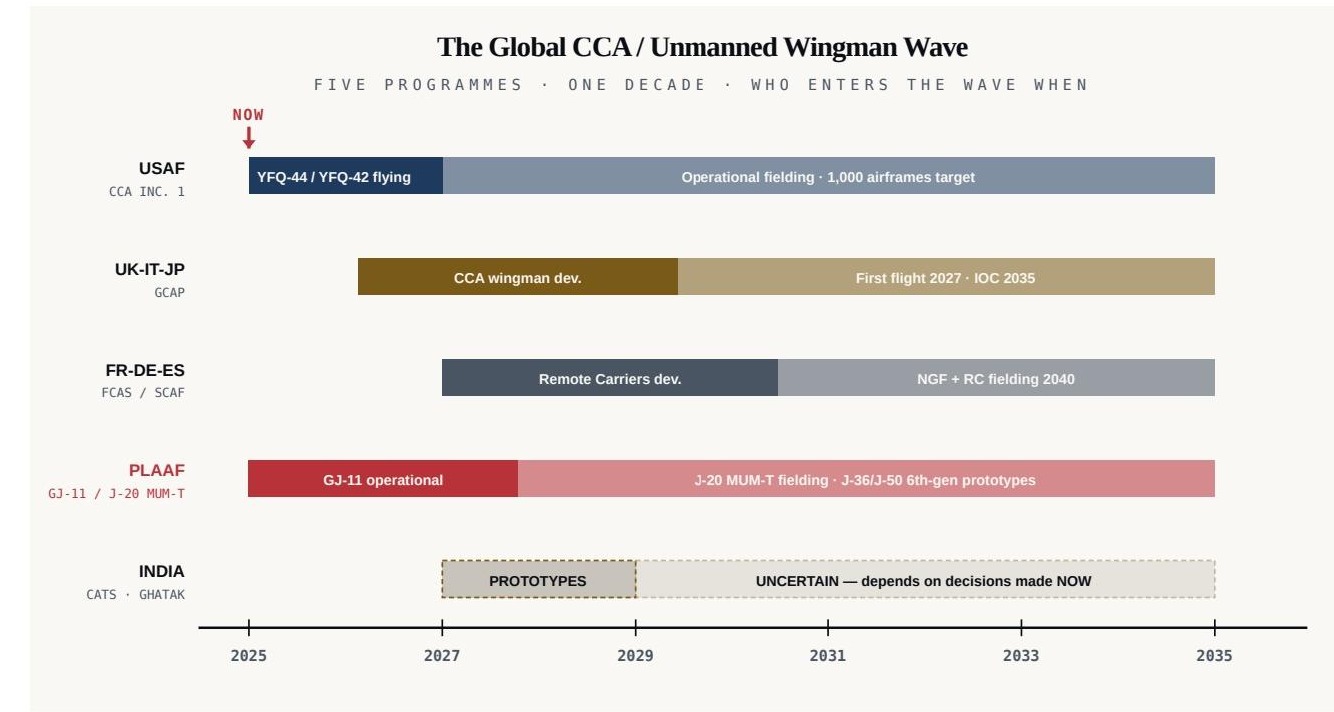
Why “With the World” Matters
It is not enough that India develop its own CCA and UCAV capabilities. India must develop them on the same clock as the leading air forces — for three reasons.
Technology lock-in: Datalink standards, autonomy frameworks, sensor fusion APIs, and weapons integration interfaces are being defined now, programme by programme. Air forces that show up late inherit the standards set by those who arrived early. India should be at the table when the standards are written, not buying compliance later.
Industrial capacity: The aerospace supply chain for autonomous combat aviation — composite airframes, propulsion at the 1,000–5,000 kgf class, mission systems, mesh-network radios, AI-enabled targeting payloads — is being built out globally right now. Indian industry that enters this supply chain early secures positions; industry that enters late competes against established incumbents on price alone.
Doctrinal alignment. If India fields its CCA fleet a decade after partners and adversaries, Indian doctrine will be a derivative of doctrines developed elsewhere. If India fields concurrent capability, Indian doctrine — shaped by Indian geography, Indian adversaries, and Indian operational experience including Op Sindoor — becomes a contribution to global airpower thinking, not a borrowing from it.
C A S E · H O W T H E W A V E H A S A L R E A D Y M O V E DUSAF CCA Increment 1 · Anduril YFQ-44A · General Atomics YFQ-42AIn April 2024, the US Air Force selected two companies — Anduril Industries and General Atomics — to build prototype Collaborative Combat Aircraft under Increment 1 of a phased programme. Both prototypes flew in 2025. A production decision is expected in 2026. The USAF target is approximately 1,000 CCAs paired with around 200 manned NGAD / F-47 airframes. The unit cost target is in the low tens of millions of US dollars — roughly an order of magnitude below an F-35.The strategic logic: the USAF cannot maintain its current force ratio against the PLAAF on F-35 numbers alone. CCAs are how the USAF generates the mass it needs. The same logic applies to India, more so — because India is closer to the threat and has fewer manned platforms to begin with. |
Manned-Unmanned Teaming as the New Combat Identity
MUM-T is not a feature added to manned aircraft. It is a redefinition of what the manned aircraft is for. In a mature MUM-T construct, the manned aircraft is a battle manager — orchestrating a formation of CCAs, UCAVs, and swarms that do the actual penetrating and engaging. The pilot’s hands are still on the controls of his own aircraft. But his mind is on the kill web.
This inverts the fighter-pilot identity that has dominated air forces since the 1950s. The next generation of IAF flight leads will be selected, trained, and equipped less as virtuoso individual operators than as network battle managers. The cockpit ergonomics of AMCA and Tejas Mk2 must be designed for this from day one. The selection pipeline must weight network and sensor management equally with weapons employment. EW literacy must be a baseline competency, not a specialist track.
None of this happens by accident. It happens because of decisions made by the IAF — in doctrine, procurement, training, and culture — over the next thirty-six months.
8. Recommendations
Doctrine work is endless. Action items are finite. What follows is a short, fundable, executable list. Each item is concrete enough to be assigned to an office, given a budget, and tracked against milestones. None requires inventing new technology. All require political will and procurement courage.
01 Update IAF doctrine for the Zone of AmbiguityD O C T R I N E · 1 2 M O N T H SThe 2022 IAF doctrine needs an honest revision in light of Op Sindoor — including a classified annex circulated to squadron level. Put Zone-of-Ambiguity operations at the centre, not in an appendix. Define airpower’s continuing primacy and the conditions under which it must operate. Make denial-resilient operations and training a Tier-1 competency. |
02 Place a 1,000-plus airframe attritable Class-2 UCAV order in the next couple of yearsF O R C E S T R U C T U R E · I N D U S T R I A L · 2 4 M O N T H STreat this with the strategic importance of an MRFA contract. Run a deliberate competition between CATS Warrior, Ghatak, and private-sector entrants. Award production to the top two. This single decision does more to address the squadron gap than any manned-platform procurement available on the same timeline. |
03 Fund three parallel CCA prototype programmesR & D · P P PSchedule risk is too high to bet on a single horse. Fund CATS Warrior, Ghatak, and one new private-sector CCA development in parallel. Treat the cost of redundancy as cheap insurance against the cost of a single-programme delay. |
04 Build a 90-day-sustained-conflict munitions floorI N D U S T R I A L S U R G E · S T O C K P I L EOperation Sindoor revealed thin reserves of stand-off precision weapons. Establish a 90-day floor across BrahMos, Astra Mk-2/3, Spice-2000, SCALP, Crystal Maze, and loitering munitions, including the one-way-attack intelligent Shahed-class. Underwrite industrial surge capacity with paid retainer contracts to manufacturers — capacity, not just product. Peacetime efficiency is wartime fragility. |
05 Stand up an IAF Strategic Communications CellI N F O R M A T I O N W A R · 1 2 M O N T H SA dedicated cell with combat-cam release authority, technical-data clearance, and social-media-speed publishing capability. Operational before the next crisis, not after. This is not a Public Affairs function — it is an operational element of the kill chain. |
06 Accelerate Netra Mk2 AEW&C and the MRTT tenderF O R C E M U L T I P L I E R S · H I G H P R I O R I T YSix AEW&C on A321 platforms; six to eight new tankers. The PL-17-class threat to existing IL-78MKI tankers and Netra Mk1 aircraft is not theoretical. These are the highest-value, lowest-redundancy assets in the IAF’s order of battle. Their loss in the opening hours of a conflict would be catastrophic. Replace them now, on accelerated procurement timelines. |
07 Launch GSAT-7C and urgently address Indian PNT on every combat platformS P A C E · C 4 I S RThe IAF’s reliance on GPS is a strategic vulnerability — China has operational co-orbital ASAT capability and the ability to deny GPS at will. NavIC integration on every combat platform reduces this dependency. GSAT-7C provides dedicated military satellite communications. Quantum-key-distribution should be on the roadmap for the highest-priority C2 backbone, not the wishlist. Given ISRO’s delayed NavIC deployment, HAPS-based PNT solutions should also be explored. |
08 Reform the pilot pipeline for the network eraP E R S O N N E L · T R A I N I N GSelection, training, and career progression must weight network and sensor management equally with weapons employment. Make EW literacy a baseline competency. Build the AMCA and Tejas Mk2 cockpit interfaces for MUM-T orchestration from day one. The next IAF flight lead is a battle manager with hands on the controls of his own aircraft and a fleet of CCAs / UCAVs to command (not control) via a tablet or MFD. |
09 Hardened aircraft shelters and dispersal at every forward baseS U R V I V A B I L I T Y · I N F R A S T R U C T U R EExpand the highway-as-runway programme. Hardened aircraft shelters (HAS) at every forward base. Rapid runway repair capability. Point air defence — Akash NG, QRSAM, CIWS, directed-energy counter-drone — at every operating airfield. Unglamorous, expensive, overdue. The Op Sindoor PAF drone and rocket salvos were a preview, not the worst case. |
10 Take an active position on autonomous lethal systems policyP O L I C Y · D I P L O M A C YIndia is currently a passive participant in the UN GGE on Lethal Autonomous Weapons. As India fields CCAs, UCAVs, and swarms at scale, that posture becomes incoherent. Develop an active Indian position — informed by operational experience and aligned with India’s strategic culture (which has historically erred toward restraint). Help write the rules India will have to live with, rather than inheriting rules written elsewhere. Wholly autonomous Ukrainian drones are already operating deep behind Russian lines without any accountability or ethics control, engaging targets via trained AI classifiers. Chinese- and Turkish-made CCAs, UCAVs and swarms operating under the PAF flag will exhibit similar behaviour in the next war. |
A Note on Sequencing
The ten recommendations are not equally urgent. Recommendations 1, 2, 5, and 6 should be initiated in the next twelve months. Recommendations 3, 4, 7, and 9 should be funded and scoped in the same period, with execution over 24–36 months. Recommendations 8 and 10 are longer-cycle institutional reforms that should begin immediately but mature over five to ten years.
None of the ten requires inventing new technology. None requires foreign vendor approval beyond what India already has. All require political will at Cabinet Committee on Security level, and procurement will at Ministry of Defence level. The window in which these decisions can be made and still take operational effect before the next contingency is approximately 24 months. After that, the wave will have crested elsewhere, and India will be paying premium prices for partial capabilities while watching its adversaries field whole ones.
T H E F I S C A L F R A M EThe investment is large; the alternative is largerImplementing the full ten-point programme would require additional capital outlay in the range of ₹150,000 to ₹200,000 crore over the next decade — roughly 1.5x the current annual IAF capital budget, spread over ten years. The numbers are not small. But they are roughly an order of magnitude smaller than the cost of a serious failure in the next contingency, measured in lost platforms, lost personnel, lost strategic position, and lost deterrent credibility. The expensive option is doing nothing. |
9. Conclusion
Airpower remains the most effective instrument of statecraft a modern nation possesses. The Zone of Ambiguity makes that truth more urgent, not less.
What replaces the airpower implementation methodology of the past is a three-faced beast. Politically, the deliberate cultivation of uncertainty by adversaries who know India’s choices are constrained. Operationally, a contested airspace where neither side owns the sky but both can deny it. Informationally, a global narrative war that begins before the first missile is in the air and continues long after the last sortie has landed.
Operation Sindoor — 88 hours, a Chinese-pattern kill web employed against India through a Pakistani interface, an Indian S-400 reaching 300 kilometres to redraw the air picture, BrahMos missiles cratering Sargodha and finding an Erieye in its hangar at Bholari, Pakistan requesting ceasefire on the morning of 10 May — was the first encounter. There will be others. The next one will be against a more confident, more networked, more capable adversary with an unmanned backbone.
The IAF that flew on the night of 6 May 2025 was a Cold War air force adapting fast. The IAF that flew on the night of 10 May 2025 had already begun the adaptation. The IAF that flies in 2030 must be a different kind of force entirely — an ecosystem, not a collection of platforms. Networks, swarms, kill webs, dispersed bases, attritable mass, and stand-off precision. Manned aircraft as battle managers at the edge, unmanned systems at the tactical front, all conducted by an air force that thinks in minutes of dominance rather than air superiority.
Three Conclusions to Carry Forward
One — airpower still wins the strategic moment. Op Sindoor reaffirmed it. Nothing else in India’s national-power toolkit delivers strategic effect on the airpower clock with the airpower precision and the airpower reversibility. The Zone of Ambiguity raises the cost of getting airpower wrong. It does not displace airpower from the centre of Indian strategic options. Build the IAF accordingly.
Two — the structural squadron gap is real and will not close. Tejas Mk1A, Tejas Mk2, MRFA Rafale, Super Sukhoi, AMCA — none of them, individually or in combination, will bring the IAF to 42 squadrons on any realistic timeline. The arithmetic does not work. The only available answer is mass through autonomy — CCAs, UCAVs, swarms, loitering munitions, MUM-T — ingested at industrial scale over the next decade. This is not optional. It is the only option.
Three — the wave is breaking now. Every serious air force in the world is committing to the unmanned-wingman / CCA / MUM-T technology cycle this decade. The USAF, the UK-Italy-Japan consortium, France-Germany-Spain, Turkey and China are all at varying stages of the same wave. India must enter it alongside them — not five years late. The decisions that determine whether India catches the wave or watches it from the beach are being made right now, in this fiscal cycle, in this budget cycle, in this procurement cycle.
The sky has stopped being a canvas. It has become a contest. The side that masters ambiguity instead of trying to eliminate it — that buys its minutes, denies the adversary his, manages the information environment, and embraces unmanned mass at scale — will hold the initiative for the decade ahead.
The lesson of the May 2025 air war is not that India won. It is that India won the second half by playing a different game than the first half. The IAF that wins the next conflict will be the one that plays the second-half game from the first minute.
That is the New Normal.
S O U R C E N O T EOperational details regarding Operation Sindoor, the 300-kilometre S-400 engagement, the Bholari hangar strike, PL-15 family characteristics, AMCA and Tejas Mk1A timelines, PLAAF and PAF order-of-battle figures, and Project Kusha are drawn from open-source reporting and on-the-record statements by IAF leadership through May 2026, including the Centre for Military History and Perspective Studies (Pully, Switzerland) Sindoor study; analyses by the Royal United Services Institute, the Stimson Center “Four Days in May” report, the Carnegie Endowment for International Peace, and the Indian and international defence press. Engagement-range figures, order-of-battle counts, and capability claims remain subject to ongoing technical debate. |
*****
CLICK TO VIEW THE PDF
(Disclaimer: The views and opinions expressed in this article are those of the author and do not necessarily reflect the position of the Centre for Aerospace Power and Strategic Studies [CAPSS])