
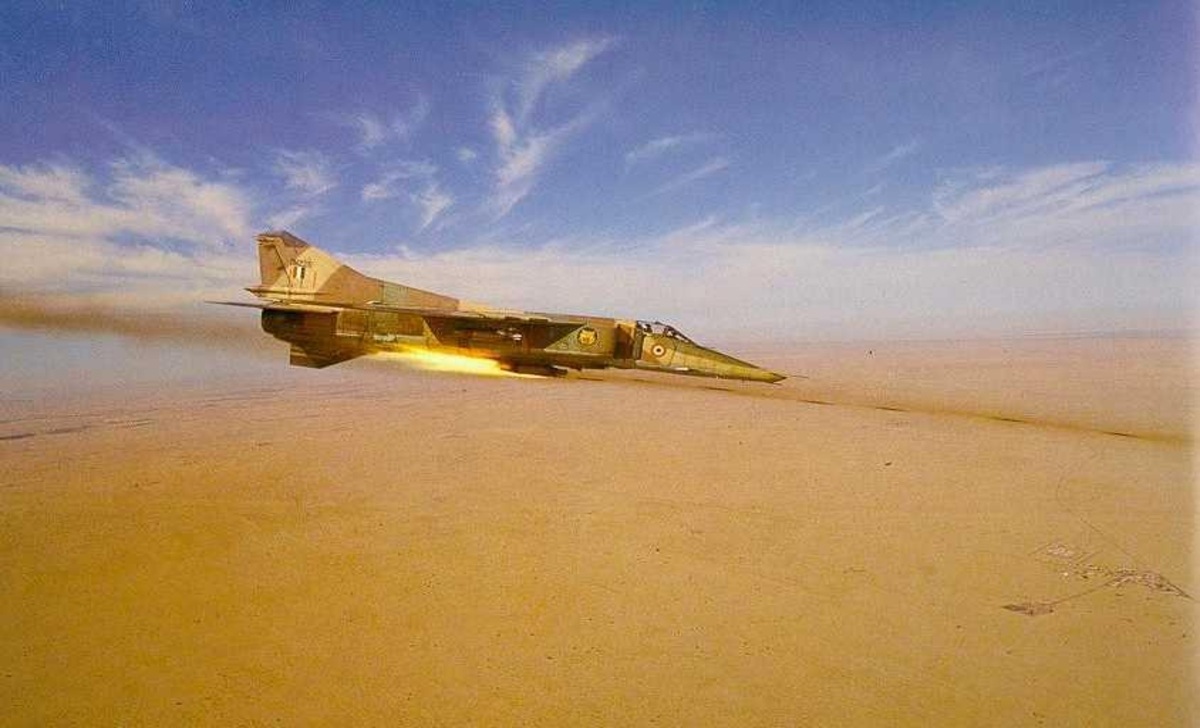
Author: Mr Arjun Prakash Iyer and Mr Shwetabh Singh, Research Scholar, Unni Kartha Chair of Excellence
Keywords: IAF MiG-23BN, RSBN-6, PRMG, AN/ALE-44 CMDS, Mk.10 IFF, Tarang RWR, Operation Safed Sagar
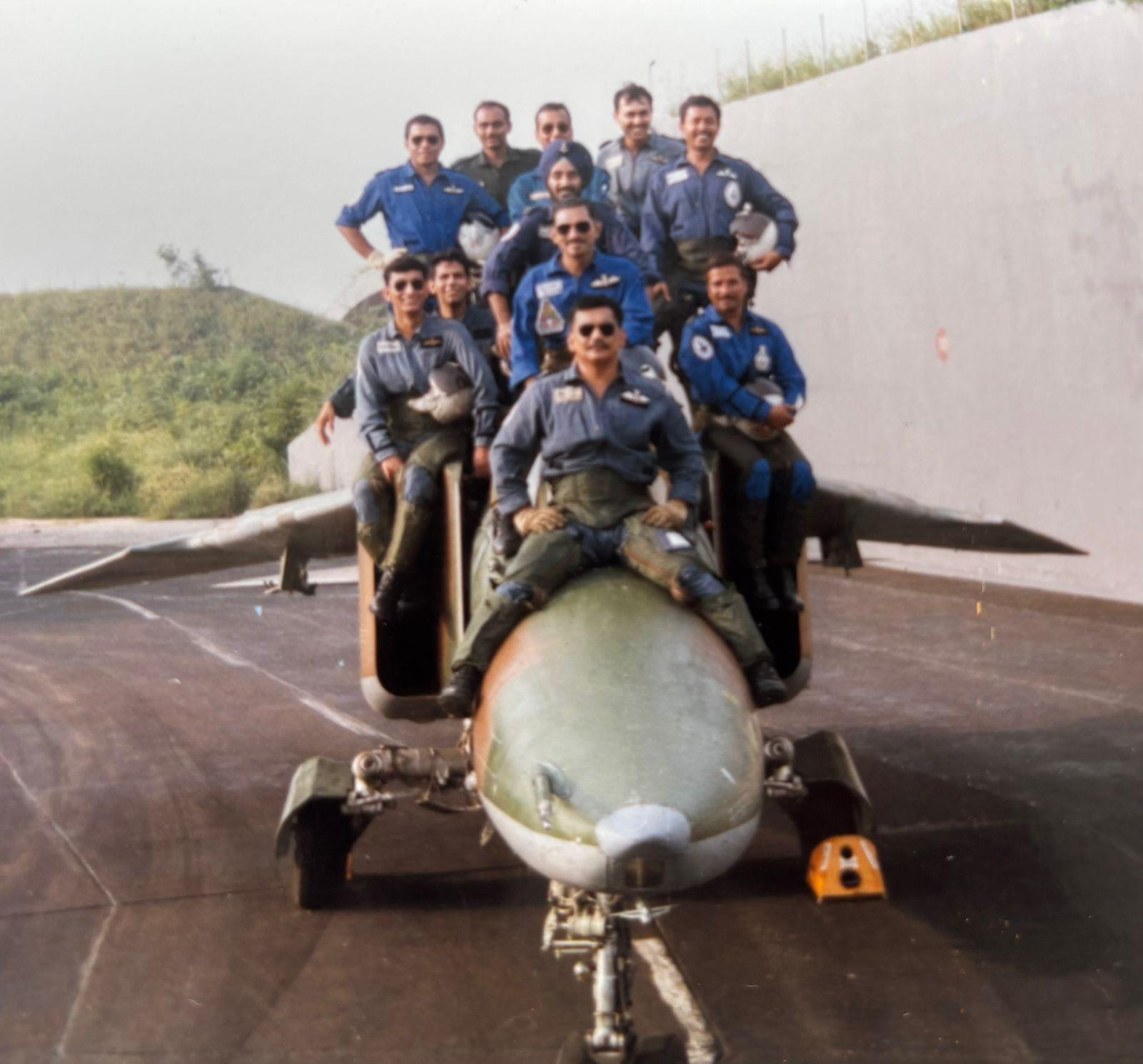
In our previous interview segment with Air Commodore Ashit Mehta (Retd), we discussed the role of the MiG-23BN in the Indian Air Force (IAF) and what life was like in a ground attack Squadron of the IAF. In this segment, we will take a dive into how Close Air Support (CAS) now known as Battlefield Air Strike (BAS) and Air Interdiction (AI) work, and how this was put to test in a rather unorthodox situation–the Kargil Conflict, during which principles of CAS, evolved over the years for flat terrain, were modified and used successfully in mountainous terrain, for the first time in the history of military aviation. Air Commodore Ashit Mehta was at the forefront of this adaptation, as he was the Commanding Officer (CO) of No.221 Squadron ‘Valiants,’ flying the MiG-23BN, and also took part in Operation Safed Sagar.
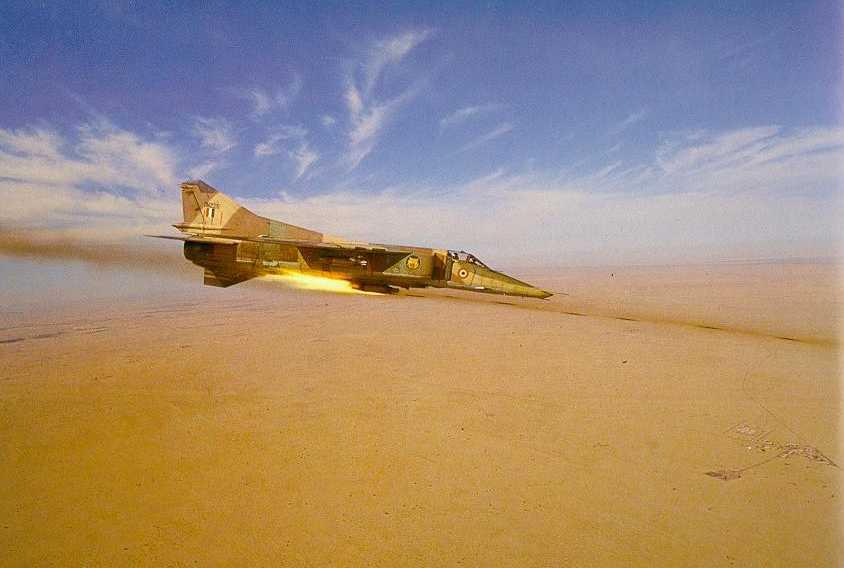
Image Credits: www.Bharat-Rakshak.com
Section 1: Tactics and Training
How does the IAF keep its pilots adequately trained in CAS? How is training for firing/dropping weapons during peacetime?
As part of our flight training and maintenance of flying currency, all operational pilots need to practice OAS (Operational Air Support) flying. The OAS is split into CAS (Close Air Support) and AI (Air Interdiction). The purpose of CAS is to support our Army in achieving their offensive or defensive objectives. IAF is requested for CAS support when the ground forces face any major fire/offensive action from the enemy that is beyond their capability to tackle/ engage. IAF, through a planned and coordinated system, provides these support missions. CAS is always under the real-time guidance and coordination of a FAC (Forward Air Controller). Whereas AI are missions flown to attack the assets/ infrastructure/lines of communication or back support of the enemy ground forces, with the aim of cutting off the replenishment of supplies, weapons, and forces to the enemy forces in the Tactical Battle Area (TBA). For example, it could be an attack on a bridge/ railway junction, or a convoy that is likely to support the enemy forces engaged with our ground forces.
The training for CAS and AI is conducted almost every quarter through a proper process involving command-level planners, Army liaison officers, joint operational unit personnel, and IAF fighter squadron pilots. This is essential training and needs very precise and detailed planning, as it is a high-risk exercise and the usual Q&As for practice firing are not available. During the CAS exercise, an FAC guides the Fighters to the target through a planned and practiced process. In the case of AI missions, they also need to be very well planned and executed.
These exercises are of high risk, as pilots are guided towards ground targets that are at times mobile. This makes it very difficult for fighter pilots to visually acquire targets because of their small size and the high speeds of the aircraft. At times, when the targets are visually picked up, the aircraft is too close to the target or not aligned with the target and has to be manoeuvred. This at times results in engagement ranges being too short and the pull-out height being too low to pull out safely. Pilots are normally used to carrying out these attacks over a well-developed, defined, and integrated air-to-ground firing range, like Pokharan in Rajasthan, Sarmat in Gujarat, and SK in Punjab. Here, each dive or level attack is closely monitored under the expert eyes of the Range Safety Officer (RSO) and their team.
For weapons training, the MiG-23BN often carried the CBLS (Carrier Bomb Light Stores) pod, loaded with 3 kg and/or 25 Lb practice bombs. This allows pilots to rehearse attack profiles without expending operational/real ordnance, which is very expensive. These light bombs have been developed to exhibit ballistics exactly like a live bomb, in terms of their forward throw and trajectory. A 3 kg bomb behaves like a set of Retarder Bombs (those which can be dropped from low altitude in level flight), and they have drag chutes to ensure that the bomb will decelerate and explode well after the fighter has gone past the target in terms of safety.
Since you mentioned the potential risks involved in flying CAS missions, could you explain what a standard CAS mission looks like?
CAS is a type of mission where you are striking enemy targets that are situated very close to friendly forces, and that is how the term ‘Close Air Support’ originated. To enhance interoperability between various forces, in this case, the Indian Army and the IAF, there is something called the Joint Operations Centre (JOC) that coordinates such operations. In the IAF’s case, the MiG-23BNs and MiG-27s were designated for CAS missions, and they would be on alert to meet any such requirements. We, of course, had the SEPECAT (Société Européenne de Production de l’avion École de Combat et d’Appui Tactique) Jaguar, but they were specialised in striking high-value and strategic targets deep inside enemy territory, so they were rarely involved in CAS.
The distance between our own troops and the enemy’s is marked by an imaginary Forward Line of Own Troops (FLOT). When we are briefed for CAS missions, we are given a rough idea of where our own troops are, where the enemy is, what their potential objective is, and where we expect them to intrude on our territory/clash with our ground troops. In most circumstances, we try to conduct CAS and Air Interdiction (AI) simultaneously. For now, let’s just focus on CAS.
The entire principle of CAS is to support our own ground forces in their tasks of undertaking offensive or defensive action. Whenever our Army faces a major challenge from the enemy that is beyond our Army’s capabilities or range, they will request a CAS mission. CAS is undertaken to attack enemy troops and their war-waging capabilities in terms of their tanks/guns/other offensive equipment/communications, etc.
CAS and AI missions are also dangerous, as one is operating very much within the firing range of MANPADS (Man-Portable Air Defence Systems) and anti-aircraft gun systems. MANPADS and heavy machine guns have become more common, like what we saw during the Kargil Conflict, but the point is to still retain a certain degree of surprise when attacking enemy troops. The aim is not just to strike the advancing enemy, but to minimise their effectiveness by giving them very little time to react. Another way this is done is by making sure that the entry and exit points of your attack run are kept as unpredictable as possible, so as to keep the enemy air defences confused and delay their detection of the striking aircraft.
As we had discussed earlier, the various flying periods determined by bird activity also influence our attack patterns. During green periods, it is easy to fly in low and perform what we call a Lay Down Attack (LDA), wherein the aircraft flies over the target and drops the bombs in level flight, from a distance from the target so that the bomb glides accurately and explodes close to/on the target. During the red period, we often use dive attacks so that we don’t come too close to the ground, and risk getting hit by birds, MANPADS, and anti-aircraft guns. However, the attack patterns aren’t just determined by bird activity, but also by nature, numbers, and size of the targets being attacked. Of course, CAS tactics have changed drastically over the past 25 years, with the advent of precision-guided munitions and other means of standoff capability.
CAS is achieved through collaboration between the Army and the Air Force, so we have an operations centre set up at the air base, where a Ground Liaison Officer (GLO) representing the Army is posted. Once a request is received from the Army, they would relay the coordinates and other specifics of the area that is to be struck. Similarly, there is also an Air Force liaison who is attached to the forward location with the Army to coordinate CAS. Apart from the liaisons themselves, there is a system called Forward Air Controller (FAC), wherein a pilot, usually a junior pilot who is trained to coordinate airstrikes, is deputed to the forward unit that is expected to witness an immediate threat from the enemy, generally at the brigade level.
Now, based on the target information received, in terms of the latitude and longitude of the enemy’s position/movements, we have to decide something called a contact point – a predetermined, prominent feature or a landmark from where the FAC would guide the strike. So, once the aircraft is fueled and loaded, we take off and head to the contact point.
One may ask, “Why do we need a contact point when we know the location of the enemy?” In reality, when the GLO receives the coordinates, it is not a fixed point or a location, but rather a box area between a few coordinates where the enemy is present. In most cases, the enemy is mobile, meaning they are in motion somewhere within that particular area. So, the updated location of the target is only known to the FAC. So that is why a contact point is established beforehand, so that the FAC can use that position relative to guide the attacking aircraft to the moving target.
When we take off and fly towards the contact point, we constantly keep a watch on our Estimated Time of Arrival (ETA) over the landmark. About one minute to the contact point, we switch over to the Radio Frequency (RF) on which the FAC guides the mission, and the FAC says something like “set course to 030 over contact point, speed 840 kmph, fly for 1 minute 30 seconds.” Very little information is provided initially to ensure that we maintain surprise. As soon as we near the Contact Point (CP), all members in our formation set their clocks to the ready position, and as and when we pass over the Contact Point, we start our watches, and in this case, it is bank 030. As we turn, we also tell the FAC to start their clock, so that the stop-clocks of both the FAC and ours are synchronised.
The FAC guides you through the run (by giving a running commentary) to the target, with something like “Maintain 450 knots and fly for 1 minute 30 seconds… at 30 seconds on your track, you will notice a culvert… 45 seconds on the right side of your track you will notice a cluster of white buildings or a Gurudwara, with a lake beside it… 1 minute and 10 seconds, you will see a railway station…” and so on. The FAC is basically guiding you to the target using other landmarks along the way between the Contact Point and the target, to ensure that you don’t go astray. Initially, very little information is given; in this case, it’s just “set course to 030 degrees, speed 840 kmph, fly for 1 minute 30 seconds.”
At that speed, you’re travelling close to 14 km a minute at ground speed, and they know that in 1 minute and 30 seconds, you would have covered 21 km. The FAC has a map with them to guide you. All the pilot does is keep acknowledging what they see based on the commentary from the FAC. Your navigation ends at the CP. You are now under the direct control of the FAC. Once you are near the target, the FAC will now describe the target to you. “At 1 ’30” when you pull up, you will see on your right, a column of six tanks in close proximity, trailing dust and smoke. Confirm contact.” Now you know that the target is somewhere 7 km up ahead, trailing smoke and dust, and you will start looking out for it.
And once you call “Contact”, the FAC will remain silent. Now the communication is only between you and your formation members. From here, you will guide your No.2 (if in a two-aircraft formation) and confirm whether they have spotted the target as well, “Contact, six tanks trailing smoke, 11 o’clock,” and make sure that they also have the same visuals as you.
In case of a live drop/fire, there will be a small reminder from the FAC about ‘Switches’, meaning to make sure your weapon switches are ON (i.e., armed) to ensure the bombs/rockets and guns are ready to fire, and then you roll in to attack. The pattern and mode for attack, as stated earlier, depend on the type of target. You could do LDAs or dive attacks, conduct passes from different directions, etc., but usually, there is a 30-second gap between each aircraft conducting its pass, as it takes approximately that much time for the bomb to explode and the dust/debris to settle. Not every time the target is an enemy tank/vehicle column; it could be bunkers, machine gun/mortar nests, as they were in Kargil, or an artillery battery setup, or a building… attack patterns vary by target. The most crucial factor is maintaining visual contact with the target. Mostly, you execute what is known as a “Pull Up Attack” – when the target is well hidden or not visible while flying low, you pull up to a certain height to easily acquire the target and also be able to put in a dive attack before you reach the target. The idea is to look out for the enemy as you climb, so that you can work on a suitable attack pattern as you roll in.
In this example, that would be around 4 km to the target area. When your formation executes a sharp pull-up, say a 90-degree pull-up attack, you need to be able to correctly spot the target to execute a successful attack. Ideally, in a pull up attack, the target should be either at your 3 o’clock or 9 o’clock, but if you fail to spot them at the right time – your whole attack pattern would be disturbed, meaning by the time you would be within the correct weapon release envelope, either you would be too steep or shallow to dive attack or still not aligned, or your speed would be too fast or too slow.
If you come in too fast and make a very steep dive, in many cases, the aircraft becomes difficult to control as the speed may be too high; in that case, you need to start pulling out early, otherwise, the aircraft’s inertia will cause it to come too close to the ground or crash into the ground. And mind it, unlike in a range exercise, you don’t have an RSO guiding your attack here. The pilot’s awareness and judgment are critical. I’ve seen times where inexperienced pilots just managed to pull out of a dive barely 50 metres above the ground… It was an absolute miracle that the aircraft didn’t crash and become a fireball.
You mentioned how CAS and AI are conducted simultaneously in combat. Could you explain the difference between CAS and AI?
When we talk about CAS, it is either the enemy advancing onto our forces or our own ground forces advancing on the enemy, which means we have a temporary, or if I must say so, a rather rudimentary understanding of the FLOT. In a CAS mission, our targets are mostly located close to the FLOT, which immediately poses a threat to friendly ground forces, as we could erroneously target friendly forces due to their close proximity to the enemy, resulting in fratricide. Now, as much as it is important to prevent the enemy from striking our forces, we also need to ensure that the enemy does not have the capability to further their own operational plans or get backup support to sustain their attack. So, we conduct Air Interdiction (AI).
During AI, we strike targets that are within enemy territory, slightly beyond the front lines, to cut off their frontline troops from their rear command or reinforcements. Targets during AI include important communication infrastructures, such as bridges, railroads, and highway nodes; identified supply depots, launching areas, and middle-level command and control centres such as their brigade headquarters, and repair facilities. Sometimes, these also include their industrial sites, like ordnance dumps, Bulk Petroleum Installations (BPIs), and chemical and industrial manufacturing factories. When AI and CAS operations are executed simultaneously, we ensure that their forward troops are cut off from their reinforcements and their war plans are disrupted.
If we take this a step further and strike deeper into enemy territory, such as their key Command and Control sites and key air bases, it becomes Deep Penetration Strikes (DPS). The IAF uses the SEPECAT Jaguar as the dedicated platform for this role. But the MiG-23s and MiG-27s could strike the enemy’s forward air bases if the need arises.
Amidst all this, there is also something called Post-Battle Damage Assessment (P-BDA) that is conducted after every mission. This is done to qualitatively assess whether the said mission has fully achieved its objectives or not, and whether there is a need to strike the same target again. Of late, this has been mostly done using satellites with the resolution to even capture a person reading a newspaper while sitting on the ground. But back in the 1980s, 1990s, and early 2000s, whenever such a strike went through, usually the last aircraft in the last formation was typically expected to note down the extent of damage done to the target. This was done using multiple methods–Fighter Reconnaissance, where the pilot visually makes note of the extent of damage based on visual cues, or uses a handheld camera to click photos, and later, when adequate technology became available, we started using Tactical Photo Reconnaissance pods. Nowadays, BDA is being done by drones or Intelligence, Surveillance, and Reconnaissance (ISR) satellites.
Based on the observations or photographs, our next mission would be planned. Immediate assessment was required, especially if it was a high-value or a strategic target, because striking it again would put our own aircraft and men into similar, if not more, danger (considering that the enemy would already know that you might come back again to strike, they would be better prepared the next time). Based on the assessment, we would decide how many aircraft and what kind of ordnance to use in the follow-up strikes.
So, we had multiple types of pods for that. One was called the Vinten 91 Long-Range Oblique Photographic (LOROP), which was mostly used on the Jaguar. Then we had Pan-Cameras, which could pan the entire horizon left to right. Then we had the Infra-Red Line Scanning pod (IRLS), which initially came with the Jaguar but was later integrated onto the MiG-23BN. For specialist reconnaissance, we, of course, had the English Electric Canberra PR.57/PR.67, and later we even got the MiG-25RBK, which was mostly used for intelligence gathering and survey flights.
Section 2: Aircraft Subsystems and Ordnance
As we know, the MiG-23BN and the MiG-27ML could carry a plethora of ordnance loadouts. But how do you decide which type of ordnance is to be used against what kind of targets?
In air warfare parlance, this decision-making is known as “Weapon to Target Matching,” and not all targets can be hit with the weapon. It all depends on a number of factors:
What kind of target are we flying against (buildings, air bases, radar sites, etc.)? Does the target require a specific type of attack pattern (such as dive attack, LDA, or Medium Altitude Level Release, also known as MALR, or Toss Bombing)? What control do we have over the airspace? Is it a favourable or an unfavourable situation? Is the target guarded by air defences? If so, what type (Anti-Aircraft Artillery, MANPADS, or full-scale Surface to Air Missile sites, and if enough intel exists, then how many of them and what types are they? What inventory does the squadron have? Is there an adequate supply of the required weapon?
An example of the last requirement is that, suppose you have non-retarded bombs. They have to be released in a dive. Sometimes your squadron may only have parachute retarded bombs. So, you have to drop it at a low level. However, as bright as we are in the IAF, we have trained ourselves such that if the need arises, we could carry out attacks with available weapons, and improvise on our tactics to ensure that even if we don’t have a full gun to target matching, we could still conduct attacks and achieve the desired results. So, there are a number of permutations and combinations we think about when you decide on the mode of attack, weapon to launch, and the kind of attack that you are going to carry out.
Since you mentioned dumb/gravity bombs, could you explain the common bombing methods?
Even during combat operations, planning is done in such a way that the safety of the pilot and the aircraft is prioritised. The various bombing tactics and types of ordnance developed over the years hinge on that important aspect.
With retarded bombs, the release is carried out at a low level. Since these bombs are fitted with a tail chute that slows their descent, it allows the aircraft to clear the target area before the ordnance detonates. In a typical retarded bomb, there is a 10 to 15 second delay between the bomb separating from the aircraft and it detonating. By that time, the attacking aircraft would have already been 10 to 15 km away, with a safe separation distance from the blast.
Toss bombing was originally conceptualised for nuclear bombs, where maximum separation from the target is essential due to the presence of enemy air defence at/near the target, and the size of the blast and the resultant mushroom cloud. In this method, the aircraft approaches at a low level and begins a sharp pull-up, roughly 10 to 15 km from the target, depending on the weapon carried. The bomb is then released during this upward climb, travelling in a ballistic arc before dropping vertically onto the target. By the time the detonation occurs, the aircraft is already at a 14-15,000 ft altitude and flying away from the target, because the mushroom cloud is expected to be so big that you would not be able to pull out if you are at a low level or in a dive when the detonation happens, and you want to remain outside the weapon launch range of the enemy air defence.
In case of dive bombing, the pilot would dive from a higher altitude, release the bomb, and then pull up, ensuring that he (and the aircraft) is above the blast ‘mushroom’ of the explosion. Sometimes, an adequate fuse setting is also used to cause the desired impact, such as delay fuses or penetration fuses (wherein the weapon would only explode after it has burrowed itself into a structure). Ultimately, the mode of attack is chosen based on safety requirements, target characteristics, and weapon-to-target matching, which is a learned science in itself. You can’t teach these things, and they are acquired through the pilot’s own experience and can’t be mastered overnight. Developing the judgement to select the right attack mode and execute it flawlessly takes years, if not decades, of operational flying. Only with such experience can a pilot move into planning and strategic leadership roles, rewriting tactics and strategies to suit both the lessons learned in combat and the capabilities of modern equipment.
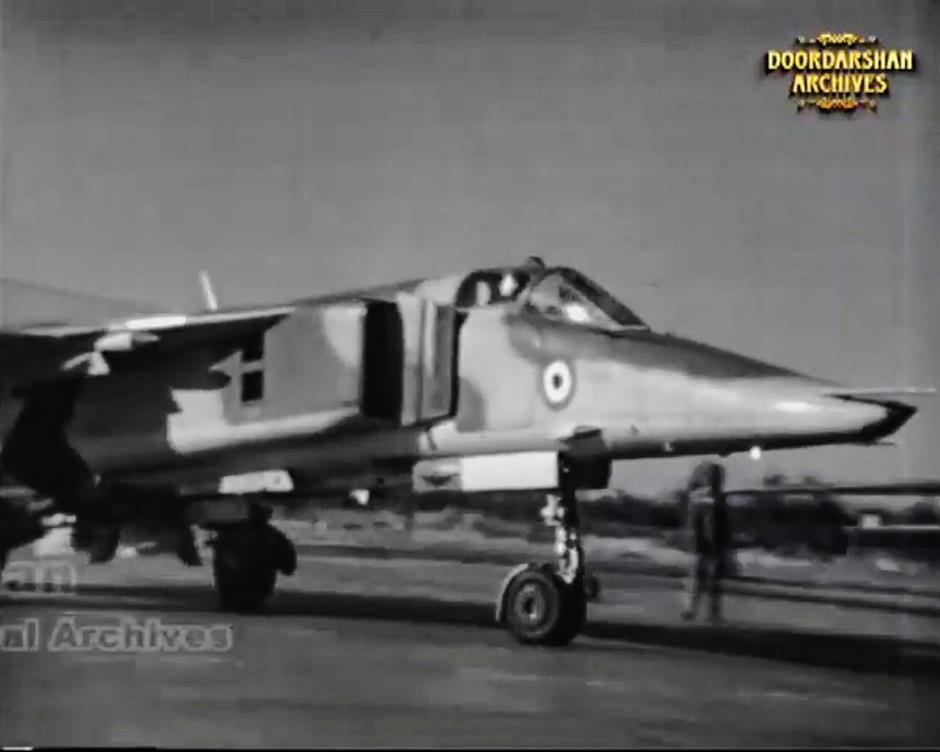
Image Credits: Doordarshan
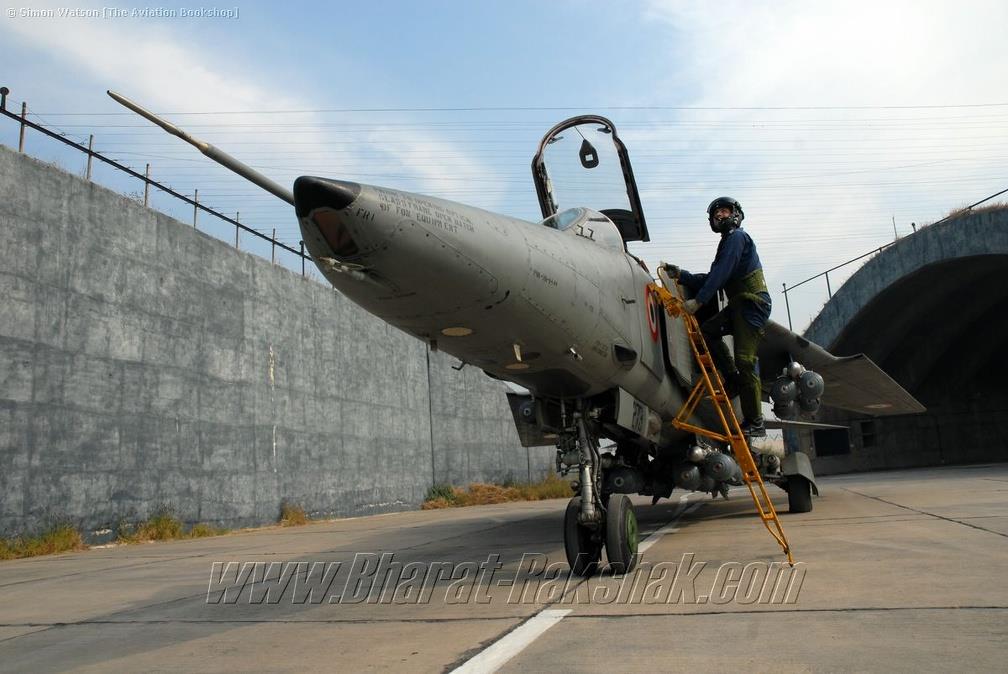
Now, let us discuss what I consider to be an interesting aspect of the MiG-23BN – the Identification Friend or Foe (IFF) System. Could you tell us a bit about this system?
Initially, our MiG-23BNs did not carry the Soviet IFF. We deliberately choose not to buy IFFs from the Soviets with the planes, because that would have meant we would have to procure the additional required network of associated ground equipment, which would have been costly and complex to integrate. Furthermore, the IAF at that time operated a plethora of aircraft types, ranging from British to French to Soviet/Russian origin. In that case, identifying friend or foe using a standardised system becomes very difficult. Each of the aforementioned countries has its own standardised IFF packages. If India were to purchase that many systems, it would become an enormous expense to maintain, a logistical nightmare and possibly a technical one too. So, we decided to develop our own IFF system, which we have standardised on all our aircraft.
The critical module inside an IFF transponder is the frequency coder, which defines and maintains the specific band for identifying friendly aircraft. Bharat Electronics Limited (BEL) Ghaziabad designed and built this module, and successfully integrated it across all the IAF combat aircraft, giving us a standard, service-wide system. On the MiG-23BN, flight trials for the indigenous IFF began at the Aircraft & Systems Testing Establishment (ASTE) around 1985–86. There were several phases of testing, and one early evaluation was interrupted when a bird strike caused an engine flameout, forcing the pilot to eject. Much later, in 1991–92, I was tasked with conducting the final clearance trials.
Let us get to the sighting systems. The Soviet MiG-23BN had the PrNK-23/Sokol 23 (ПрНК-23 «Сокол») [with a Fon (фон) laser rangefinder] navigation and sighting system, while the MiG-27 variant featured the PrNK-44L (ПрНК-44Л) with a Klyon-PS (Клён-ПМ) laser rangefinder and marked-target seeker. Could you please comment on these systems and their performance?
The Sokol-23 was a fairly basic system, a sight with a camera, and I am speaking from over 30 years of memory here. In those days, pilots were primarily trained in manual sighting techniques. For example, if you were in a 30-degree dive, you’d apply the “1 in 60” rule to calculate your release point. We learned these techniques early in our careers, and they became second nature to us. Using these calculations, we would set the required depression on the gunsight, then fire the gun, rockets, or release bombs manually, based on the specific weapon being fired. Sokol-23 had an automatic mode called the “gyro” mode, which could compute a release solution based on input parameters, but the gyros of that period weren’t very efficient; there was a lag, and if you relied entirely on them, due to gyro drift and lag, the errors could be significant while in mission. Still, it was a simple, robust sight, and over time, with experience, we refined our techniques enough to achieve excellent results with it.
As technology improved over time, especially on the MiG-27ML. I personally used the GPS-aided INS more than the Klyon LRMTS on the MiG-27ML. The PrNK-44L navigation and attack system could take up to 12 input parameters. The Russians had refined their design compared to the MiG-23BN. We also had at some point a GPS-aided INS (GPS-aided Inertial Navigation System) from Honeywell, which would deliver near-perfect results every time. So, we used automatic bombing in the MiG-27MLs but not in the MiG-23BN.
Could you talk more about the IKV (ИКВ, pronounced as ‘Ikava’), the gyro-stabilised Inertial Navigation System (INS) on the MiG-27? I have heard multiple instances about how they were prone to deviate if interfered with on the ground, while warming up/calibrating. Was it also the same on the MiG-23BN’s KN-23 Doppler navigation system?
The IKV system required a precise pre-flight alignment procedure, 15 minutes for coarse alignment and 15 minutes for final alignment. Frankly, it was a very sensitive system, and because of that, it wasn’t a very reliable system. It would drift over time and sometimes put us 5 to 7 km away from the target. In case there was any disturbance to the aircraft during the calibration process, the deviation in flight would be even greater.
On the MiG-23BN, we had an inertial system called Ikava (ИКВ). Before the flight, we would turn on the ‘Ikava’. It means to start the alignment, and during that time, the aircraft had to remain completely undisturbed, even by the ground crew. Once the alignment was complete, it would be in ‘operations’ mode, and only then would people (including pilots) be allowed to touch the aircraft. This is when the gyros and accelerometers would be calibrating, and even the slightest movement would throw off the calibration. The ground crew took this very seriously. The airman assigned to start ИКВ wouldn’t even rest a hand on the ladder touching the aircraft. He would lean forward without contact, flip the switch to “Operations,” and only then touch the aircraft once alignment was complete. Even with such precautions, the system itself used to drift, and if you relied purely on its position fixes, the accuracy was only about 50 to 70 per cent. Additionally, you would only be able to add about six or seven waypoints. For that reason, we primarily navigated using manual map reading and dead reckoning.
While talking about navigation, let’s focus on other major navigational aids used by the Floggers, in the form of the Radio Engineering System of Short-Range Navigation (RSBN)-6S and PRMG (ПРМГ, often pronounced ‘Paramga’). We have been told that we have a few PRMG ground systems as used by the MiG-23MF pilots. Could you share your experiences with RSBN and PRMG and the MiG-23BN, and how they were used in the IAF?
I respect the RSBN as a system. When it worked, it was quite reliable. In many ways, it was similar to a modern-day VOR (VHF Omnidirectional Range) station, giving both range and bearing to a ground station. A typical procedure would be to fly an “RSBN approach” by navigating to a particular radial over the beacon, then manoeuvring to feed into PRMG (which was the ILS equivalent) for the final approach. Once directly overhead the RSBN beacon, it would try to rotate. That meant you were on top of it. From there, you stayed on course, but then deviated slightly on the approach path. Then you approached, and by then the PRMG would pick you up and provide you with the requisite vertical and horizontal inputs for landing on the runway.
The RSBN was certainly more dependable than the MiG-23BN’s own inertial navigation system, and we trusted it for non-combat navigation, especially when returning to base in poor weather or at night. The use of PRMG was limited to the three MiG-23 bases: Jodhpur, Halwara, and Adampur.
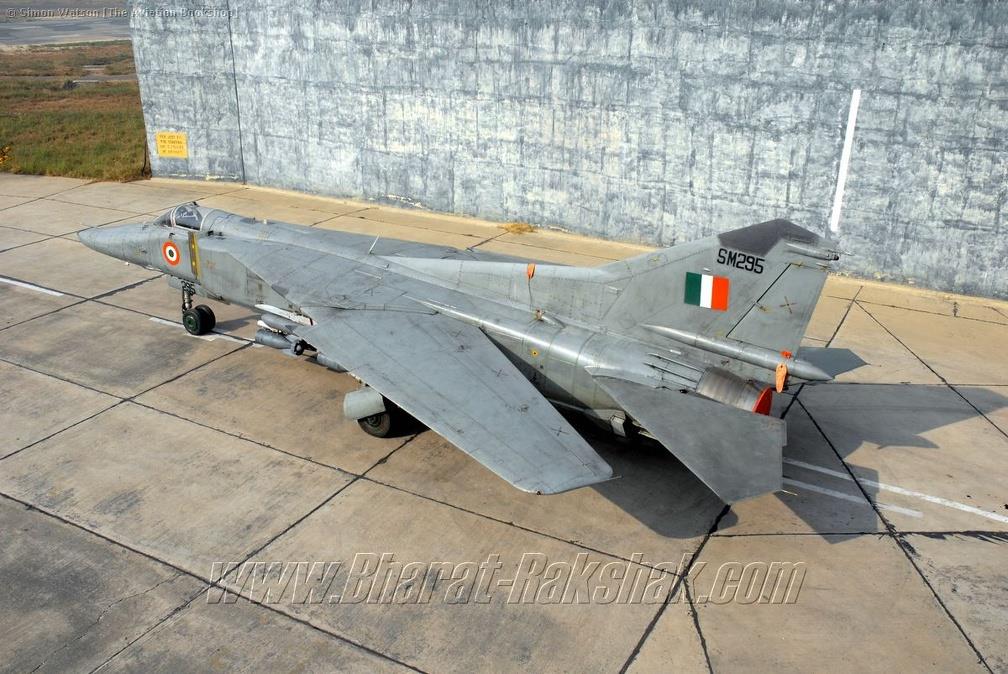
Image Credits: www.Bharat-Rakshak.com
Let us close this section with the Radar Warning Receiver (RWR). Could you comment on the RWR’s performance on the MiG-23BN?
The original Soviet one was of little utility to us. The threat library on it was entirely geared towards American threats and primarily western aircrafts, which didn’t translate very well for us, due to both our and Pakistan Air Force (PAF) fleet composition having types from multiple different countries (the PAF having a mix of American, French, and Chinese aircraft of partly Soviet origins). We integrated DRDO’s (Defence Research and Development Organisation) Tarang RWR on our Floggers as it could be programmed to our expected threats.
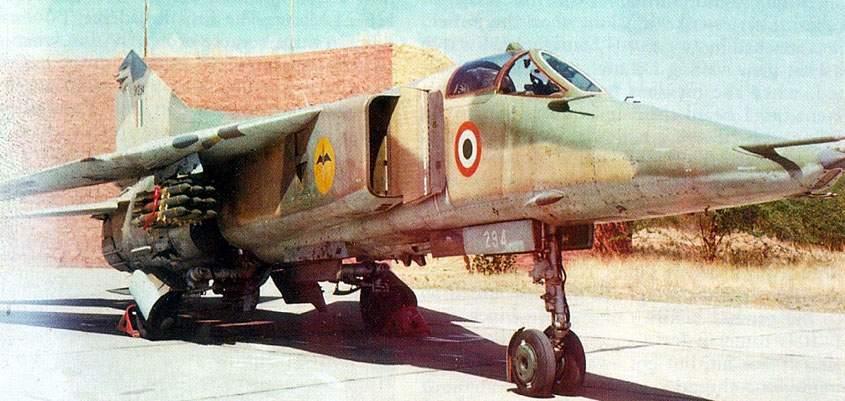
Shifting gears, let us look at the claws of the aircraft, the weapons. There is a famous picture of a MiG-23BN, integrated with the French BAP-100 Runway Denial Weapon (RDW). How was the BAP-100 integrated on the MIG-23BN, and, you know, how was it compatible with the aircraft, and what were the results?
The BAP-100 was a new technology in the 1980s, an Anti-Runway bomb made up of smaller rocket-type projectiles with penetration fuses and a hardened nose. Each sub-munition unit would strike the runway surface at high speed, penetrate roughly a metre into the concrete, and then detonate after a short delay. This would cause a violent upheaval of the runway surface, creating craters to deny enemy aircraft the ability to take off or land. We discussed it a lot internally and may have overestimated its utility. We conducted practice drops over range targets, but in my view, its real-world impact was somewhat overestimated because the BAP’s full effect required cluster launch. Personally, I never fired it, though I did participate in several trials with the weapon.
Did the MiG-23BN have any air-air weapons for self-defence? I understand that, for self-defence, the MiG-23BN could carry up to four R-3R/R-3S/R-60s. I have also heard there were attempts to integrate the French Matra R.550 Magic. Could you provide some context?
I recall the Magic being planned for integration, but I don’t think it ever happened. The R-60s were definitely integrated and could be carried without issue because they were part of the aircraft’s loadout. The R-60s also showed up in the mission planning stages, and we would talk about carrying a pair of R-60s for self-defence. The problem was the payload trade-off. Every station you gave to an air-to-air missile was one less station available for bombs. For example, carrying two R-60s could mean losing the capacity for up to a thousand pounds of bombs. That’s a 25 per cent reduction in bomb load on a MiG-23BN configured for maximum strike weight. For high-priority targets, the aim was always to maximise the strike package and let dedicated air-defence escorts protect you.
Ultimately, it was all about weapon-to-target matching and deciding what was more important for that mission: the number of bombs on target or the ability to defend oneself if intercepted.
Did the MiG-23BN have any Counter Measures Dispensing Systems (CMDS)?
The MiG-23BN had very rudimentary countermeasures systems. So, what we used to do was stuff in the chaff/flare cartridges inside the airbrakes and then shut them close. We never opened the airbrakes while flying. However, when there was a need to deploy countermeasures, we just opened the airbrakes, and the flare or chaff would just fly out. In the 1990s, we retrofitted the MiG-23BN and the MiG-27ML with the ‘Tracore’ CMDS (AN/ALE-44 CMDS), which could deploy flares and chaff alike in the same mission. I was also involved in testing that system. Eventually, when the MiG-27 upgrade was announced, we realised that this was an excellent system and a necessity, so it was integrated as a default on all airframes that received the upgrade.
Section 3: Flying the MiG-23BN into combat
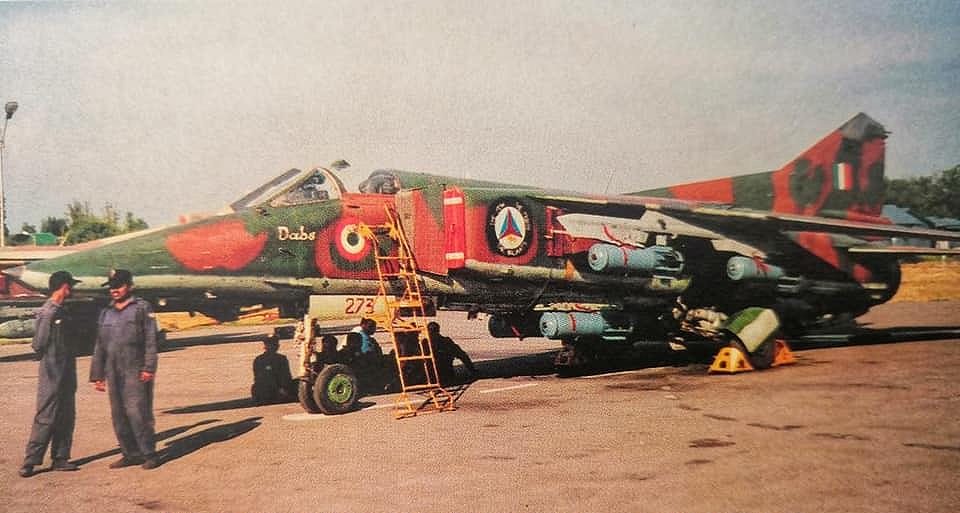
As you always say that you were ‘fortunate’ to have taken the MiG-23BN into combat, and that it was certainly a ‘Baptism by Fire’ for the type, could you help us understand how you employed an aircraft designed for Close Air Support over flat terrain, into flying combat over the Himalayas? How were traditional CAS tactics and training adapted/modified for this unexpected change?
The IAF played a pivotal role during Operation Safed Sagar, and undeniably, the Mirage 2000 played a crucial role, because it could carry the Paveway II Precision Guided Bombs (PGMs). However, it is unfortunate that most people forget the role of MiG-23BN and MiG-27s during the war. It is even more important because these aircraft were never designed to be used at such high altitudes. Despite these inherent limitations, if the IAF managed to deploy them in Kargil and use them to great success, it shows how the IAF is adaptable and capable of innovating and improvising, even when nobody had fought an air battle before, at that altitude.
I took over command of No.221 Squadron during the war, around June 17, 1999. By that time, we had already lost three aircraft, two of them due to enemy MANPADS (Man-Portable Air Defence Systems). The challenge still remained that we had to strike enemy bunkers and sangars atop mountains, which were too small to be hit with the high-calibre munitions that we usually use over flat terrain. Also, a five metre Circular Error Probable (CEP) in the plains would not yield the same results as a five metre CEP over the mountains, because, if your bomb overshot or undershot even by a bit, it could inadvertently cause an avalanche or kill friendly troops that were trying to scale the very peak you just attacked.


, we discussed the role of the MiG-23BN in the Indian Air Force (IAF))